Understanding the Remainder Theorem and Its Applications
Fundamentals of the Remainder Theorem
Concept and Explanation
The Remainder Theorem provides a straightforward method to find the remainder when a polynomial \( P(x) \) is divided by a linear divisor of the form \( x - a \). According to this theorem, the remainder obtained from this division is exactly the value of the polynomial evaluated at \( x = a \), that is, \( P(a) \). This means that if \( P(a) = 0 \), then \( x - a \) is a factor of the polynomial \( P(x) \).
This theorem is particularly useful for factorizing polynomials and determining roots without performing long division completely.
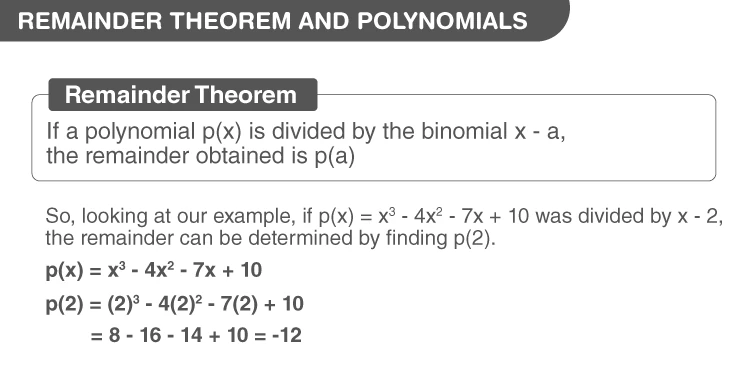
Illustration of polynomial division by a linear factor
Example: Evaluating the Remainder
Consider the polynomial \( f(t) = t^3 - 10t^2 + 35 \). If we divide \( f(t) \) by \( t - 4 \), find the remainder.
Solution:
Using the Remainder Theorem, the remainder is \( f(4) \):
\[ f(4) = 4^3 - 10 \times 4^2 + 35 = 64 - 160 + 35 = -61 \]
Therefore, the remainder when \( f(t) \) is divided by \( t - 4 \) is \(-61\).
Deriving the Remainder Theorem
Proof and Logical Reasoning
When a polynomial \( P(x) \) is divided by \( x - a \), it can be expressed as:
\[ P(x) = (x - a) \cdot Q(x) + R \]
Here, \( Q(x) \) is the quotient polynomial and \( R \) is the remainder, which is a constant because the divisor is linear.
Substituting \( x = a \) into the equation gives:
\[ P(a) = (a - a) \cdot Q(a) + R = 0 \cdot Q(a) + R = R \]
This shows that the remainder \( R \) equals the value of the polynomial at \( x = a \), thus proving the theorem.
Example: Verifying the Theorem
Divide \( P(x) = 2x^3 + 3x^2 - x + 4 \) by \( x - 2 \) and verify the remainder using the theorem.
Solution:
Calculate \( P(2) \):
\[ P(2) = 2(2)^3 + 3(2)^2 - 2 + 4 = 2 \times 8 + 3 \times 4 - 2 + 4 = 16 + 12 - 2 + 4 = 30 \]
Thus, the remainder when dividing by \( x - 2 \) is 30.
Practical Approach to Polynomial Division
Stepwise Method for Dividing Polynomials
To divide a polynomial by another non-zero polynomial, follow these steps:
Arrange both dividend and divisor in descending order of their degrees.
Divide the leading term of the dividend by the leading term of the divisor to find the first term of the quotient.
Multiply the entire divisor by this quotient term and subtract the result from the dividend.
Replace the dividend with the remainder obtained and repeat the process until the degree of the remainder is less than the degree of the divisor.
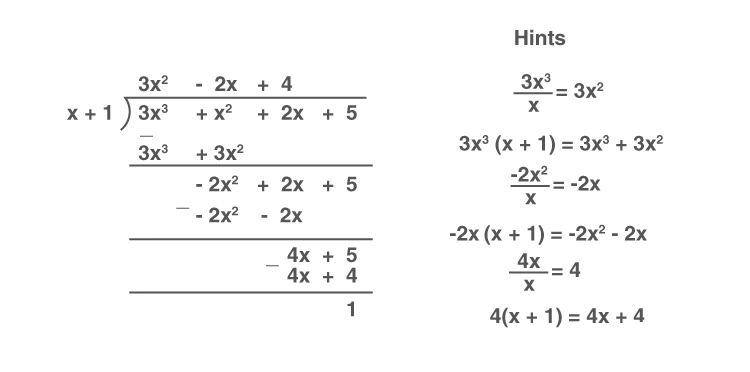
Stepwise polynomial division example
Example: Dividing a Cubic Polynomial
Divide \( 4x^3 + 2x^2 + 3x + 7 \) by \( x + 2 \).
Solution:
Step 1: Divide \( 4x^3 \) by \( x \) to get \( 4x^2 \).
Step 2: Multiply \( x + 2 \) by \( 4x^2 \) to get \( 4x^3 + 8x^2 \).
Step 3: Subtract from dividend: \( (4x^3 + 2x^2) - (4x^3 + 8x^2) = -6x^2 \).
Step 4: Bring down \( 3x \), new dividend is \( -6x^2 + 3x \).
Step 5: Divide \( -6x^2 \) by \( x \) to get \( -6x \).
Step 6: Multiply \( x + 2 \) by \( -6x \) to get \( -6x^2 - 12x \).
Step 7: Subtract: \( (-6x^2 + 3x) - (-6x^2 - 12x) = 15x \).
Step 8: Bring down \( +7 \), new dividend is \( 15x + 7 \).
Step 9: Divide \( 15x \) by \( x \) to get \( 15 \).
Step 10: Multiply \( x + 2 \) by \( 15 \) to get \( 15x + 30 \).
Step 11: Subtract: \( (15x + 7) - (15x + 30) = -23 \).
Since the degree of the remainder \(-23\) is less than the divisor, the division ends here.
Quotient: \( 4x^2 - 6x + 15 \)
Remainder: \(-23\)
Applying the Remainder Theorem in Problem Solving
Examples Demonstrating the Theorem
The Remainder Theorem is a powerful tool to quickly find remainders and check for roots of polynomials without performing full division.
Example 1: Confirming a Root
Check if \( x = 2 \) is a root of \( P(x) = x^2 - 5x + 6 \).
Solution:
Evaluate \( P(2) \):
\[ P(2) = 2^2 - 5 \times 2 + 6 = 4 - 10 + 6 = 0 \]
Since \( P(2) = 0 \), \( x - 2 \) is a factor of \( P(x) \), confirming \( x = 2 \) is a root.
Example 2: Finding the Remainder
Determine the remainder when \( f(x) = x^3 - 4x^2 + x + 6 \) is divided by \( x - 3 \).
Solution:
Calculate \( f(3) \):
\[ f(3) = 3^3 - 4 \times 3^2 + 3 + 6 = 27 - 36 + 3 + 6 = 0 \]
The remainder is 0, so \( x - 3 \) is a factor of \( f(x) \).
Euler's Theorem and Its Relation to Remainders
Understanding Euler's Totient Function and Theorem
Euler's theorem states that for two positive integers \( n \) and \( a \) that are coprime (i.e., their greatest common divisor is 1), the following holds:
\[ a^{\varphi(n)} \equiv 1 \pmod{n} \]
Here, \( \varphi(n) \) is Euler's totient function, which counts the positive integers up to \( n \) that are relatively prime to \( n \).
If \( n \) can be factored into primes as \( n = p^r q^s \cdots \), then:
\[ \varphi(n) = n \left(1 - \frac{1}{p}\right) \left(1 - \frac{1}{q}\right) \cdots \]
Example: Calculating Totient and Remainder
Find the remainder when \( 5^{10} \) is divided by 21.
Solution:
First, factorize 21: \( 21 = 3 \times 7 \).
Calculate \( \varphi(21) \):
\[ \varphi(21) = 21 \left(1 - \frac{1}{3}\right) \left(1 - \frac{1}{7}\right) = 21 \times \frac{2}{3} \times \frac{6}{7} = 12 \]
Since 5 and 21 are coprime, Euler's theorem applies:
\[ 5^{12} \equiv 1 \pmod{21} \]
Express \( 5^{10} \) as \( 5^{12} \times 5^{-2} \equiv 1 \times 5^{-2} \pmod{21} \), but since negative exponents are complex, calculate directly:
Calculate \( 5^{10} \mod 21 \) stepwise:
\[ 5^1 = 5 \pmod{21} \]
\[ 5^2 = 25 \equiv 4 \pmod{21} \]
\[ 5^4 = (5^2)^2 = 4^2 = 16 \pmod{21} \]
\[ 5^8 = (5^4)^2 = 16^2 = 256 \equiv 4 \pmod{21} \]
\[ 5^{10} = 5^8 \times 5^2 = 4 \times 4 = 16 \pmod{21} \]
Therefore, the remainder when \( 5^{10} \) is divided by 21 is 16.
Summary of Key Points
Concept | Explanation |
|---|---|
Remainder Theorem | The remainder when \( P(x) \) is divided by \( x - a \) is \( P(a) \). |
Factor Theorem | \( x - a \) is a factor of \( P(x) \) if and only if \( P(a) = 0 \). |
Polynomial Division Steps | Divide leading terms, multiply divisor, subtract, and repeat until remainder degree is less. |
Euler's Totient Function | Counts integers coprime to \( n \), used in Euler's theorem for modular arithmetic. |
Euler's Theorem | If \( a \) and \( n \) are coprime, then \( a^{\varphi(n)} \equiv 1 \pmod{n} \). |
Glossary of Important Terms
Term | Definition |
|---|---|
Polynomial | An algebraic expression consisting of variables and coefficients combined using addition, subtraction, and multiplication. |
Remainder | The amount left over after division when one number does not divide another exactly. |
Quotient | The result obtained by dividing one quantity by another. |
Divisor | The number or polynomial by which another is divided. |
Factor | A number or polynomial that divides another without leaving a remainder. |
Root of Polynomial | A value of \( x \) for which the polynomial equals zero. |
Euler's Totient Function (\( \varphi(n) \)) | The count of positive integers up to \( n \) that are coprime to \( n \). |
Copime | Two numbers are coprime if their greatest common divisor is 1. |
Modulus | The remainder after division of one number by another in modular arithmetic. |
Synthetic Division | A shortcut method for dividing polynomials, especially by linear divisors. |
Frequently Asked Questions
What does the Remainder Theorem state?
It states that the remainder when a polynomial \( P(x) \) is divided by \( x - a \) is equal to \( P(a) \).
How can the Remainder Theorem help in factorization?
If \( P(a) = 0 \), then \( x - a \) is a factor of \( P(x) \), which helps in breaking down the polynomial into factors.
Is the remainder always a constant when dividing by \( x - a \)?
Yes, because the divisor is linear, the remainder is always a constant term.
What is Euler's Totient Function used for?
It is used to determine the number of integers coprime to \( n \) and plays a key role in modular arithmetic and Euler's theorem.
Can the Remainder Theorem be applied to divisors other than linear polynomials?
No, the theorem specifically applies to divisors of the form \( x - a \).
Additional Visual Examples
Stepwise calculation of remainder in modular arithmetic