Understanding Decimal Expansions of Rational Numbers
Fundamentals of Rational Numbers and Their Decimal Forms
Defining Rational Numbers and Their Decimal Representations
A rational number is any value that can be expressed as a fraction \( \frac{p}{q} \), where \( p \) and \( q \) are integers and \( q \neq 0 \). When simplified, these numbers can be represented as decimals, which may either terminate or repeat indefinitely.
Examples of rational numbers include integers like 6, decimals such as -8.1, and fractions like \( \frac{4}{5} \).
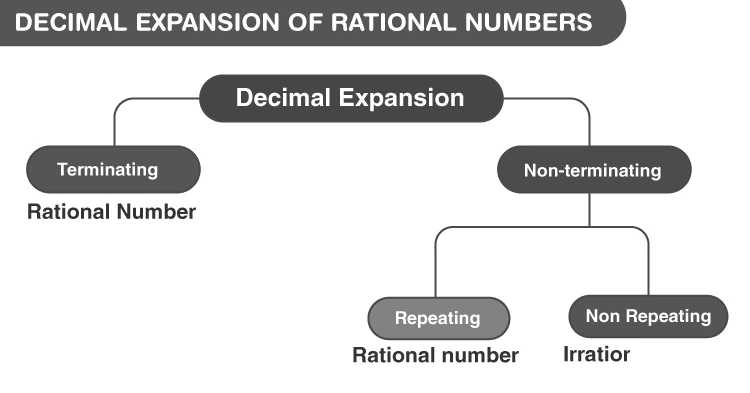
Visual representation of rational numbers
How Rational Numbers Translate into Decimal Expansions
Rational numbers can have decimal expansions that either terminate after a finite number of digits or continue infinitely with a repeating pattern. These decimals are classified as terminating decimals or recurring decimals respectively.
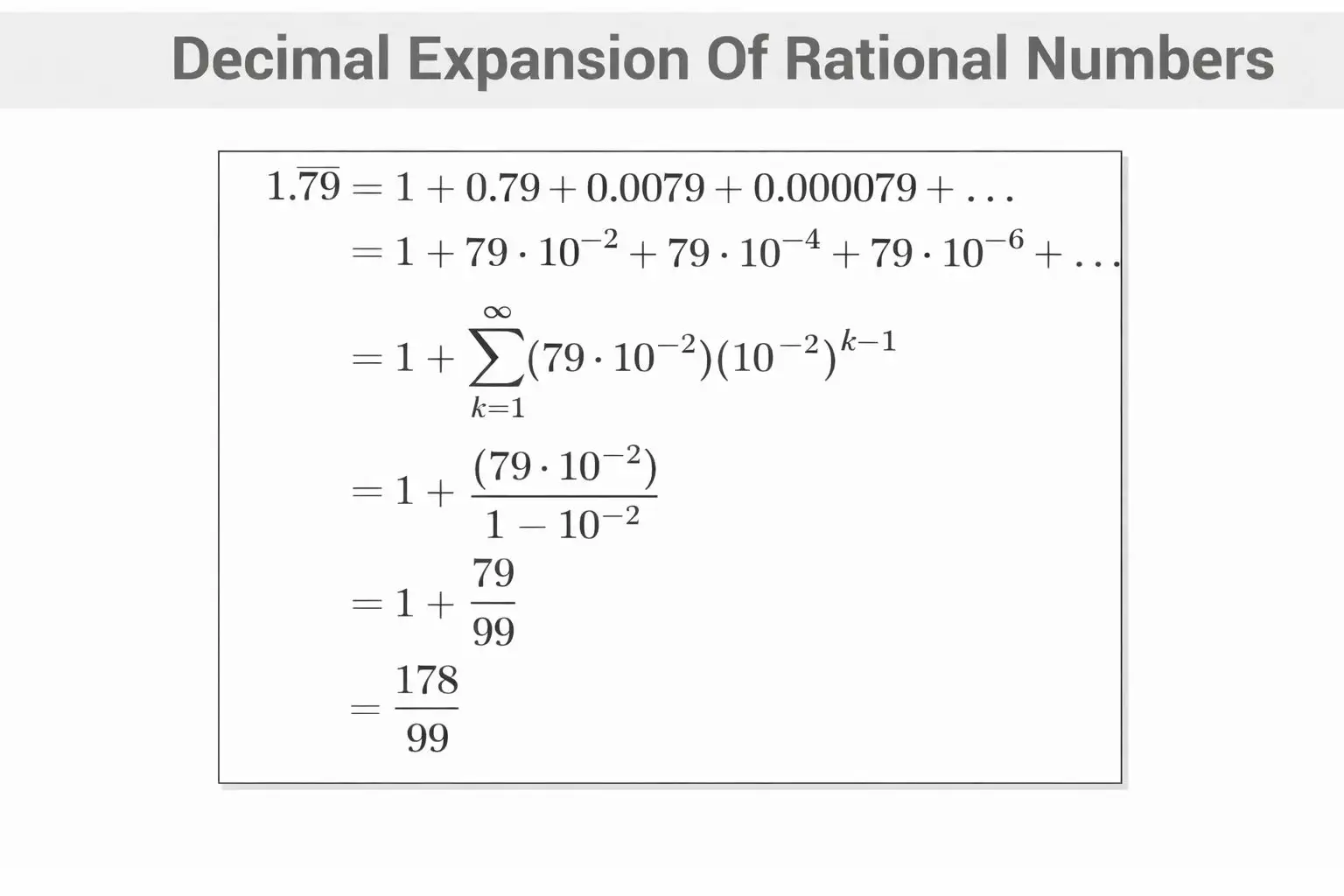
This shows that a repeating decimal can be exactly represented as a fraction, confirming it is a rational number.
Types of decimal expansions for rational numbers
For instance, the number \( 33.33333\ldots \) is rational because it equals \( \frac{100}{3} \). Its decimal part, \( .333\ldots \), repeats indefinitely, making it a recurring decimal.
On the other hand, decimals like 0.375 and 0.6 are terminating decimals and can be expressed as fractions such as \( \frac{3}{8} \) and \( \frac{3}{5} \) respectively.
Example: Express the decimal 0.567 as a fraction.
Since 0.567 has three decimal places, it can be written as \( \frac{567}{1000} \). Simplifying this fraction if possible gives the rational form of the decimal.
Key Theorems on Decimal Expansions of Rational Numbers
Terminating Decimal Expansions and Their Fractional Forms
Any rational number with a terminating decimal expansion can be expressed as a fraction \( \frac{p}{q} \) where \( p \) and \( q \) are coprime integers, and the denominator \( q \) has only 2 and 5 as its prime factors. This is because denominators that are powers of 10 factor into primes 2 and 5.
This leads to the following theorem:
Theorem 1: If a rational number has a decimal expansion that terminates, then it can be written as \( \frac{p}{q} \) where the prime factorization of \( q \) is \( 2^x 5^y \), with \( x, y \geq 0 \).
The converse is also true:
Theorem 2: If a rational number is expressed as \( \frac{p}{q} \) and the prime factors of \( q \) are only 2s and 5s, then its decimal expansion will terminate.
Example: Show that \( \frac{7}{8} \) has a terminating decimal expansion.
Since \( 8 = 2^3 \), multiply numerator and denominator by \( 5^3 \) to get denominator as \( 10^3 \):
\[ \frac{7}{8} = \frac{7}{2^3} = \frac{7 \times 5^3}{2^3 \times 5^3} = \frac{875}{10^3} \]
Thus, \( \frac{7}{8} = 0.875 \), a terminating decimal.
Example: Verify the decimal form of \( \frac{3}{80} \).
Factorize denominator: \( 80 = 2^4 \times 5 \). Multiply numerator and denominator by \( 5^3 \) to get denominator as \( 10^4 \):
\[ \frac{3}{80} = \frac{3}{2^4 \times 5} = \frac{3 \times 5^3}{2^4 \times 5^4} = \frac{375}{10^4} \]
Therefore, \( \frac{3}{80} = 0.0375 \), which is terminating.
Recurring Decimals and Their Characteristics
When Decimal Expansions Repeat Indefinitely
Rational numbers whose denominators contain prime factors other than 2 and 5 produce decimal expansions that do not terminate but repeat a pattern endlessly. These are called recurring decimals.
Theorem 3: If a rational number \( \frac{p}{q} \) has a denominator \( q \) whose prime factorization includes primes other than 2 and 5, then its decimal expansion is non-terminating and repeating.
Example: Express \( \frac{1}{6} \) as a decimal.
Since \( 6 = 2 \times 3 \), and 3 is a prime other than 2 or 5, the decimal expansion repeats:
\[ \frac{1}{6} = 0.1666\ldots = 0.1\overline{6} \]
Example: Write the decimal form of \( \frac{7}{12} \).
Factorize denominator: \( 12 = 2^2 \times 3 \). Since 3 is present, the decimal repeats:
\[ \frac{7}{12} = 0.58333\ldots = 0.58\overline{3} \]
Example: Convert \( \frac{9}{11} \) to decimal.
Since 11 is a prime other than 2 or 5, the decimal repeats:
\[ \frac{9}{11} = 0.8181\ldots = 0.\overline{81} \]
Practical Examples of Decimal Expansions from Rational Numbers
Terminating Decimal Case: Zero Remainder
When dividing the numerator by the denominator, if the remainder becomes zero, the decimal expansion terminates.

Division resulting in terminating decimal
Example: Find the decimal expansion of \( \frac{3}{6} \).
Dividing 3 by 6 gives quotient 0.5 and remainder 0, so the decimal terminates:
\[ \frac{3}{6} = 0.5 \]
Recurring Decimal Case: Non-zero Remainder
If the remainder never becomes zero during division, the decimal expansion repeats indefinitely.
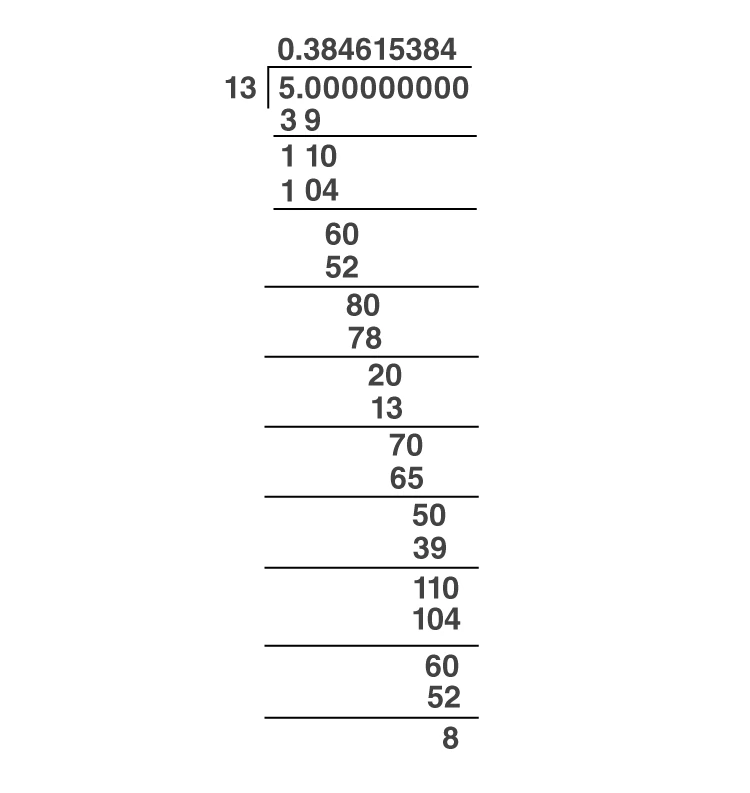
Division resulting in recurring decimal
Example: Express \( \frac{5}{13} \) as a decimal.
The division yields a quotient of approximately 0.384615384 with a repeating remainder, so the decimal repeats:
\[ \frac{5}{13} = 0.\overline{384615} \]
In summary, rational numbers always produce decimal expansions that either terminate or repeat indefinitely.
Summary Table for Decimal Expansions of Rational Numbers
Type of Decimal | Denominator Prime Factors | Decimal Behavior | Example |
|---|---|---|---|
Terminating Decimal | Only 2 and/or 5 | Decimal ends after finite digits | \( \frac{7}{8} = 0.875 \) |
Recurring Decimal | Includes primes other than 2 or 5 | Decimal repeats infinitely | \( \frac{1}{6} = 0.1\overline{6} \) |
Glossary of Key Terms
Term | Definition |
|---|---|
Rational Number | A number expressible as \( \frac{p}{q} \) where \( p, q \) are integers and \( q \neq 0 \). |
Terminating Decimal | A decimal number that ends after a finite number of digits. |
Recurring Decimal | A decimal number with digits repeating infinitely after some point. |
Prime Factorization | Expressing a number as a product of prime numbers. |
Denominator | The bottom part of a fraction indicating into how many parts the whole is divided. |
Numerator | The top part of a fraction indicating how many parts are considered. |
Copimes | Two numbers with no common factors other than 1. |
Decimal Expansion | The representation of a number in decimal form. |
Non-terminating Decimal | A decimal number that continues infinitely without ending. |
Remainder | The amount left over after division. |
Frequently Asked Questions
What defines a rational number?
A rational number is any number that can be written as a fraction \( \frac{p}{q} \) where \( p \) and \( q \) are integers and \( q \neq 0 \).
How can I tell if a decimal is terminating or recurring?
If the denominator of the fraction form has only 2s and 5s as prime factors, the decimal terminates; otherwise, it recurs.
Can all decimals be expressed as fractions?
Only decimals that are terminating or recurring can be expressed as fractions, making them rational numbers.
Why do some decimals repeat infinitely?
Decimals repeat infinitely when the denominator of their fraction form contains prime factors other than 2 or 5.
Is zero a rational number?
Yes, zero can be expressed as \( \frac{0}{q} \) for any non-zero integer \( q \), so it is rational.