Understanding Parallel Lines, Transversals, and Angle Properties
Fundamentals of Parallel Lines and Transversals
Defining Parallel Lines and Their Characteristics
Two lines are considered parallel if they never meet, no matter how far they extend in either direction. Essentially, these lines maintain a constant distance apart and can be thought of as meeting only at infinity. This property ensures they do not intersect at any point within the plane.
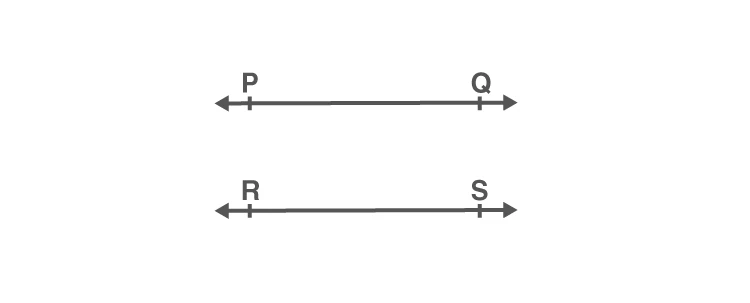
Diagram showing two lines running parallel without intersection
Understanding Transversals and Their Role
A transversal is a line that crosses two or more other lines at distinct points. When a transversal intersects two lines, it creates various angles at the points of intersection. For example, if line \( l \) intersects lines \( a \) and \( b \) at points \( P \) and \( Q \) respectively, then \( l \) is the transversal.
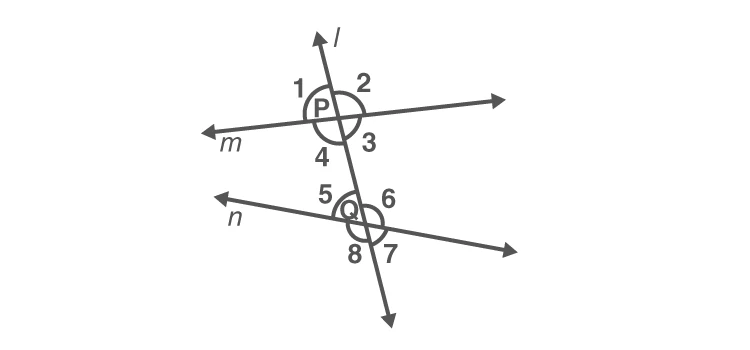
A transversal line intersecting two distinct lines at separate points
Clarifying What Does Not Qualify as a Transversal
It is important to note that a line intersecting two lines at the same point is not a transversal. For instance, if line \( EF \) intersects lines \( AB \) and \( CD \) at the same point \( O \), it does not meet the criteria of a transversal because it does not cross the lines at two distinct points.
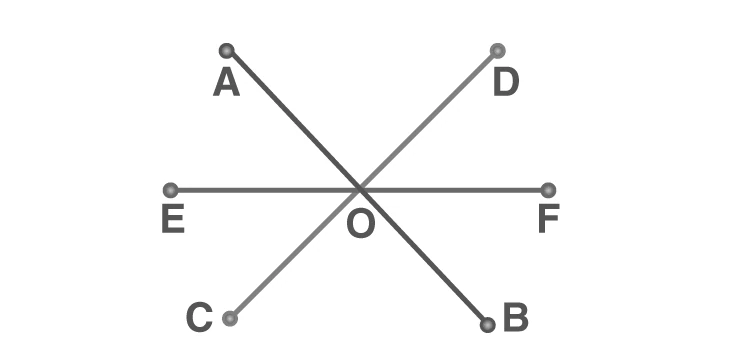
Line intersecting two lines at a single point, not a transversal
Example Problem
Question: Identify whether the line \( EF \) is a transversal to lines \( AB \) and \( CD \) if it intersects both at the same point \( O \).
Solution: Since \( EF \) intersects both \( AB \) and \( CD \) at the same point \( O \), it does not cross them at two distinct points. Therefore, \( EF \) is not a transversal.
Angle Relationships Formed by Transversals and Parallel Lines
Exploring Corresponding Angles
When a transversal cuts across two parallel lines, it forms pairs of corresponding angles. These angles occupy matching corners at each intersection point. For example, if lines \( a \) and \( d \) are parallel and cut by transversal \( l \) at points \( P \) and \( Q \), then angles such as \( \angle 1 \) and \( \angle 6 \), \( \angle 4 \) and \( \angle 8 \), \( \angle 2 \) and \( \angle 5 \), and \( \angle 3 \) and \( \angle 7 \) are corresponding angles.
Each pair of corresponding angles is congruent, meaning:
\[ \angle 1 = \angle 6, \quad \angle 4 = \angle 8, \quad \angle 2 = \angle 5, \quad \angle 3 = \angle 7 \]
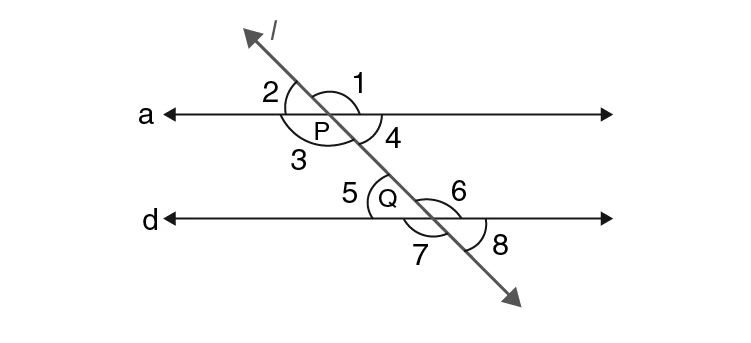
Angle pairs formed by a transversal intersecting parallel lines
Alternate Interior Angles and Their Properties
Alternate interior angles are located between the two lines but on opposite sides of the transversal. For parallel lines, these angles are equal. For instance, \( \angle 4 \) and \( \angle 5 \), as well as \( \angle 3 \) and \( \angle 6 \), are alternate interior angles and satisfy:
\[ \angle 4 = \angle 5, \quad \angle 3 = \angle 6 \]
Alternate Exterior Angles Explained
These angles lie outside the two lines and on opposite sides of the transversal. When the lines are parallel, alternate exterior angles are congruent. Examples include \( \angle 1 \) and \( \angle 7 \), and \( \angle 2 \) and \( \angle 8 \), where:
\[ \angle 1 = \angle 7, \quad \angle 2 = \angle 8 \]
Interior Angles on the Same Side of the Transversal
Also known as consecutive interior or co-interior angles, these pairs lie between the two lines and on the same side of the transversal. For parallel lines, their measures add up to 180°, making them supplementary. For example:
\[ \angle 3 + \angle 5 = 180^\circ, \quad \angle 4 + \angle 6 = 180^\circ \]
Vertically Opposite Angles at Intersections
When two lines intersect, the angles opposite each other at the point of intersection are called vertically opposite angles. These angles are always equal. For example:
\[ \angle 1 = \angle 3, \quad \angle 2 = \angle 4, \quad \angle 7 = \angle 6, \quad \angle 8 = \angle 5 \]
Example Problem
Question: In the figure below, lines \( AB \) and \( CD \) are parallel and cut by a transversal. If one of the corresponding angles is \( 125^\circ \), find the values of \( x \) and \( y \) shown in the diagram.
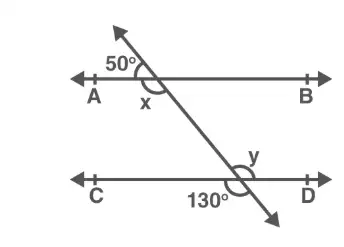
This image shows two parallel lines AB and CD crossed by a diagonal line, creating angles labeled x, y, and a given angle of 130°. Step-by-step explanation: 1. Lines AB and CD are parallel. 2. The diagonal line creates corresponding angles on these parallel lines. 3. The angle labeled 130° and angle y are corresponding angles, so y = 130°. 4. Angles x and y form a straight line, so together they add up to 180°. 5. To find x, subtract y from 180°: \( x = 180° - y = 180° - 130° = 50° \). So, angle x equals 50°, which matches the angle shown.
Solution:
Since \( x \) and \( 125^\circ \) are corresponding angles, they are equal: \( x = 125^\circ \).
Angles \( y \) and \( 125^\circ \) are vertically opposite, so \( y = 125^\circ \).
Determining Parallelism Using Angle Criteria
Using Corresponding Angles to Confirm Parallel Lines
One practical method to verify if two lines are parallel is by examining the corresponding angles formed when a transversal crosses them. If these angles are equal, the lines are parallel. For example, if a transversal \( AB \) intersects two lines \( XY \) and \( PQ \), and the corresponding angles \( X \) and \( Y \) are congruent, then \( XY \) and \( PQ \) are parallel.
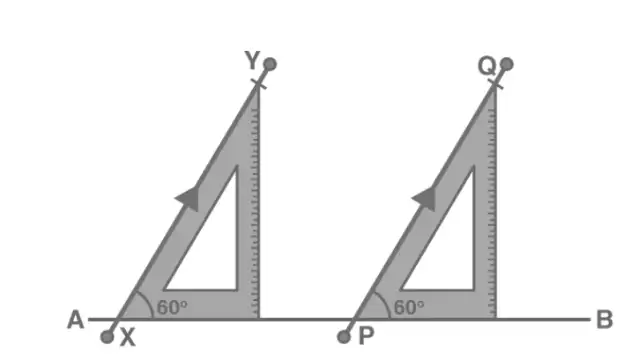
This image shows two identical set squares placed on a horizontal line AB. Both are positioned such that their hypotenuses form a 60° angle with the line AB, and their right angles rest on the line. Step-by-step explanation: 1. Draw a straight horizontal line AB. 2. Place the first set square at point A so that it forms a 60° angle with the horizontal line. 3. Note that point Y is at the top vertex of this set square, and the right angle rests on AB. 4. Similarly, place the second set square at point P on the line AB, also angled at 60°. 5. Note that point Q is at the top vertex of this set square. 6. The arrows show the direction of the angles from points A to Y and P to Q. This setup is used to illustrate how angles and perpendicular lines relate using set squares.
Example Problem
Question: Alan drew two lines \( XY \) and \( PQ \) using a transversal \( AB \). If the corresponding angles formed are equal, explain why \( XY \) and \( PQ \) are parallel.
Solution:
The transversal \( AB \) intersects \( XY \) and \( PQ \) creating corresponding angles.
Since these corresponding angles are equal, by the Corresponding Angles Postulate, \( XY \) and \( PQ \) must be parallel.
Summary of Angle Relationships and Key Concepts
Angle Pair | Definition | Relationship When Lines are Parallel |
|---|---|---|
Corresponding Angles | Angles in matching corners formed by a transversal | Equal (\( \angle 1 = \angle 6 \), etc.) |
Alternate Interior Angles | Angles between the lines on opposite sides of the transversal | Equal (\( \angle 4 = \angle 5 \), etc.) |
Alternate Exterior Angles | Angles outside the lines on opposite sides of the transversal | Equal (\( \angle 1 = \angle 7 \), etc.) |
Consecutive Interior Angles | Angles between the lines on the same side of the transversal | Supplementary (\( \angle 3 + \angle 5 = 180^\circ \)) |
Vertically Opposite Angles | Opposite angles formed by two intersecting lines | Equal (\( \angle 1 = \angle 3 \), etc.) |
Glossary of Key Terms
Term | Meaning |
|---|---|
Parallel Lines | Lines in the same plane that never intersect |
Transversal | A line that intersects two or more lines at distinct points |
Corresponding Angles | Angles in matching positions formed by a transversal |
Alternate Interior Angles | Angles between two lines on opposite sides of a transversal |
Alternate Exterior Angles | Angles outside two lines on opposite sides of a transversal |
Consecutive Interior Angles | Angles between two lines on the same side of a transversal |
Vertically Opposite Angles | Opposite angles formed at the intersection of two lines |
Supplementary Angles | Two angles whose sum is \( 180^\circ \) |
Congruent Angles | Angles that have equal measure |
Coplanar Lines | Lines that lie in the same plane |
Frequently Asked Questions
What defines two lines as parallel?
Two lines are parallel if they lie in the same plane and never intersect, maintaining a constant distance apart indefinitely.
How can we identify a transversal line?
A transversal is a line that crosses two or more other lines at different points, creating various angle pairs at the intersections.
What is the significance of corresponding angles?
Corresponding angles are equal when a transversal cuts parallel lines, and this property helps in proving lines are parallel.
Are alternate interior angles always equal?
Alternate interior angles are equal only when the lines cut by the transversal are parallel.
How do consecutive interior angles relate to each other?
Consecutive interior angles on the same side of a transversal are supplementary, meaning their measures add up to \( 180^\circ \) when the lines are parallel.