Comprehensive Guide to Number Systems and Their Conversions
Understanding the Fundamentals of Number Systems
Defining Number Systems and Their Role in Mathematics
A number system is a structured method for representing numbers using a consistent set of symbols or digits. It provides a unique way to express every number and supports arithmetic operations such as addition, subtraction, multiplication, and division. The value of each digit depends on its position and the base (or radix) of the system.
In essence, number systems form the backbone of numerical representation, enabling us to count, measure, and perform calculations efficiently.
Clarifying the Concept of Numbers
Numbers are abstract mathematical entities used for counting, measuring, and labeling. They come in various forms including natural numbers, whole numbers, rational and irrational numbers. Zero represents the absence of quantity but is an essential number in mathematics.
Numbers can also be categorized as even or odd based on divisibility by 2, and as prime or composite depending on the number of their factors. These classifications are fundamental in understanding number properties and their applications.
Example: Identifying Number Types
Problem: Classify the number 29 based on its properties.
Solution:
29 is a natural number as it is a positive integer.
It is an odd number since it is not divisible by 2.
29 is a prime number because it has only two factors: 1 and 29.
Exploring Various Number Systems and Their Characteristics
Decimal System: The Base-10 Framework
The decimal system is the most widely used number system, employing ten digits from 0 to 9. Each digit's position represents a power of 10, starting from units, tens, hundreds, and so forth. This positional value system allows for the representation of any number.
For example, the number 2634 can be expanded as:
\[ (2 \times 10^3) + (6 \times 10^2) + (3 \times 10^1) + (4 \times 10^0) \]
\[ = 2000 + 600 + 30 + 4 = 2634 \]
Binary System: Base-2 Representation
The binary system uses only two digits, 0 and 1, making it the fundamental language of computers. Each position represents a power of 2. Binary numbers are sequences of these digits, such as 101101.
Conversion between decimal and binary is essential in computer science and digital electronics.
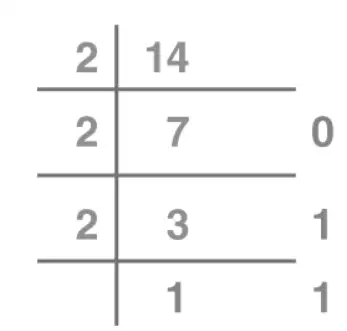
This image shows the process of finding the prime factorization of the number 84 by dividing it repeatedly by prime numbers. Step-by-step explanation: 1. Start with the number 84. 2. Divide 84 by 2 (the smallest prime number), which gives 42. 3. Divide 42 by 2 again, giving 21. 4. Divide 21 by 3 (the next prime number), resulting in 7. 5. Divide 7 by 7, which equals 1. 6. When you reach 1, the process stops. 7. The prime factors of 84 are all the divisors used: 2, 2, 3, and 7.
Example: Decimal to Binary Conversion
Problem: Convert the decimal number 23 to binary.
Solution:
Divide 23 by 2 repeatedly and record the remainders:
23 ÷ 2 = 11 remainder 1
11 ÷ 2 = 5 remainder 1
5 ÷ 2 = 2 remainder 1
2 ÷ 2 = 1 remainder 0
1 ÷ 2 = 0 remainder 1
Reading remainders from bottom to top gives: \(10111_2\).
Therefore, \( (23)_{10} = (10111)_2 \).
Octal System: Base-8 Numbering
The octal system uses digits from 0 to 7 and is often used in computing as a shorthand for binary numbers. Each digit represents a power of 8.
For instance, the octal number 347 can be expanded as:
\[ (3 \times 8^2) + (4 \times 8^1) + (7 \times 8^0) = 192 + 32 + 7 = 231 \]
Example: Octal to Decimal Conversion
Problem: Convert the octal number 526 to decimal.
Solution:
Calculate the decimal equivalent:
\[ (5 \times 8^2) + (2 \times 8^1) + (6 \times 8^0) = (5 \times 64) + (2 \times 8) + (6 \times 1) \]
\[ = 320 + 16 + 6 = 342 \]
Thus, \( (526)_8 = (342)_{10} \).
Hexadecimal System: Base-16 Notation
The hexadecimal system extends beyond digits 0-9 by including letters A to F to represent values 10 to 15. It is widely used in computer science for compact representation of binary data.
Each position corresponds to a power of 16. For example, the hexadecimal number 3FA can be expanded as:
\[ (3 \times 16^2) + (15 \times 16^1) + (10 \times 16^0) = 768 + 240 + 10 = 1018 \]
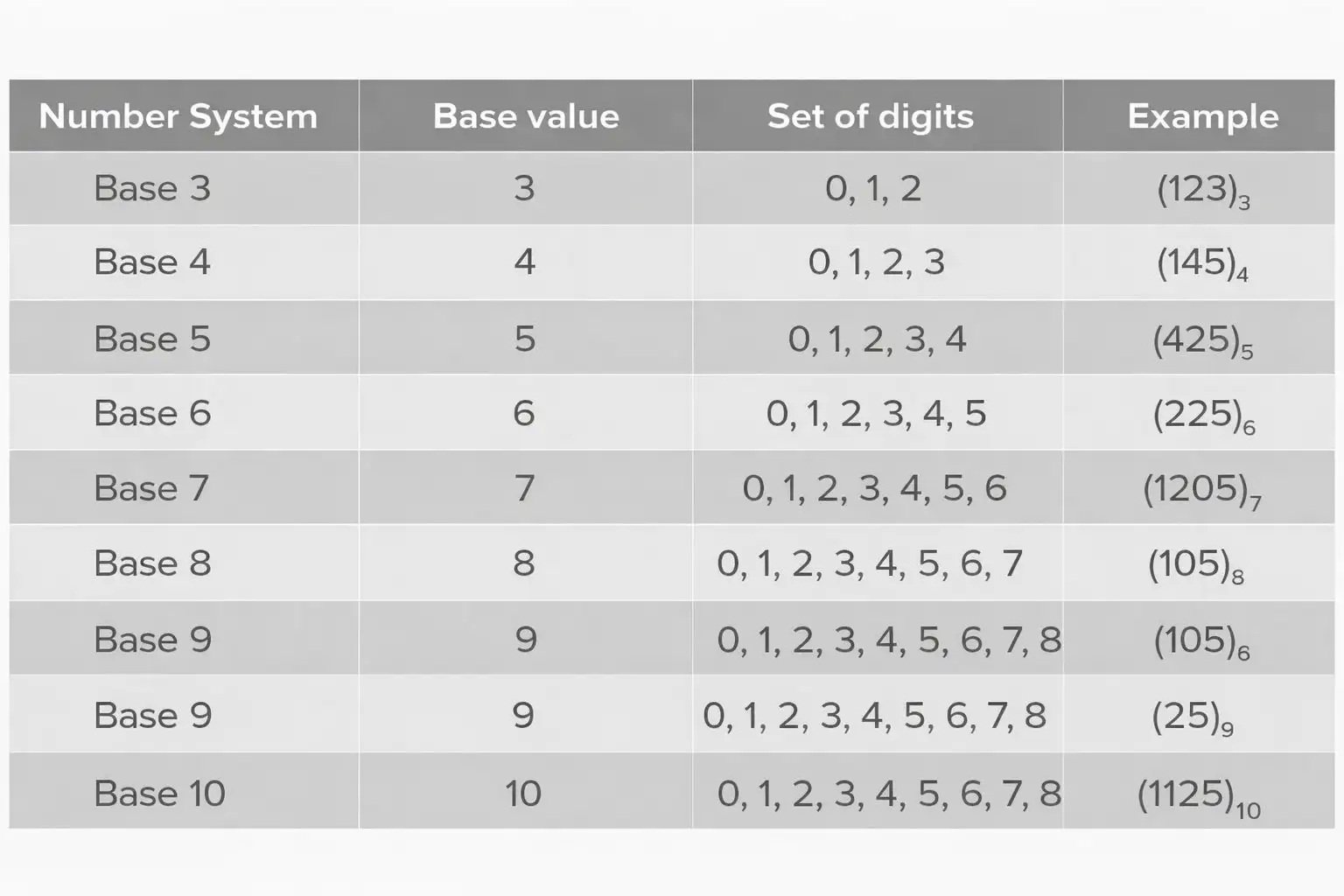
Chart showing various number systems and their bases
Example: Hexadecimal to Decimal Conversion
Problem: Convert the hexadecimal number 2F to decimal.
Solution:
Calculate the decimal value:
\[ (2 \times 16^1) + (15 \times 16^0) = 32 + 15 = 47 \]
Therefore, \( (2F)_{16} = (47)_{10} \).
Techniques for Converting Between Number Systems
Stepwise Conversion Methods
Numbers can be converted from one base to another by following systematic procedures. Typically, conversions involve:
Converting the original number to decimal (base 10) if it is not already in decimal.
Converting the decimal number to the target base by repeated division or multiplication.
Understanding these steps is crucial for working with different numeral systems, especially in computing and digital electronics.
Example: Hexadecimal to Octal Conversion
Problem: Convert the hexadecimal number \( (1A3)_{16} \) to octal.
Solution:
Step 1: Convert hexadecimal to decimal:
\[ (1 \times 16^2) + (10 \times 16^1) + (3 \times 16^0) = 256 + 160 + 3 = 419 \]
Step 2: Convert decimal 419 to octal by dividing by 8:
419 ÷ 8 = 52 remainder 3
52 ÷ 8 = 6 remainder 4
6 ÷ 8 = 0 remainder 6
Reading remainders from bottom to top gives \( (643)_8 \).
Hence, \( (1A3)_{16} = (643)_8 \).
Example: Binary to Decimal Conversion
Problem: Convert the binary number \( (11011)_2 \) to decimal.
Solution:
Expand using powers of 2:
\[ (1 \times 2^4) + (1 \times 2^3) + (0 \times 2^2) + (1 \times 2^1) + (1 \times 2^0) = 16 + 8 + 0 + 2 + 1 = 27 \]
Therefore, \( (11011)_2 = (27)_{10} \).
Example: Binary to Octal Conversion
Problem: Convert the binary number \( (101101)_2 \) to octal.
Solution:
Group the binary digits into sets of three from right to left:
\( 101 \quad 101 \)
Convert each group to octal:
\(101_2 = 5_8\)
\(101_2 = 5_8\)
Thus, the octal equivalent is \( (55)_8 \).
Example: Hexadecimal to Binary and Decimal Conversion
Problem: Convert hexadecimal \( (3B)_{16} \) to binary and decimal.
Solution:
Hexadecimal to binary:
\(3 = 0011\), \(B = 1011\)
So, \( (3B)_{16} = 00111011_2 \).
Binary to decimal:
\[ (0 \times 2^7) + (0 \times 2^6) + (1 \times 2^5) + (1 \times 2^4) + (1 \times 2^3) + (0 \times 2^2) + (1 \times 2^1) + (1 \times 2^0) = 0 + 0 + 32 + 16 + 8 + 0 + 2 + 1 = 59 \]
Therefore, \( (3B)_{16} = (00111011)_2 = (59)_{10} \).
Summary and Quick Reference for Number Systems
Number System | Base | Digits Used | Example Number | Decimal Equivalent |
|---|---|---|---|---|
Decimal | 10 | 0–9 | 4721 | 4721 |
Binary | 2 | 0, 1 | 101101 | 45 |
Octal | 8 | 0–7 | 1573 | 875 |
Hexadecimal | 16 | 0–9, A–F | 2F9 | 761 |
Glossary of Key Terms in Number Systems
Term | Definition |
|---|---|
Base (Radix) | The number of unique digits, including zero, used to represent numbers in a system. |
Binary | A number system with base 2, using digits 0 and 1. |
Decimal | The standard number system with base 10, using digits 0 to 9. |
Digit | A single symbol used to represent numbers in a number system. |
Hexadecimal | A base-16 number system using digits 0–9 and letters A–F. |
Octal | A base-8 number system using digits 0 to 7. |
Positional Value | The value of a digit determined by its position and the base of the number system. |
Prime Number | A number greater than 1 with exactly two factors: 1 and itself. |
Composite Number | A number with more than two factors. |
Unary System | A base-1 number system representing natural numbers with repeated symbols. |
Frequently Asked Questions on Number Systems
What is the significance of different number systems?
Different number systems allow efficient representation and processing of numbers in various contexts, such as decimal for daily use and binary for computing.
How do you convert a decimal number to binary?
Divide the decimal number by 2 repeatedly and record the remainders. Reading the remainders from bottom to top gives the binary equivalent.
Why is the binary system important in computers?
Computers use binary because it simplifies hardware design by representing data with two states: on (1) and off (0).
What digits are used in the hexadecimal system?
Hexadecimal uses digits 0 to 9 and letters A to F, where A to F represent decimal values 10 to 15.
Can any number be converted between number systems?
Yes, any number can be converted from one base to another using standard conversion methods involving decimal as an intermediate base.