Comprehensive Guide to Cyclic Quadrilaterals
Understanding the Concept of Cyclic Quadrilaterals
Fundamentals and Definition
A quadrilateral is a polygon with four sides and four vertices. The term originates from Latin, where 'quadri' means four and 'latus' means side. When all four vertices of such a quadrilateral lie precisely on the circumference of a single circle, the figure is known as a cyclic quadrilateral, also called an inscribed quadrilateral. The circle passing through all these vertices is termed the circumcircle or circumscribed circle.
Visualize selecting any four points on a circle's boundary and connecting them sequentially; the resulting shape is a cyclic quadrilateral.
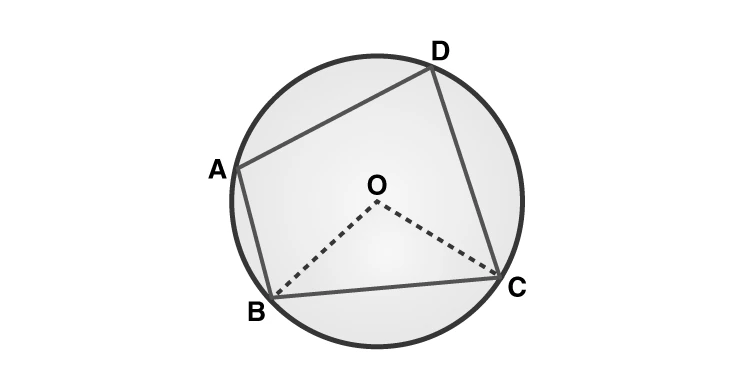
Illustration of a cyclic quadrilateral ABCD inscribed in a circle
By measuring the interior angles of such a quadrilateral, it is observed that the sum of all four angles is always 360°, and the sum of each pair of opposite angles is exactly 180°, a key property of cyclic quadrilaterals.
Example
Consider a circle where four points P, Q, R, and S lie on its circumference. Connect these points to form quadrilateral PQRS. Measure the interior angles at each vertex. You will find that the sum of opposite angles, such as ∠P + ∠R, equals 180°, confirming the cyclic nature of PQRS.
Key Properties and Angle Relationships
Angle Sum and Supplementary Opposites
One of the defining characteristics of cyclic quadrilaterals is that the sum of the measures of opposite angles is supplementary, meaning they add up to 180°. If the angles of the quadrilateral are denoted as \( \angle A, \angle B, \angle C, \) and \( \angle D \), then the following holds true:
\[ \angle A + \angle C = 180^\circ \]
\[ \angle B + \angle D = 180^\circ \]
Additionally, the total of all interior angles remains 360°, consistent with any quadrilateral:
\[ \angle A + \angle B + \angle C + \angle D = 360^\circ \]
Example
In a cyclic quadrilateral, if \( \angle B = 70^\circ \), find \( \angle D \).
Solution:
Since opposite angles are supplementary,
\[ \angle B + \angle D = 180^\circ \]
\[ 70^\circ + \angle D = 180^\circ \]
\[ \angle D = 180^\circ - 70^\circ = 110^\circ \]
Therefore, \( \angle D = 110^\circ \).
Dimensions and Calculations in Cyclic Quadrilaterals
Radius of the Circumscribed Circle
For a cyclic quadrilateral with sides \( a, b, c, \) and \( d \), and semiperimeter \( s = \frac{a+b+c+d}{2} \), the radius \( R \) of the circumcircle can be determined using specific formulas derived from the sides and angles. Although the exact formula for radius depends on additional parameters, the semiperimeter is a crucial component in related calculations.
Determining the Lengths of Diagonals
If the sides of the cyclic quadrilateral are \( a, b, c, \) and \( d \), and the diagonals are \( p \) and \( q \), their lengths can be calculated by:
\[ p = \sqrt{\frac{(a c + b d)(a d + b c)}{a b + c d}} \quad \text{and} \quad q = \sqrt{\frac{(a c + b d)(a b + c d)}{a d + b c}} \]
Formula for Area
The area \( A \) of a cyclic quadrilateral can be found using Brahmagupta's formula, which is:
\[ A = \sqrt{(s - a)(s - b)(s - c)(s - d)} \]
where \( s \) is the semiperimeter defined as:
\[ s = \frac{a + b + c + d}{2} \]
Example
Calculate the area of a cyclic quadrilateral with sides 7 cm, 8 cm, 5 cm, and 6 cm.
Solution:
First, find the semiperimeter:
\[ s = \frac{7 + 8 + 5 + 6}{2} = \frac{26}{2} = 13 \text{ cm} \]
Then, apply Brahmagupta's formula:
\[ A = \sqrt{(13 - 7)(13 - 8)(13 - 5)(13 - 6)} = \sqrt{6 \times 5 \times 8 \times 7} \]
\[ A = \sqrt{1680} \approx 40.99 \text{ cm}^2 \]
The area of the cyclic quadrilateral is approximately \( 40.99 \text{ cm}^2 \).
Fundamental Theorems Governing Cyclic Quadrilaterals
Opposite Angles Supplementary Theorem
This theorem states that in any cyclic quadrilateral, the sum of each pair of opposite angles is 180°. The converse is also true: if a quadrilateral has opposite angles that add up to 180°, it must be cyclic.
Proof Sketch: Consider a cyclic quadrilateral ABCD inscribed in a circle with center O. By joining vertices A and C, and using properties of arcs and inscribed angles, it can be shown that \( \angle A + \angle C = 180^\circ \).
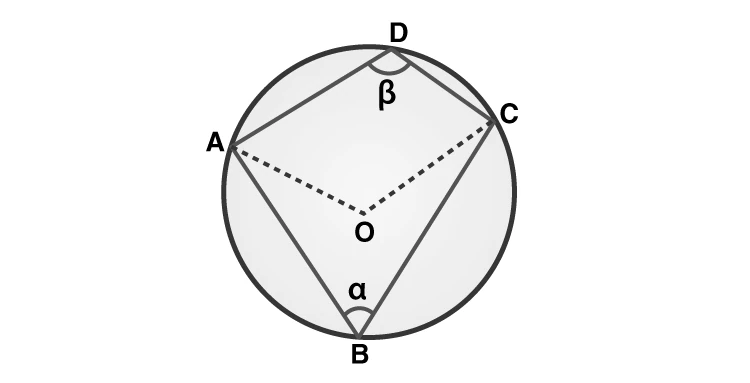
Diagram illustrating the proof of opposite angles supplementary theorem
Relation Between Diagonals and Sides
Another important property is that the product of the diagonals equals the sum of the products of the two pairs of opposite sides. For a cyclic quadrilateral PQRS with diagonals PR and QS, and sides PQ, QR, RS, and SP, the relation is:
\[ (PQ \times RS) + (QR \times SP) = PR \times QS \]
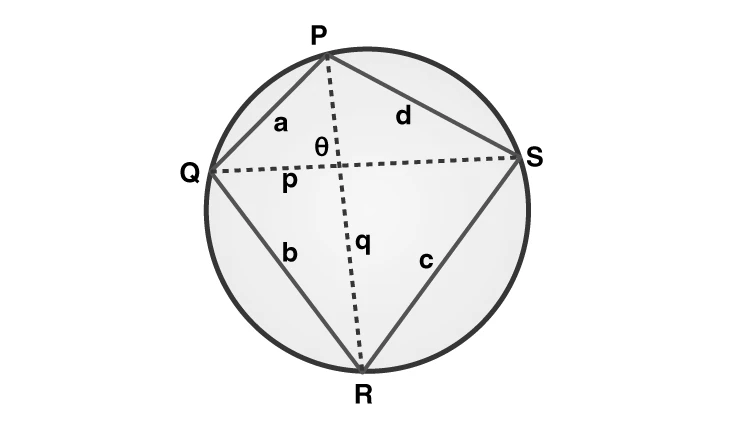
Cyclic quadrilateral showing the relationship between diagonals and sides
Distinctive Characteristics and Additional Properties
Summary of Key Features
The sum of opposite angles in a cyclic quadrilateral is always 180°.
If a quadrilateral has opposite angles summing to 180°, it is cyclic.
The area can be calculated using Brahmagupta's formula.
All four vertices lie on the circumference of the circumscribed circle.
Joining midpoints of sides of a cyclic quadrilateral forms a parallelogram or rectangle.
Angles subtended by the same chord are equal, e.g., \( \angle SPR = \angle SQR \).
The product of segments formed by the intersection of diagonals satisfies \( PT \times TR = QT \times TS \) where T is the intersection point.
An exterior angle formed by extending a side equals the interior opposite angle.
The perpendicular bisectors of the sides concur at the center of the circumcircle.
Example
In cyclic quadrilateral PQRS, the diagonals intersect at T. If \( PT = 3 \text{ cm} \), \( TR = 5 \text{ cm} \), and \( QT = 4 \text{ cm} \), find \( TS \).
Solution:
Using the property of intersecting diagonals:
\[ PT \times TR = QT \times TS \]
\[ 3 \times 5 = 4 \times TS \]
\[ 15 = 4 \times TS \implies TS = \frac{15}{4} = 3.75 \text{ cm} \]
Thus, \( TS = 3.75 \text{ cm} \).
Practical Problems and Their Solutions
Calculating Unknown Angles
Problem 1
In a cyclic quadrilateral ABCD, if \( \angle B = 60^\circ \), determine \( \angle D \).
Solution:
Since opposite angles are supplementary:
\[ \angle B + \angle D = 180^\circ \]
\[ 60^\circ + \angle D = 180^\circ \implies \angle D = 120^\circ \]
Problem 2
Find \( \angle D \) if \( \angle B = 80^\circ \) in cyclic quadrilateral ABCD.
Solution:
\[ \angle B + \angle D = 180^\circ \]
\[ 80^\circ + \angle D = 180^\circ \implies \angle D = 100^\circ \]
Regular practice with such problems enhances understanding of cyclic quadrilateral properties and formulas.
Quick Reference Summary
Property | Formula / Description |
|---|---|
Sum of Opposite Angles | \( \angle A + \angle C = 180^\circ \), \( \angle B + \angle D = 180^\circ \) |
Total Interior Angles | \( 360^\circ \) |
Area | \( \sqrt{(s - a)(s - b)(s - c)(s - d)} \), where \( s = \frac{a+b+c+d}{2} \) |
Diagonals | \( p = \sqrt{\frac{(a c + b d)(a d + b c)}{a b + c d}} \), \( q = \sqrt{\frac{(a c + b d)(a b + c d)}{a d + b c}} \) |
Diagonal and Side Relation | \( (PQ \times RS) + (QR \times SP) = PR \times QS \) |
Intersecting Diagonals | \( PT \times TR = QT \times TS \) |
Glossary of Terms
Term | Meaning |
|---|---|
Quadrilateral | A polygon with four sides and four vertices. |
Cyclic Quadrilateral | A quadrilateral whose vertices all lie on a single circle. |
Circumcircle | The circle passing through all vertices of a polygon. |
Semiperimeter | Half the sum of the sides of a polygon. |
Brahmagupta's Formula | A formula to calculate the area of a cyclic quadrilateral. |
Supplementary Angles | Two angles whose sum is 180°. |
Diagonal | A line segment connecting two non-adjacent vertices of a polygon. |
Inscribed Angle | An angle formed by two chords in a circle which have a common endpoint. |
Perpendicular Bisector | A line that divides a segment into two equal parts at 90°. |
Opposite Angles | Angles that are across from each other in a quadrilateral. |
Frequently Asked Questions
What defines a cyclic quadrilateral?
A cyclic quadrilateral is a four-sided polygon with all vertices lying on the circumference of a single circle.
What is the key angle property of cyclic quadrilaterals?
The opposite angles of a cyclic quadrilateral always add up to 180 degrees.
Can a square be considered a cyclic quadrilateral?
Yes, a square is cyclic because all its vertices lie on a circle, and its opposite angles sum to 180 degrees.
Is every parallelogram cyclic?
No, only those parallelograms whose opposite angles are supplementary can be inscribed in a circle and thus be cyclic.
How is the area of a cyclic quadrilateral calculated?
Using Brahmagupta's formula: \( A = \sqrt{(s - a)(s - b)(s - c)(s - d)} \), where \( s \) is the semiperimeter.