Understanding Chords in Circles: Properties and Calculations
Fundamentals of Chords in a Circle
Defining Chords and Their Characteristics
A chord is a straight line segment that connects any two points lying on the circumference of a circle. Among all chords, the diameter stands out as the longest one, passing directly through the circle's center. This unique property distinguishes the diameter from other chords.
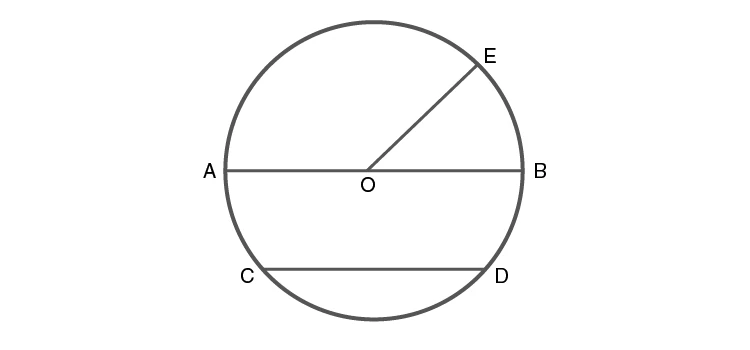
In the diagram, 'O' marks the center of the circle. The segment AB represents the diameter, which is the longest chord. The segment OE is the radius, and CD is another chord within the circle.
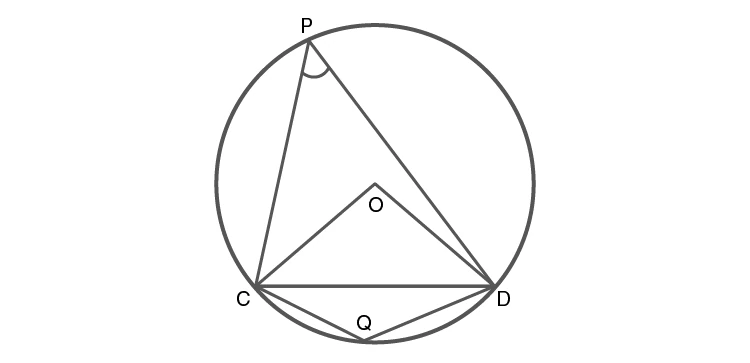
Consider the chord CD and two points P and Q located on the circumference but not on the chord itself. When the endpoints of chord CD are connected to point P, the angle formed, denoted as ∠CPD, is called the angle subtended by the chord at point P. Similarly, ∠CQD is the angle subtended at point Q, and ∠COD is the angle subtended at the center O.
Example Problem
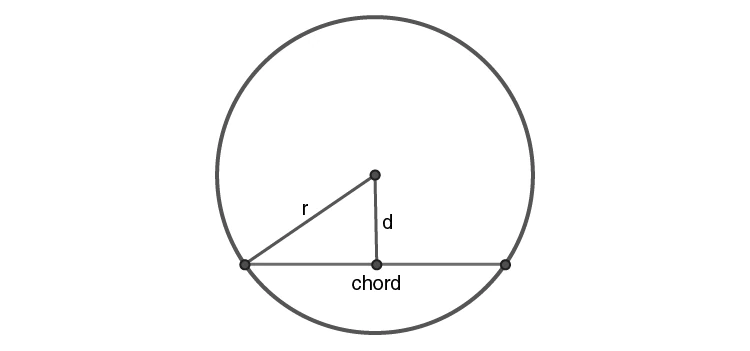
Calculate the length of a chord in a circle with a radius of 8 cm, where the perpendicular distance from the chord to the center is 3 cm.
Solution:
Given radius, \( r = 8 \text{ cm} \)
Perpendicular distance from chord to center, \( d = 3 \text{ cm} \)
The chord length \( L \) is given by:
\[ L = 2 \sqrt{r^2 - d^2} \]
Substituting the values:
\[ L = 2 \sqrt{8^2 - 3^2} = 2 \sqrt{64 - 9} = 2 \sqrt{55} \]
Calculating the square root:
\[ L = 2 \times 7.416 = 14.832 \text{ cm} \]
Therefore, the chord length is approximately 14.83 cm.
Calculating Chord Lengths Using Geometric Relations
Formulas for Determining Chord Length
The length of a chord can be found using two primary formulas depending on the known parameters:
- If the radius \( r \) and the angle \( \theta \) subtended by the chord at the center are known, the chord length \( L \) is:
\[ L = 2r \sin\left(\frac{\theta}{2}\right) \]
- If the radius \( r \) and the perpendicular distance \( d \) from the chord to the center are known, then:
\[ L = 2 \sqrt{r^2 - d^2} \]
Example Problem
Find the length of a chord in a circle with radius 10 cm, where the chord subtends an angle of 60° at the center.
Solution:
Given radius, \( r = 10 \text{ cm} \)
Angle subtended at center, \( \theta = 60^\circ \)
Using the formula:
\[ L = 2r \sin\left(\frac{\theta}{2}\right) = 2 \times 10 \times \sin(30^\circ) \]
Since \( \sin(30^\circ) = 0.5 \),
\[ L = 20 \times 0.5 = 10 \text{ cm} \]
Thus, the chord length is 10 cm.
Key Theorems on Chords and Their Angles
Relationship Between Equal Chords and Angles at the Center
In a circle, chords of equal length always subtend equal angles at the center. Conversely, if two chords subtend equal angles at the center, they must be equal in length. This fundamental property helps in solving many geometric problems involving circles.
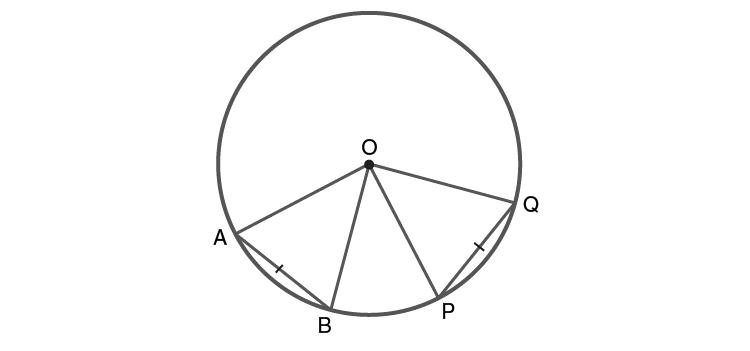
Proof Sketch: Triangles formed by joining the endpoints of the chords to the center are congruent by the Side-Angle-Side criterion, confirming equal angles and chord lengths.
Equal Chords Are Equidistant from the Center
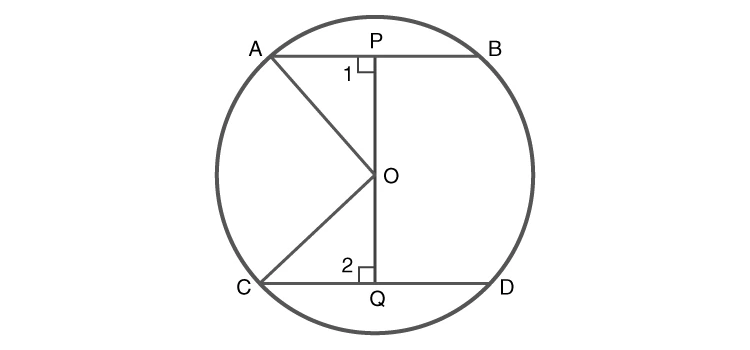
Another important theorem states that chords of equal length lie at the same perpendicular distance from the center of the circle. This means if two chords are equal, the perpendiculars dropped from the center to these chords are equal in length.
Example Problem
A chord in a circle is equal in length to the radius of the circle. Determine the angle this chord subtends at a point located in the major segment of the circle.
Solution:
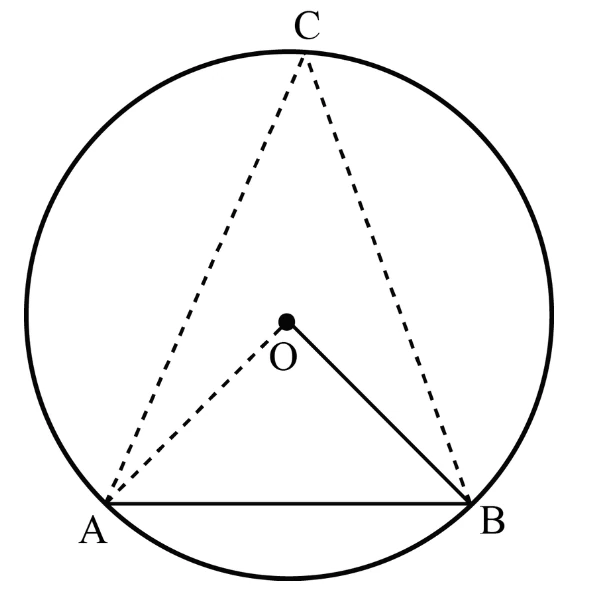
Let O be the center and AB the chord such that \( AB = OA = OB \).
Since all sides are equal, triangle \( \triangle OAB \) is equilateral, so each angle is 60°.
Angle at center, \( \angle AOB = 60^\circ \).
The angle subtended by the chord at any point on the major segment, \( \angle ACB \), is half the angle at the center:
\[ \angle ACB = \frac{1}{2} \times 60^\circ = 30^\circ \]
Therefore, the chord subtends a 30° angle at a point in the major segment.
Example Problem
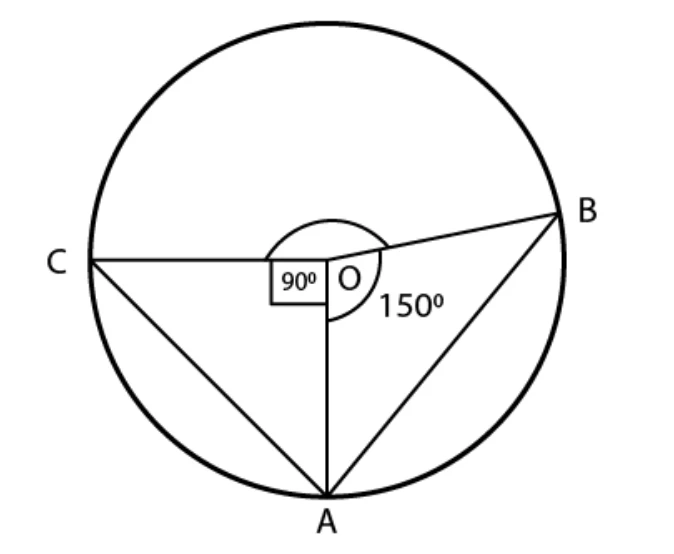
Two chords AB and AC in a circle subtend angles of 100° and 140° respectively at the center. If AB and AC lie on opposite sides of the center, find the angle \( \angle BAC \).
Solution:
Given:
- \( \angle AOB = 100^\circ \)
- \( \angle AOC = 140^\circ \)
Since OA = OB = OC (radii), triangles \( \triangle AOB \) and \( \triangle AOC \) are isosceles.
In \( \triangle AOB \), let \( \angle OAB = \angle OBA = x \).
Sum of angles in triangle:
\[ 2x + 100^\circ = 180^\circ \implies 2x = 80^\circ \implies x = 40^\circ \]
In \( \triangle AOC \), let \( \angle OAC = \angle OCA = y \).
Sum of angles:
\[ 2y + 140^\circ = 180^\circ \implies 2y = 40^\circ \implies y = 20^\circ \]
Therefore, the angle \( \angle BAC = x + y = 40^\circ + 20^\circ = 60^\circ \).
Summary of Chord Properties and Formulas
| Property | Description | Formula/Note |
|---|---|---|
| Chord | Line segment joining two points on the circle | — |
| Diameter | Longest chord passing through center | Diameter = 2 × radius |
| Chord length (using angle) | Length based on angle subtended at center | \( L = 2r \sin\left(\frac{\theta}{2}\right) \) |
| Chord length (using distance) | Length based on perpendicular distance from center | \( L = 2 \sqrt{r^2 - d^2} \) |
| Equal chords | Subtend equal angles at center | Equal chords → equal central angles |
| Equal chords | Are equidistant from center | Equal chords → equal perpendicular distances |
Glossary of Key Terms
| Term | Definition |
|---|---|
| Chord | A line segment joining two points on a circle's circumference. |
| Diameter | The longest chord passing through the center of the circle. |
| Radius | Distance from the center of the circle to any point on the circumference. |
| Angle Subtended | The angle formed at a point by lines drawn from the endpoints of a chord. |
| Perpendicular Distance | The shortest distance from the center of the circle to the chord. |
| Major Segment | The larger part of the circle divided by a chord. |
| Minor Segment | The smaller part of the circle divided by a chord. |
| Isosceles Triangle | A triangle with two sides of equal length. |
| Equilateral Triangle | A triangle with all three sides equal in length. |
| Central Angle | The angle subtended by a chord at the center of the circle. |
Frequently Asked Questions
What defines a chord in a circle?
A chord is a straight line segment connecting any two points on the circle's circumference.
Is the diameter considered a chord?
Yes, the diameter is the longest chord passing through the center of the circle.
How can the length of a chord be calculated?
Chord length can be found using either the radius and the angle subtended at the center or the radius and the perpendicular distance from the chord to the center.
Do equal chords always subtend equal angles?
Yes, chords of equal length subtend equal angles at the center of the circle.
Are equal chords equally distant from the center?
Indeed, equal chords lie at the same perpendicular distance from the center of the circle.