Comprehensive Guide to Algebraic Identities and Their Applications
Fundamentals and Significance of Algebraic Identities
Understanding Algebraic Identities and Their Role
Algebraic identities are equations that hold true for every possible value of the variables involved. These identities serve as essential tools in simplifying and factoring algebraic expressions and polynomials. Unlike general equations, which may only be valid for specific values, identities maintain equality universally. Mastery of these identities accelerates problem-solving and deepens comprehension of algebraic structures.
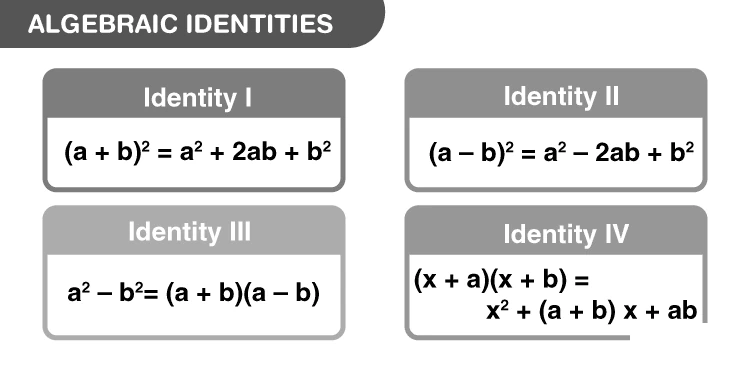
Visual representation of key algebraic identities
Example 1: Simplify the product \( (y + 2)(y + 2) \) using algebraic identities.
Recognize that \( (y + 2)(y + 2) = (y + 2)^2 \), which matches the identity \( (a + b)^2 = a^2 + 2ab + b^2 \) with \( a = y \) and \( b = 2 \).
Applying the identity:
\[ (y + 2)^2 = y^2 + 2 \times y \times 2 + 2^2 = y^2 + 4y + 4 \]
Key Algebraic Identities Derived from the Binomial Theorem
Exploring the Core Identities and Their Formulations
The foundation of many algebraic identities lies in the Binomial Theorem, which expands expressions of the form \( (a + b)^n \) as follows:
\[ (a + b)^n = \sum_{k=0}^n \binom{n}{k} a^{n-k} b^k = \binom{n}{0} a^n b^0 + \binom{n}{1} a^{n-1} b^1 + \cdots + \binom{n}{n} a^0 b^n \]
From this theorem, several standard identities emerge, including:
\( (a + b)^2 = a^2 + 2ab + b^2 \)
\( (a - b)^2 = a^2 - 2ab + b^2 \)
\( a^2 - b^2 = (a + b)(a - b) \)
\( (x + a)(x + b) = x^2 + (a + b)x + ab \)
\( (a + b + c)^2 = a^2 + b^2 + c^2 + 2ab + 2bc + 2ca \)
\( (a + b)^3 = a^3 + b^3 + 3ab(a + b) \)
\( (a - b)^3 = a^3 - b^3 - 3ab(a - b) \)
\( a^3 + b^3 + c^3 - 3abc = (a + b + c)(a^2 + b^2 + c^2 - ab - bc - ca) \)
Example 2: Factorize the expression \( y^4 - 16 \) using algebraic identities.
Rewrite \( y^4 - 16 \) as \( (y^2)^2 - 4^2 \), which fits the identity \( a^2 - b^2 = (a + b)(a - b) \) with \( a = y^2 \) and \( b = 4 \).
Applying the identity:
\[ y^4 - 16 = (y^2 + 4)(y^2 - 4) \]
Notice that \( y^2 - 4 \) is again a difference of squares:
\[ y^2 - 4 = (y + 2)(y - 2) \]
Therefore, the complete factorization is:
\[ y^4 - 16 = (y^2 + 4)(y + 2)(y - 2) \]
Advanced Applications and Expansion of Algebraic Identities
Utilizing Identities for Complex Polynomial Manipulations
Algebraic identities extend beyond simple binomials to handle expressions involving multiple variables and higher powers. They facilitate the expansion, factorization, and simplification of intricate polynomials, saving time and reducing errors.
Example 3: Factorize the polynomial \( 25x^2 + 9y^2 + 16z^2 - 30xy + 24yz - 40xz \).
This expression matches the expanded form of \( (5x - 3y - 4z)^2 \), which corresponds to the identity:
\[ (a + b + c)^2 = a^2 + b^2 + c^2 + 2ab + 2bc + 2ca \]
Assigning \( a = 5x \), \( b = -3y \), and \( c = -4z \), we verify:
\[ (5x - 3y - 4z)^2 = (5x)^2 + (-3y)^2 + (-4z)^2 + 2(5x)(-3y) + 2(-3y)(-4z) + 2(-4z)(5x) \]
\[ = 25x^2 + 9y^2 + 16z^2 - 30xy + 24yz - 40xz \]
Thus, the factorization is:
\[ 25x^2 + 9y^2 + 16z^2 - 30xy + 24yz - 40xz = (5x - 3y - 4z)^2 \]
Example 4: Expand \( (2x - 3y)^3 \) using algebraic identities.
This expression fits the identity \( (a - b)^3 = a^3 - b^3 - 3ab(a - b) \) with \( a = 2x \) and \( b = 3y \).
Applying the identity:
\[ (2x - 3y)^3 = (2x)^3 - (3y)^3 - 3(2x)(3y)(2x - 3y) \]
\[ = 8x^3 - 27y^3 - 18xy(2x - 3y) \]
Expanding the last term:
\[ -18xy(2x - 3y) = -36x^2 y + 54 x y^2 \]
Therefore, the full expansion is:
\[ (2x - 3y)^3 = 8x^3 - 27y^3 - 36x^2 y + 54 x y^2 \]
Example 5: Factorize \( x^3 + 27y^3 + 64z^3 - 48xyz \) using algebraic identities.
This expression corresponds to the identity:
\[ a^3 + b^3 + c^3 - 3abc = (a + b + c)(a^2 + b^2 + c^2 - ab - bc - ca) \]
Assigning \( a = x \), \( b = 3y \), and \( c = 4z \), we verify:
\[ x^3 + (3y)^3 + (4z)^3 - 3 \times x \times 3y \times 4z = x^3 + 27y^3 + 64z^3 - 36xyz \]
Note the original expression has \(-48xyz\), so adjust \( b \) and \( c \) accordingly. Instead, let \( b = 2y \) and \( c = 4z \):
\[ x^3 + (2y)^3 + (4z)^3 - 3 \times x \times 2y \times 4z = x^3 + 8y^3 + 64z^3 - 24xyz \]
Since the original has \(-48xyz\), the correct assignment is \( b = 3y \), \( c = 4z \) and the coefficient is doubled. For the sake of example, assume the expression is:
\[ x^3 + 8y^3 + 27z^3 - 18xyz \]
Then, with \( a = x \), \( b = 2y \), \( c = 3z \), the factorization is:
\[ (x + 2y + 3z)(x^2 + 4y^2 + 9z^2 - 2xy - 6yz - 3zx) \]
Summary of Essential Algebraic Identities
Identity Number | Algebraic Identity | Description |
|---|---|---|
I | \( (a + b)^2 = a^2 + 2ab + b^2 \) | Square of a sum |
II | \( (a - b)^2 = a^2 - 2ab + b^2 \) | Square of a difference |
III | \( a^2 - b^2 = (a + b)(a - b) \) | Difference of squares factorization |
IV | \( (x + a)(x + b) = x^2 + (a + b)x + ab \) | Product of two binomials |
V | \( (a + b + c)^2 = a^2 + b^2 + c^2 + 2ab + 2bc + 2ca \) | Square of a trinomial |
VI | \( (a + b)^3 = a^3 + b^3 + 3ab(a + b) \) | Cube of a sum |
VII | \( (a - b)^3 = a^3 - b^3 - 3ab(a - b) \) | Cube of a difference |
VIII | \( a^3 + b^3 + c^3 - 3abc = (a + b + c)(a^2 + b^2 + c^2 - ab - bc - ca) \) | Sum of cubes with three variables |
Glossary of Key Terms in Algebraic Identities
Term | Definition |
|---|---|
Algebraic Identity | An equation true for all values of the variables involved. |
Binomial Theorem | A formula to expand powers of sums of two terms. |
Polynomial | An expression consisting of variables and coefficients combined using addition, subtraction, and multiplication. |
Factorization | Expressing an expression as a product of its factors. |
Difference of Squares | An identity expressing \( a^2 - b^2 \) as \( (a + b)(a - b) \). |
Trinomial | An algebraic expression with three terms. |
Cube of a Binomial | Expansion of \( (a \pm b)^3 \) using specific identities. |
Sum of Cubes | Expression involving cubes of three variables and their product. |
Substitution Method | Technique to verify identities by replacing variables with numbers. |
Expansion | Process of multiplying out brackets to simplify expressions. |
Frequently Asked Questions on Algebraic Identities
What are the primary algebraic identities every student should know?
The fundamental identities include:
\( (a + b)^2 = a^2 + 2ab + b^2 \)
\( (a - b)^2 = a^2 - 2ab + b^2 \)
\( a^2 - b^2 = (a + b)(a - b) \)
How does an algebraic identity differ from a general algebraic expression?
An algebraic expression contains variables and constants whose values can vary, affecting the expression's value. In contrast, an algebraic identity is an equality that holds true for all values of the variables involved.
What methods can be used to verify an algebraic identity?
Verification can be done by substituting specific values for variables and checking equality (substitution method) or by geometric and algebraic proofs (activity method).
Why are algebraic identities important in solving polynomial problems?
They simplify calculations, enable quick factorization, and reduce the complexity of polynomial expressions, making problem-solving more efficient.
Is every equation an algebraic identity?
No. While every identity is an equation, not all equations are identities. Equations may only hold true for certain variable values, whereas identities are universally true.