Understanding the Wheatstone Bridge and Its Applications
Fundamentals of the Wheatstone Bridge
Concept and Purpose of the Wheatstone Bridge
Scientists rely on precise measurements to explore and understand the physical world. When it comes to electrical circuits, measuring unknown resistance accurately is crucial. The Wheatstone bridge, invented by Samuel Hunter Christie in 1833 and later popularized by Sir Charles Wheatstone in 1843, is a device designed to determine an unknown resistance by balancing two legs of a bridge circuit. This method provides highly accurate resistance measurements, essential for scientific experiments and electrical engineering.
The Wheatstone bridge circuit consists of four resistors arranged in a diamond shape: two known resistors, one unknown resistor, and one variable resistor. A galvanometer and a power source are connected across the bridge to detect current flow, which helps in determining the balance condition.
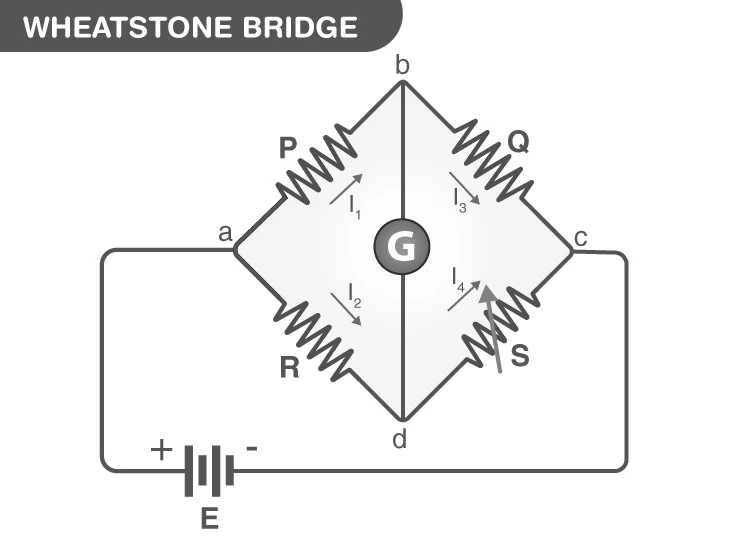
Schematic representation of a Wheatstone Bridge
Example: Identifying Unknown Resistance Using Wheatstone Bridge
In a Wheatstone bridge, the known resistors are \( 120 \, \Omega \) and \( 180 \, \Omega \), and the variable resistor is adjusted to \( 150 \, \Omega \) to balance the bridge. Calculate the unknown resistance.
Solution:
At balance, the ratio of resistances satisfies:
\[ \frac{P}{Q} = \frac{R}{S} \]
Given \( P = 120 \, \Omega \), \( Q = 180 \, \Omega \), and \( S = 150 \, \Omega \), we find \( R \) as:
\[ R = \frac{P}{Q} \times S = \frac{120}{180} \times 150 = \frac{2}{3} \times 150 = 100 \, \Omega \]
Therefore, the unknown resistance \( R \) is \( 100 \, \Omega \).
Working Principle and Circuit Details
How the Wheatstone Bridge Operates
The Wheatstone bridge functions on the principle of null deflection, meaning the bridge is balanced when no current flows through the galvanometer. This balance occurs when the ratio of resistances in one leg equals the ratio in the other leg, resulting in zero potential difference across the galvanometer. Initially, the bridge is unbalanced, and current flows through the galvanometer. By adjusting the variable resistor, the bridge reaches a balanced state, allowing the unknown resistance to be calculated precisely.
The circuit includes four arms: two with known resistors, one with an unknown resistor, and one with a variable resistor. A galvanometer is connected between two junction points to detect current flow, and an electromotive force (emf) source powers the circuit.
Example: Determining Balance Condition in Wheatstone Bridge
In a Wheatstone bridge, the resistors are arranged such that \( P = 200 \, \Omega \), \( Q = 300 \, \Omega \), and the variable resistor \( S \) is adjusted to \( 250 \, \Omega \). Find the unknown resistance \( R \) when the bridge is balanced.
Solution:
At balance, the condition is:
\[ \frac{P}{Q} = \frac{R}{S} \]
Rearranging to find \( R \):
\[ R = \frac{P}{Q} \times S = \frac{200}{300} \times 250 = \frac{2}{3} \times 250 = 166.67 \, \Omega \]
Thus, the unknown resistance \( R \) is approximately \( 166.67 \, \Omega \).
Mathematical Derivation and Practical Uses
Deriving the Wheatstone Bridge Formula
When the Wheatstone bridge is balanced, the current through the galvanometer is zero. Let the currents in the two branches be \( I_1 \) and \( I_2 \). Applying Kirchhoff’s laws and the balance condition, the following relation holds:
\[ \frac{P}{Q} = \frac{R}{S} \]
Here, \( R \) is the unknown resistance, \( S \) is the standard known resistance, and \( P \) and \( Q \) are the ratio arms of the bridge. This formula allows the calculation of the unknown resistance by adjusting the variable resistor until the galvanometer shows zero deflection.
Applications and Limitations of the Wheatstone Bridge
The Wheatstone bridge is widely used for precise measurement of low resistances. It also forms the basis for sensors measuring physical quantities such as temperature, light intensity, and strain when combined with operational amplifiers. Variations of the Wheatstone bridge can measure impedance, inductance, and capacitance.
However, the device has limitations. For very low resistances, the resistance of connecting leads can introduce errors. For very high resistances, the galvanometer may not detect small imbalances effectively. Additionally, heating effects due to current can alter resistance values, potentially causing permanent changes.
Example: Calculating Unknown Resistance with Given Ratios
In a Wheatstone bridge, the ratio arms are \( P = 250 \, \Omega \) and \( Q = 500 \, \Omega \), and the standard arm \( S \) is \( 400 \, \Omega \). Find the unknown resistance \( R \) when the bridge is balanced.
Solution:
Using the balance formula:
\[ R = \frac{P}{Q} \times S = \frac{250}{500} \times 400 = \frac{1}{2} \times 400 = 200 \, \Omega \]
The unknown resistance \( R \) is \( 200 \, \Omega \).
Quick Reference Summary
Parameter | Description |
|---|---|
Wheatstone Bridge | Electrical circuit used to measure unknown resistance by balancing two legs of a bridge |
Balance Condition | No current flows through the galvanometer; ratio of resistances equal |
Formula | \( \frac{P}{Q} = \frac{R}{S} \), where \( R \) is unknown resistance |
Components | Two known resistors, one unknown resistor, one variable resistor, galvanometer, emf source |
Applications | Measurement of low resistance, sensors for temperature, light, strain, and electrical parameters |
Limitations | Errors due to lead resistance, galvanometer sensitivity, and heating effects |
Glossary of Key Terms
Term | Definition |
|---|---|
Galvanometer | Device that detects and measures small electric currents |
Resistance | Property of a material that opposes the flow of electric current |
Variable Resistor | A resistor whose resistance can be adjusted manually |
Electromotive Force (emf) | Voltage generated by a source such as a battery |
Null Deflection | Condition when the galvanometer shows zero current, indicating balance |
Bridge Circuit | Electrical circuit arranged in a diamond shape for measurement purposes |
Standard Arm | Known resistor used as a reference in the Wheatstone bridge |
Ratio Arms | Two resistors whose ratio is compared to find the unknown resistance |
Impedance | Measure of opposition to alternating current, including resistance and reactance |
Kirchhoff’s Laws | Fundamental rules for current and voltage in electrical circuits |
Frequently Asked Questions
What is the Wheatstone Bridge used for?
It is primarily used to measure unknown electrical resistance with high accuracy by balancing two legs of a bridge circuit.
How does the Wheatstone Bridge achieve balance?
Balance is achieved when the ratio of resistances in one leg equals the ratio in the other leg, causing zero current through the galvanometer.
What happens when the Wheatstone Bridge is unbalanced?
Current flows through the galvanometer, indicating that the resistance ratios are not equal and the unknown resistance is not yet determined.
What are the main limitations of the Wheatstone Bridge?
Errors can arise from lead and contact resistances in low resistance measurements, galvanometer insensitivity at high resistances, and resistance changes due to heating effects.
Can the Wheatstone Bridge measure other electrical properties?
Yes, with modifications, it can measure impedance, inductance, and capacitance, and it is also used in sensors for physical parameters like temperature and strain.