Fundamentals and Applications of Wave Optics
Foundations of Wave Optics and Light Theories
Historical Perspectives on the Nature of Light
Wave optics, also known as physical optics, explores phenomena such as interference, diffraction, and polarization, which cannot be explained by the simple ray approximation of geometric optics. This branch focuses on the wave-like behavior of light and its interactions with matter.
Historically, the nature of light was debated between two camps: one advocating the particle theory and the other supporting the wave theory. Sir Isaac Newton championed the particle or corpuscular theory, proposing that light consists of tiny particles called corpuscles that travel rapidly from the source and produce vision by reflecting off the retina.
Newton's theory successfully explained reflection and refraction but failed to account for interference, diffraction, and polarization. Moreover, it could not justify why light slows down in denser media compared to vacuum.
Huygens' Wave Model of Light
In the early 18th century, Christopher Huygens challenged Newton's corpuscular theory by proposing that light behaves as a wave traveling through a hypothetical medium called ether, which was thought to be extremely elastic and rarefied. This wave theory explained reflection, refraction, interference, and diffraction effectively.
However, Huygens' model assumed light waves to be longitudinal mechanical disturbances, which could not explain polarization. It also failed to address phenomena like black body radiation, the photoelectric effect, and the Compton effect. Additionally, the ether medium was never detected, and modern physics confirms that light can propagate through vacuum without any medium.
Maxwell's Electromagnetic Wave Theory
James Clerk Maxwell revolutionized the understanding of light by demonstrating that it is an electromagnetic wave, transverse in nature, traveling at a finite speed determined by the permittivity and permeability of free space. The speed of light \( c \) is given by:
\[ c = \frac{1}{\sqrt{\mu_0 \epsilon_0}} \]
where \( \mu_0 = 4\pi \times 10^{-7} \, \text{H/m} \) is the permeability and \( \epsilon_0 = 8.854 \times 10^{-12} \, \text{F/m} \) is the permittivity of free space.
Wavefronts, Wave Normals, and Their Geometrical Properties
Understanding Wavefronts and Their Types
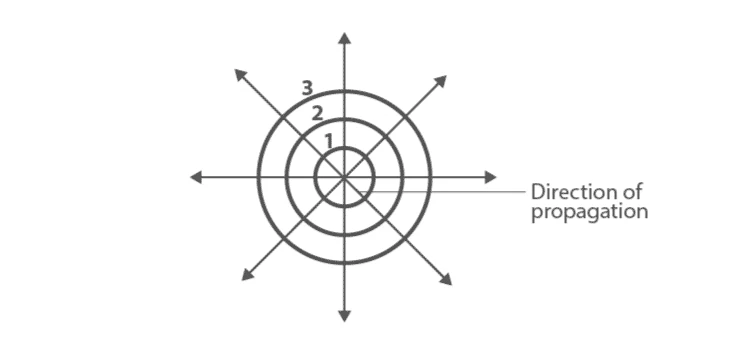
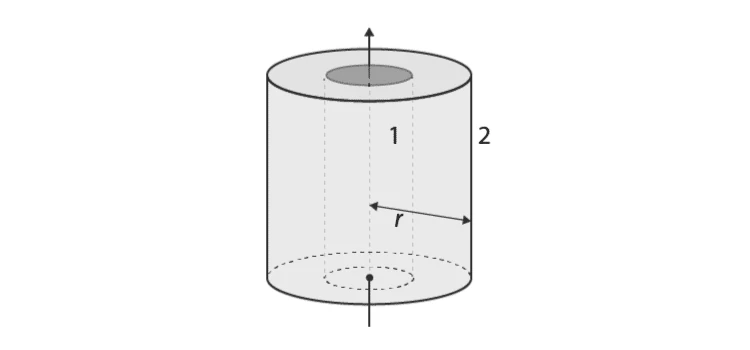
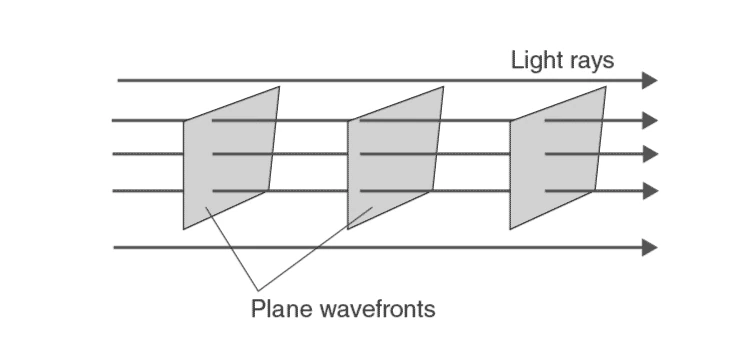
A wavefront is defined as the set of points in a medium that oscillate in unison, i.e., in the same phase. The shape of wavefronts depends on the nature and position of the light source:
- Spherical Wavefront: Emitted from a point source, wavefronts are spherical surfaces expanding outward.
- Cylindrical Wavefront: Produced by a linear source, wavefronts form cylindrical shapes with points equidistant from the source.
- Plane Wavefront: When the source is very distant, wavefronts appear planar, with uniform amplitude and intensity.
Amplitude and intensity relations for these wavefronts are:
- Spherical: \( A \propto \frac{1}{r} \), \( I \propto \frac{1}{r^2} \)
- Cylindrical: \( A \propto \frac{1}{\sqrt{r}} \), \( I \propto \frac{1}{r} \)
- Plane: Amplitude and intensity remain constant with distance.
Wave Normal and Its Significance
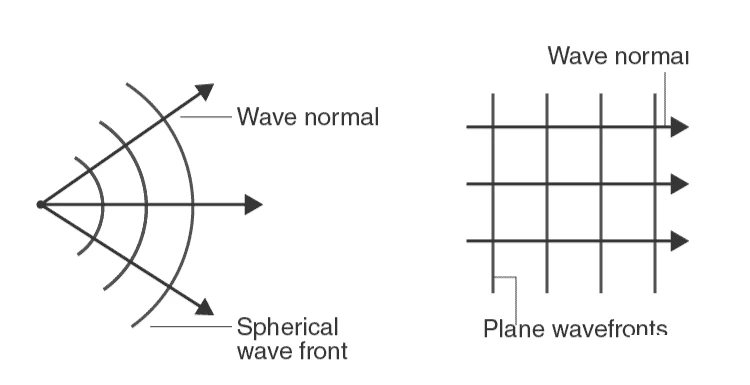
The wave normal is a line drawn perpendicular to the wavefront at any point, indicating the direction of wave propagation. This direction coincides with the path of a light ray. Thus, wave normals and rays are geometrically equivalent.
Transformation of Wavefronts by Optical Elements
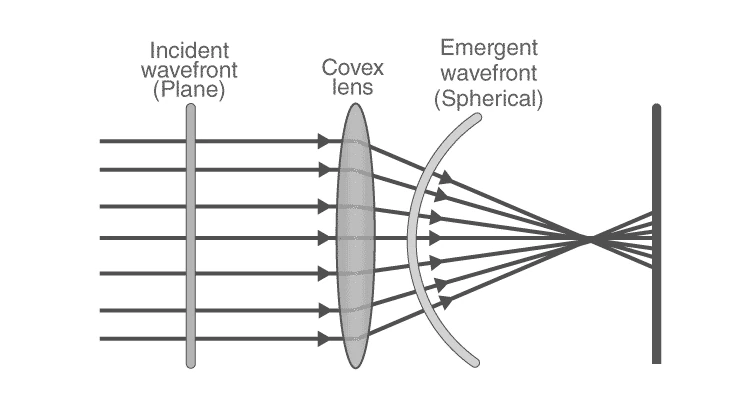
Wavefront shapes can be altered by lenses and mirrors, affecting how light propagates:
- Reflection from Plane Mirror: Plane wavefronts remain planar after reflection.
- Reflection from Concave Mirror: Plane wavefronts become spherical upon reflection.
- Reflection from Convex Mirror: Plane wavefronts also transform into spherical shapes.
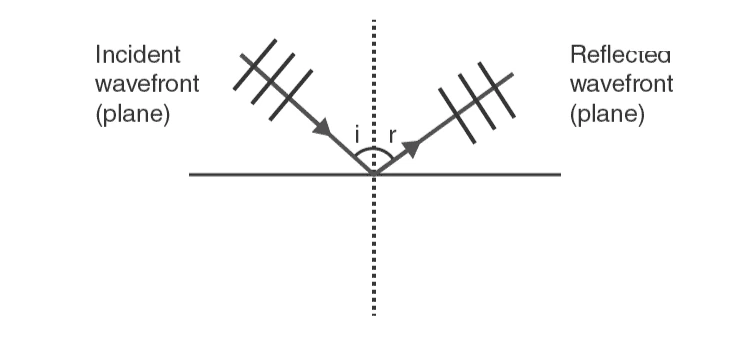
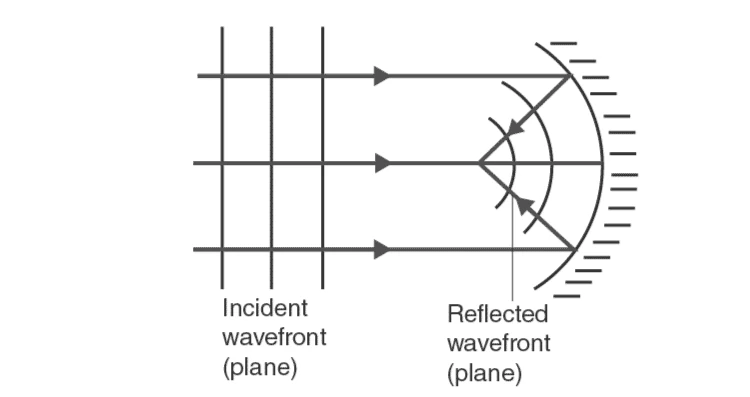
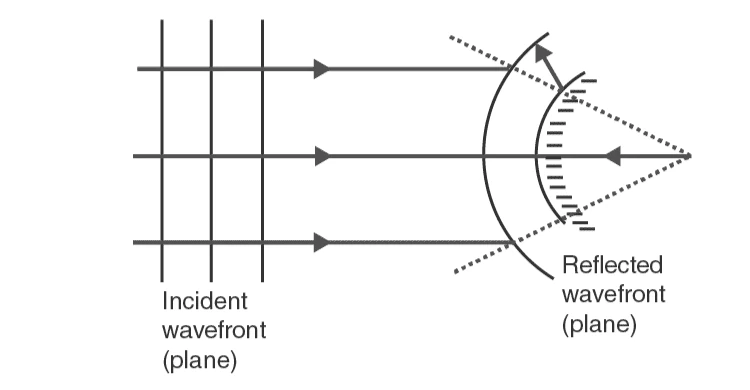
Similarly, refraction affects wavefronts as follows:
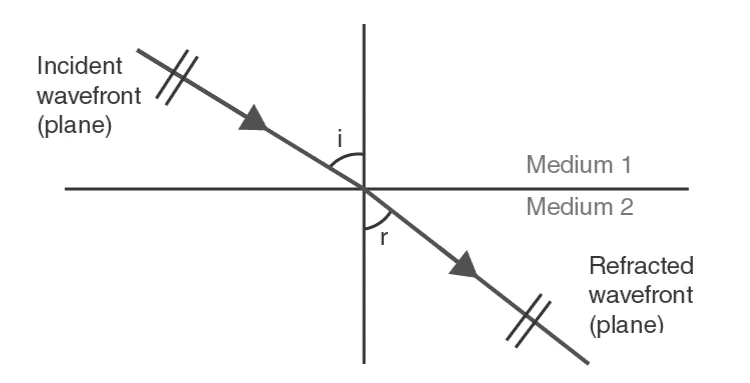
- Refraction at Plane Surfaces: Plane wavefronts remain plane after refraction.
- Refraction at Curved Surfaces: Plane wavefronts become spherical when passing through converging or diverging lenses.
Example: Determining Wave Propagation Direction from Wavefront Equation
Given a wavefront described by the plane equation \( y = 10 - \sqrt{3}x \), find the angle at which the wave propagates relative to the x-axis.
Solution:
The slope of the wavefront line is \( m = -\sqrt{3} \), so the angle \( \theta \) it makes with the x-axis satisfies:
\[ \tan \theta = -\sqrt{3} \]
This corresponds to \( \theta = 150^\circ \) (since the slope is negative and the line is in the second quadrant).
The wave propagates perpendicular to the wavefront, so the propagation angle \( \phi \) is:
\[ \phi = \theta - 90^\circ = 60^\circ \]
Therefore, the wave travels at an angle of \( 60^\circ \) with respect to the x-axis.
Huygens' Principle and Interference Phenomena
Concept of Secondary Wavelets and Wavefront Construction
Huygens' principle states that every point on a wavefront acts as a source of secondary spherical wavelets that spread out in all directions at the wave's speed. The new wavefront at a later time is the surface tangent to all these secondary wavelets.
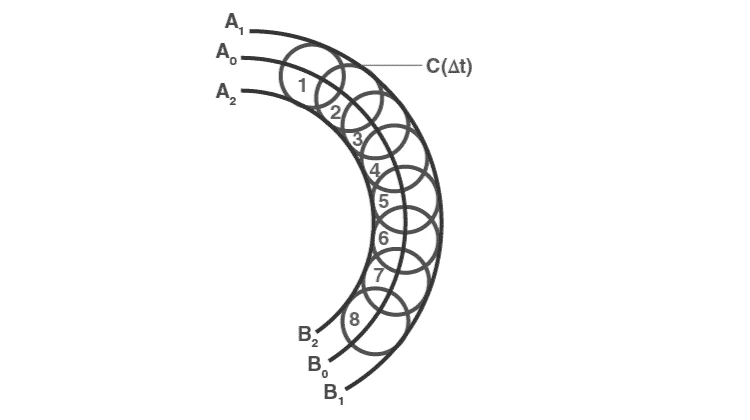
This principle successfully explains reflection, refraction, interference, and diffraction. However, it does not clarify why wavelets propagate only forward and not backward.
Interference of Light Waves
Interference arises when two or more light waves superpose, resulting in a spatial variation of intensity due to constructive and destructive interactions.
Coherent Sources: Two sources emitting monochromatic light with a constant phase difference produce stable interference patterns.
Incoherent Sources: Sources with varying phase differences do not produce consistent interference effects.
Example: Identifying Coherent and Incoherent Sources
Question: Two lamps emit light of the same color but with random phase differences. Are these sources coherent or incoherent? Explain.
Answer:
- The lamps emit light with random phase differences, so the phase relationship is not constant.
- Therefore, they are incoherent sources.
- Incoherent sources do not produce stable interference patterns.
Summary Table: Key Concepts in Wave Optics
| Concept | Description | Key Relation |
|---|---|---|
| Wavefront | Surface of points vibrating in phase | Types: Spherical, Cylindrical, Plane |
| Wave Normal | Line perpendicular to wavefront indicating propagation | Direction of light ray |
| Huygens' Principle | Every point on wavefront acts as source of secondary wavelets | New wavefront is tangent to wavelets |
| Maxwell's Theory | Light is an electromagnetic transverse wave | \( c = \frac{1}{\sqrt{\mu_0 \epsilon_0}} \) |
| Amplitude-Intensity Relation (Spherical) | Amplitude and intensity decrease with distance | \( A \propto \frac{1}{r}, \quad I \propto \frac{1}{r^2} \) |
| Amplitude-Intensity Relation (Cylindrical) | Amplitude and intensity decrease slower than spherical | \( A \propto \frac{1}{\sqrt{r}}, \quad I \propto \frac{1}{r} \) |
| Coherent Sources | Emit light with constant phase difference | Produce stable interference |
| Incoherent Sources | Emit light with random phase difference | No stable interference |
| Reflection Wavefronts | Plane mirror: plane wavefronts remain plane | Concave/Convex mirrors: plane to spherical |
| Refraction Wavefronts | Plane surfaces: plane wavefronts remain plane | Curved lenses: plane to spherical wavefronts |
Glossary of Essential Terms in Wave Optics
| Term | Definition |
|---|---|
| Wavefront | Surface connecting points oscillating in the same phase |
| Wave Normal | Line perpendicular to a wavefront indicating direction of propagation |
| Coherent Sources | Sources emitting waves with constant phase difference |
| Incoherent Sources | Sources emitting waves with random phase differences |
| Huygens' Principle | Every point on a wavefront acts as a source of secondary wavelets |
| Interference | Superposition of waves causing variation in intensity |
| Diffraction | Bending of waves around obstacles or through apertures |
| Polarization | Orientation of oscillations in transverse waves |
| Electromagnetic Wave | Wave consisting of oscillating electric and magnetic fields |
| Ether | Hypothetical medium once thought necessary for light propagation |
Frequently Asked Questions on Wave Optics
What is diffraction in the context of wave optics?
Diffraction refers to the bending and spreading of waves when they encounter an obstacle or pass through a narrow aperture, causing the waves to enter the geometrical shadow region.
How can one distinguish between constructive and destructive interference?
Constructive interference occurs when wave crests align, resulting in increased amplitude, while destructive interference happens when a crest meets a trough, reducing the resultant amplitude.
What defines wave optics in physics?
Wave optics is the study of light phenomena where the ray approximation fails, such as interference, diffraction, and polarization, emphasizing the wave nature of light.
Why is the wave normal important in optics?
The wave normal indicates the direction of wave propagation and is essential for understanding reflection, refraction, and the behavior of light rays.
What role does Huygens' principle play in explaining optical phenomena?
Huygens' principle provides a framework to understand how wavefronts propagate and explains reflection, refraction, interference, and diffraction by considering secondary wavelets.