Understanding Heisenberg’s Uncertainty Principle
Fundamentals of the Uncertainty Principle
Conceptual Overview and Quantum Implications
Heisenberg’s uncertainty principle reveals a fundamental limit in quantum mechanics: it is impossible to precisely determine both the position and momentum of a particle simultaneously. This arises from the wave-particle duality inherent in microscopic entities. While this principle has negligible effects on large-scale objects due to their substantial mass, it becomes crucial when dealing with atoms and subatomic particles, where increased accuracy in position measurement leads to greater uncertainty in momentum, and vice versa.
To illustrate, measuring an electron’s position involves interaction with photons, which impart momentum to the electron, thus disturbing its original state. This disturbance prevents exact simultaneous knowledge of both position and momentum. In contrast, macroscopic objects like a basketball experience negligible momentum change from photons due to their large mass, making the uncertainty principle insignificant at that scale.
Example: Momentum Disturbance in Electron Position Measurement
Consider an electron whose position is measured by scattering photons. The photon’s momentum transfer alters the electron’s momentum unpredictably, making precise simultaneous measurement impossible. This exemplifies the core of Heisenberg’s principle: measurement itself affects the system.
Mathematical Formulation and Practical Applications
Deriving the Uncertainty Relations and Their Significance
The uncertainty principle can be quantitatively expressed as the product of uncertainties in position (\( \Delta x \)) and momentum (\( \Delta p \)) being at least on the order of Planck’s constant divided by \(4\pi\):
\[ \Delta x \cdot \Delta p \geq \frac{h}{4\pi} \]
Since momentum \( p = mv \), the relation can also be written in terms of velocity uncertainty \( \Delta v \) as:
\[ \Delta x \cdot m \Delta v \geq \frac{h}{4\pi} \]
This implies that improving the precision in measuring position inevitably increases the uncertainty in momentum, and vice versa.
For example, an electron in an atom with mass \( m = 9.11 \times 10^{-31} \text{kg} \) and Planck’s constant \( h = 6.626 \times 10^{-34} \text{Js} \), if its position is known to within \( 10^{-10} \text{m} \), the uncertainty in its velocity becomes extremely large, on the order of \( 10^{6} \text{m/s} \), demonstrating the principle’s impact at quantum scales.
Example: Calculating Velocity Uncertainty for an Electron
Given \( \Delta x = 1 \times 10^{-10} \text{m} \), calculate the minimum uncertainty in velocity \( \Delta v \):
\[ \Delta v \geq \frac{h}{4 \pi m \Delta x} = \frac{6.626 \times 10^{-34}}{4 \pi \times 9.11 \times 10^{-31} \times 1 \times 10^{-10}} \approx 5.8 \times 10^{5} \text{m/s} \]
This large uncertainty highlights the quantum limitation on simultaneous measurements.
Illustrative Thought Experiment and Quantum Measurement Limits
Heisenberg’s Gamma-Ray Microscope and Its Insights
Heisenberg’s gamma-ray microscope thought experiment vividly demonstrates the uncertainty principle. To observe an electron, a photon with wavelength \( \lambda \) is used, and the microscope’s resolving power limits the precision of position measurement to:
\[ \Delta x = \frac{\lambda}{\sin \theta} \]
where \( \theta \) is the angle subtended by the microscope’s aperture. Using shorter wavelengths (gamma rays) and larger angles improves position accuracy but increases uncertainty in the electron’s momentum along the x-axis due to photon recoil:
\[ \Delta p_x = \frac{2h}{\lambda} \sin \theta \]
The product of these uncertainties yields:
\[ \Delta x \Delta p_x = 4 \pi h \]
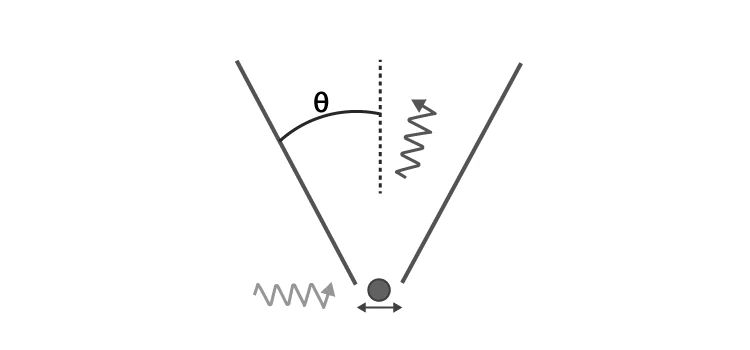
This experiment encapsulates the trade-off between position and momentum precision, reinforcing the fundamental quantum limit.
Example: Uncertainty Product in Gamma-Ray Microscope
Given \( \lambda = 1 \times 10^{-12} \text{m} \) and \( \sin \theta = 0.5 \), calculate \( \Delta x \Delta p_x \):
\[ \Delta x = \frac{1 \times 10^{-12}}{0.5} = 2 \times 10^{-12} \text{m} \]
\[ \Delta p_x = \frac{2 \times 6.626 \times 10^{-34}}{1 \times 10^{-12}} \times 0.5 = 6.626 \times 10^{-22} \text{kg m/s} \]
\[ \Delta x \Delta p_x = 2 \times 10^{-12} \times 6.626 \times 10^{-22} = 1.325 \times 10^{-33} \text{Js} \]
This value aligns with the quantum limit set by Planck’s constant, confirming the principle’s validity.
Practical Calculations and Quantum Measurement Challenges
Worked Numerical Problems Demonstrating the Principle
Problem 1: Momentum Uncertainty from Position Accuracy
An electron’s position is measured with an accuracy of \( 0.003 \text{nm} \). Calculate the minimum uncertainty in its momentum.
Solution:
Given \( \Delta x = 3 \times 10^{-12} \text{m} \), Planck’s constant \( h = 6.626 \times 10^{-34} \text{Js} \),
\[ \Delta p \geq \frac{h}{4 \pi \Delta x} = \frac{6.626 \times 10^{-34}}{4 \times 3.14 \times 3 \times 10^{-12}} \approx 1.76 \times 10^{-23} \text{kg m/s} \]
This uncertainty is significant compared to typical electron momenta, illustrating measurement limitations.
Problem 2: Velocity Uncertainty for a Chloride Ion
A chloride ion’s position is determined with an error of \( 1 \mu m \). Given its mass \( 5.86 \times 10^{-26} \text{kg} \), find the minimum velocity uncertainty.
Solution:
\[ \Delta v \geq \frac{h}{4 \pi m \Delta x} = \frac{6.626 \times 10^{-34}}{4 \times 3.14 \times 5.86 \times 10^{-26} \times 1 \times 10^{-6}} \approx 9 \times 10^{-4} \text{m/s} \]
This small velocity uncertainty is negligible for macroscopic observations but relevant in precise quantum contexts.
Problem 3: Energy Uncertainty from Excited State Lifetime
An atom’s excited state lasts \( 4 \times 10^{-3} \text{s} \). Calculate the minimum uncertainty in its energy in electronvolts (eV).
Solution:
Using \( \Delta E \cdot \Delta t \geq \frac{h}{4 \pi} \),
\[ \Delta E \geq \frac{6.626 \times 10^{-34}}{4 \times 3.14 \times 4 \times 10^{-3}} = 1.32 \times 10^{-32} \text{J} \]
Converting to eV (\(1 \text{J} = 6.242 \times 10^{18} \text{eV}\)):
\[ \Delta E = 1.32 \times 10^{-32} \times 6.242 \times 10^{18} \approx 8.24 \times 10^{-14} \text{eV} \]
This tiny energy uncertainty reflects the quantum nature of atomic states.
Summary Table for Quick Reference
| Quantity | Symbol | Uncertainty Relation | Typical Value |
|---|---|---|---|
| Position uncertainty | \( \Delta x \) | Part of \( \Delta x \cdot \Delta p \geq \frac{h}{4\pi} \) | Varies (e.g., \(10^{-10} \text{m}\) for electrons) |
| Momentum uncertainty | \( \Delta p \) | Part of \( \Delta x \cdot \Delta p \geq \frac{h}{4\pi} \) | Depends on \( \Delta x \) |
| Velocity uncertainty | \( \Delta v \) | \( \Delta v \geq \frac{h}{4 \pi m \Delta x} \) | Large for small \( \Delta x \) |
| Energy uncertainty | \( \Delta E \) | \( \Delta E \cdot \Delta t \geq \frac{h}{4\pi} \) | Inverse of lifetime \( \Delta t \) |
| Time uncertainty | \( \Delta t \) | Part of \( \Delta E \cdot \Delta t \geq \frac{h}{4\pi} \) | Lifetime of quantum state |
Glossary of Key Terms
| Term | Definition |
|---|---|
| Heisenberg’s Uncertainty Principle | A fundamental quantum mechanics principle stating the impossibility of simultaneously measuring position and momentum with arbitrary precision. |
| Wave-Particle Duality | The concept that particles exhibit both wave-like and particle-like properties. |
| Planck’s Constant (h) | A fundamental constant \(6.626 \times 10^{-34} \text{Js}\) used in quantum mechanics. |
| Momentum (p) | The product of mass and velocity of a particle. |
| Position Uncertainty (\( \Delta x \)) | The range within which the exact position of a particle is unknown. |
| Momentum Uncertainty (\( \Delta p \)) | The range within which the exact momentum of a particle is unknown. |
| Gamma-Ray Microscope | A thought experiment illustrating the uncertainty principle using high-energy photons to observe electrons. |
| Conjugate Variables | Pairs of physical quantities like position-momentum or energy-time that are linked by uncertainty relations. |
| Quantum State Lifetime | The average time an excited quantum state exists before decaying. |
| Compton Scattering | The scattering of photons by particles, causing changes in photon wavelength and particle momentum. |
Frequently Asked Questions
Who first introduced the concept of locating an electron in an orbital?
Werner Heisenberg was the pioneer who developed the idea of electron localization within orbitals through his uncertainty principle.
Is it possible to pinpoint an electron’s exact position with complete certainty at a given time?
No, due to the uncertainty principle, exact simultaneous knowledge of position and momentum is fundamentally impossible.
Which scientists contributed to the uncertainty principle and wave nature of matter?
Heisenberg formulated the uncertainty principle, while Louis de Broglie introduced the wave nature of matter concept.
Can the uncertainty principle be violated under any circumstances?
Hypothetically, if an object could travel back in time in a specific manner, it might allow perfect measurement of conjugate variables, violating the principle; however, this remains speculative and unproven.
Does the uncertainty principle apply to all objects regardless of size?
While it applies universally, its effects are only significant for microscopic particles with very small masses; for macroscopic objects, the uncertainties are negligible.