Understanding the Motion of Charged Particles in Magnetic Fields
Effect of Magnetic Force on Moving Charges
When a charged particle moves through a magnetic field, it experiences a force known as the magnetic force. This force acts perpendicular to both the particle's velocity and the magnetic field direction. Because the force is always at right angles to the velocity, it does not perform work on the particle, meaning the particle's speed remains constant though its direction changes.
The magnetic force \( \mathbf{F} \) on a charge \( q \) moving with velocity \( \mathbf{v} \) in a magnetic field \( \mathbf{B} \) is given by the Lorentz force equation:
\[
\mathbf{F} = q (\mathbf{v} \times \mathbf{B})
\]
This force acts as a centripetal force, causing the particle to move in a circular path if the velocity is perpendicular to the magnetic field.
Example: Calculating Radius of Circular Path
A proton with mass \( 1.67 \times 10^{-27} \text{kg} \) and charge \( 1.6 \times 10^{-19} \text{C} \) moves with a velocity of \( 3.0 \times 10^{5} \text{m/s} \) perpendicular to a uniform magnetic field of strength \( 0.2 \text{T} \). Find the radius of the circular path described by the proton.
Solution:
The magnetic force provides the centripetal force:
\[
F = q v B = m \frac{v^2}{r}
\]
Rearranging for radius \( r \):
\[
r = \frac{m v}{q B}
\]
Substituting the values:
\[
r = \frac{(1.67 \times 10^{-27} \text{kg})(3.0 \times 10^{5} \text{m/s})}{(1.6 \times 10^{-19} \text{C})(0.2 \text{T})} = \frac{5.01 \times 10^{-22}}{3.2 \times 10^{-20}} = 0.0157 \text{m}
\]
Therefore, the radius of the proton's circular path is approximately \( 1.57 \text{cm} \).
Helical Motion of Charged Particles in Magnetic Fields
If the velocity of the charged particle has a component parallel to the magnetic field, that component remains unaffected because the magnetic force acts only perpendicular to the velocity. The perpendicular component causes circular motion, while the parallel component causes uniform motion along the field direction. The combination results in a helical trajectory.
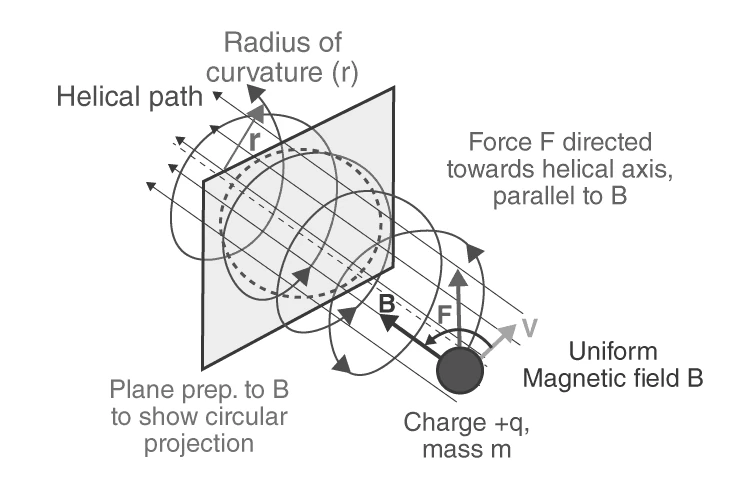
Helical path of a charged particle in a magnetic field
The radius \( r \) of the circular component is given by:
\[
r = \frac{m v_{\perp}}{q B}
\]
where \( v_{\perp} \) is the velocity component perpendicular to the magnetic field.
The angular frequency \( \omega \) of the circular motion is:
\[
\omega = \frac{q B}{m}
\]
The time period \( T \) for one complete revolution is:
\[
T = \frac{2 \pi}{\omega} = \frac{2 \pi m}{q B}
\]
The distance the particle moves along the magnetic field in one revolution is called the pitch \( p \), calculated as:
\[
p = v_{\parallel} T = \frac{2 \pi m v_{\parallel}}{q B}
\]
where \( v_{\parallel} \) is the velocity component parallel to the magnetic field.
Example: Determining Pitch of Helical Motion
An electron with mass \( 9.11 \times 10^{-31} \text{kg} \) and charge \( 1.6 \times 10^{-19} \text{C} \) moves in a magnetic field of \( 0.1 \text{T} \). Its velocity components are \( v_{\perp} = 2.0 \times 10^{6} \text{m/s} \) and \( v_{\parallel} = 1.0 \times 10^{6} \text{m/s} \). Calculate the pitch of the helical path.
Solution:
First, find the time period \( T \):
\[
T = \frac{2 \pi m}{q B} = \frac{2 \pi (9.11 \times 10^{-31})}{(1.6 \times 10^{-19})(0.1)} = \frac{5.72 \times 10^{-30}}{1.6 \times 10^{-20}} = 3.58 \times 10^{-10} \text{s}
\]
Then, calculate the pitch \( p \):
\[
p = v_{\parallel} T = (1.0 \times 10^{6} \text{m/s})(3.58 \times 10^{-10} \text{s}) = 3.58 \times 10^{-4} \text{m}
\]
The pitch of the electron's helical path is approximately \( 0.358 \text{mm} \).
Frequency and Period of Circular Motion in Magnetic Fields
The frequency \( f \) of revolution of a charged particle moving in a magnetic field is the reciprocal of the time period \( T \). It depends only on the charge-to-mass ratio and the magnetic field strength, independent of the particle's velocity.
Mathematically, the frequency is:
\[
f = \frac{1}{T} = \frac{q B}{2 \pi m}
\]
This frequency is also called the cyclotron frequency and is fundamental in devices like cyclotrons used to accelerate charged particles.
Example: Calculating Cyclotron Frequency
A singly charged ion with mass \( 3.32 \times 10^{-26} \text{kg} \) is placed in a magnetic field of \( 0.5 \text{T} \). Find the frequency of its circular motion.
Solution:
Using the formula for frequency:
\[
f = \frac{q B}{2 \pi m}
\]
Substitute the values (\( q = 1.6 \times 10^{-19} \text{C} \)):
\[
f = \frac{(1.6 \times 10^{-19})(0.5)}{2 \pi (3.32 \times 10^{-26})} = \frac{8.0 \times 10^{-20}}{2.086 \times 10^{-25}} = 3.83 \times 10^{5} \text{Hz}
\]
The ion completes approximately \( 3.83 \times 10^{5} \) revolutions per second.
Frequently Asked Questions
What is the magnetic force on a moving charge?
The magnetic force is the force experienced by a charged particle moving in a magnetic field, acting perpendicular to both the velocity and the magnetic field.
How is the radius of the circular path of a charged particle determined?
The radius depends on the particle's mass, velocity, charge, and magnetic field strength, given by \( r = \frac{m v}{q B} \).
What causes a charged particle to move in a helical path?
A helical path occurs when the particle's velocity has components both perpendicular and parallel to the magnetic field, combining circular and linear motion.
What is the cyclotron frequency?
The cyclotron frequency is the frequency at which a charged particle orbits in a magnetic field, calculated as \( f = \frac{q B}{2 \pi m} \).
Does the magnetic force change the speed of a charged particle?
No, the magnetic force only changes the direction of the velocity, not its magnitude, so the speed remains constant.