Understanding Lenz’s Law and Its Practical Implications
Fundamentals of Lenz’s Law in Electromagnetic Induction
Conceptual Overview of Lenz’s Law
Lenz’s law, named after physicist Emil Lenz, is a fundamental principle in electromagnetism that describes the direction of induced currents. It is grounded in the conservation of energy and Newton’s third law, ensuring that any induced current creates a magnetic field opposing the change in magnetic flux that caused it. This opposition maintains the original magnetic flux through the circuit, preventing energy creation from nothing.
In simpler terms, when a magnetic field through a coil changes, the induced current flows in a direction that resists that change, either opposing an increase or a decrease in flux.
Example: Determining Induced Current Direction
A coil is placed near a magnet whose magnetic field is increasing through the coil. According to Lenz’s law, in which direction will the induced current flow?
Solution:
- The increasing magnetic field through the coil means the magnetic flux is rising.
- Lenz’s law states the induced current will oppose this increase.
- Therefore, the induced current will generate a magnetic field opposing the magnet’s field increase.
- Hence, the current direction is such that it creates a magnetic field opposing the magnet’s approach.
Mathematical Expression and Interpretation of Lenz’s Law
Formula and Its Significance
Lenz’s law is mathematically incorporated into Faraday’s law of electromagnetic induction through a negative sign, indicating the opposition of induced emf to the change in magnetic flux. The formula is:
\[ \mathcal{E} = -N \frac{d\Phi_B}{dt} \]
Where:
- \( \mathcal{E} \) is the induced electromotive force (emf) in volts.
- \( N \) is the number of turns in the coil.
- \( \Phi_B \) is the magnetic flux through one loop in webers.
- \( \frac{d\Phi_B}{dt} \) is the rate of change of magnetic flux.
The negative sign explicitly shows that the induced emf acts to oppose the change in flux, consistent with energy conservation.
Example: Calculating Induced emf in a Coil
A coil with 50 turns experiences a magnetic flux change from 0.2 Wb to 0.5 Wb in 0.1 seconds. Calculate the induced emf.
Solution:
Given:
- \( N = 50 \)
- \( \Delta \Phi_B = 0.5 - 0.2 = 0.3 \text{ Wb} \)
- \( \Delta t = 0.1 \text{ s} \)
Using the formula:
\[ \mathcal{E} = -N \frac{\Delta \Phi_B}{\Delta t} = -50 \times \frac{0.3}{0.1} = -150 \text{ V} \]
The negative sign indicates the emf direction opposes the flux increase.
Practical Demonstrations and Applications of Lenz’s Law
Experimental Verifications of Lenz’s Principle
Emil Lenz conducted several experiments to validate his law, demonstrating how induced currents oppose changes in magnetic flux.
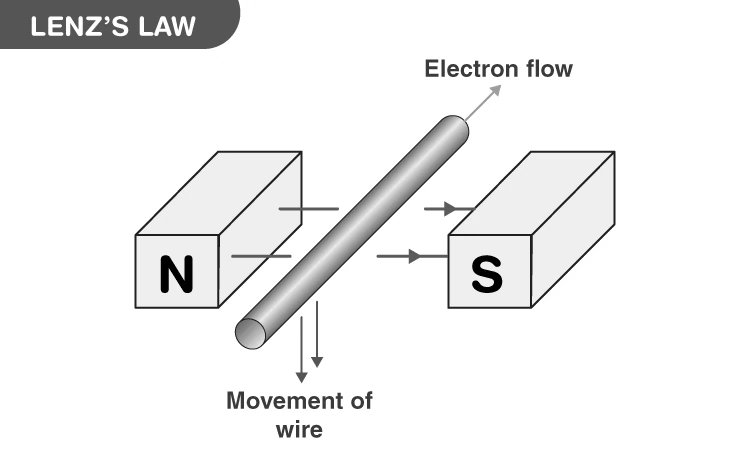
Experiment 1: Increasing Current in a Coil
When current flows through a coil, it produces magnetic field lines. As the current increases, the magnetic flux through the coil rises. The induced current generated opposes this increase, creating a magnetic field that resists the change.
Example: Opposing Magnetic Flux Increase
A coil’s current is ramped up steadily, increasing magnetic flux. What effect does the induced current have?
Answer: The induced current flows in a direction that produces a magnetic field opposing the increase, thus resisting the change in flux.
Experiment 2: Moving a Magnet Towards a Coil
A coil wound around an iron rod behaves like a magnet with a north pole at one end. When this assembly is moved towards another coil with a south pole, an induced current arises in the second coil due to changing magnetic flux.
Example: Induced Current from Moving Magnet
If the iron rod coil is moved closer to a stationary coil, what happens to the induced current?
Answer: The induced current flows in a direction that opposes the approach of the magnetic field, resisting the increase in flux.
Experiment 3: Pulling a Coil Away from a Magnetic Field
When a coil is pulled away from a magnetic field, the magnetic flux linked with it decreases. According to Lenz’s law, the induced current flows in a way that opposes this reduction, effectively resisting the coil’s motion.
Example: Coil Movement Against Induced Current
What force acts on a coil being pulled out of a magnetic field?
Answer: The induced current generates a magnetic field that opposes the decrease in flux, exerting a force that resists the coil’s removal.
Summary Table: Key Points on Lenz’s Law
| Aspect | Description |
|---|---|
| Definition | Induced current opposes the change in magnetic flux causing it. |
| Formula | \( \mathcal{E} = -N \frac{d\Phi_B}{dt} \) |
| Physical Principle | Conservation of energy and Newton’s third law |
| Direction of Induced Current | Always opposes the change in magnetic flux |
| Applications | Eddy current brakes, metal detectors, AC generators, microphones |
| Experimental Evidence | Coil current increase, moving magnets, coil displacement experiments |
Glossary of Important Terms
| Term | Meaning |
|---|---|
| Electromotive Force (emf) | Voltage generated by changing magnetic flux |
| Magnetic Flux (\( \Phi_B \)) | Measure of magnetic field passing through a surface |
| Induced Current | Current generated in a conductor due to changing magnetic flux |
| Faraday’s Law | Law relating induced emf to rate of change of magnetic flux |
| Conservation of Energy | Principle that energy cannot be created or destroyed |
| Newton’s Third Law | For every action, there is an equal and opposite reaction |
| Eddy Currents | Loops of induced current in conductors opposing magnetic changes |
| Magnetic Field | Region around a magnet where magnetic forces act |
| Coil | Wire wound in loops to create magnetic effects |
| Magnetic Pole | Ends of a magnet where magnetic forces are strongest |
Frequently Asked Questions (FAQs)
How does Lenz’s law demonstrate conservation of energy?
Lenz’s law ensures that the induced current opposes the change in magnetic flux, preventing the creation of energy from nothing and thus upholding the conservation of energy principle.
What distinguishes Lenz’s law from Faraday’s law?
Faraday’s law quantifies the magnitude of induced emf, while Lenz’s law specifies the direction of the induced current, emphasizing its opposition to flux changes.
Why is the negative sign important in Lenz’s law formula?
The negative sign indicates that the induced emf acts in a direction to oppose the change in magnetic flux, reflecting the law’s fundamental principle.
In which devices is Lenz’s law applied?
Lenz’s law is utilized in devices like eddy current brakes, metal detectors, AC generators, microphones, and card readers to control induced currents and magnetic effects.
What is the main practical significance of Lenz’s law?
It helps predict the direction of induced currents, enabling the design of electromagnetic devices that efficiently manage energy and magnetic interactions.