Understanding Hooke’s Law and Its Applications
Fundamentals of Elasticity and Hooke’s Principle
Conceptualizing the Relationship Between Force and Extension
In the 19th century, Robert Hooke observed that many elastic materials exhibit a proportional relationship between the force applied and the resulting extension, as long as the material remains within its elastic limit. This proportionality is the foundation of what is now known as Hooke’s Law.
Hooke’s Law states that the deformation (strain) of an elastic object is directly proportional to the applied force (stress), provided the material is not stretched beyond its elastic capacity. When the force is removed, the material returns to its original shape due to the restoring forces at the atomic level.
The mathematical expression of Hooke’s Law is:
\[ F = -k x \]
Here, \(F\) represents the restoring force exerted by the spring, \(x\) is the displacement or extension from the equilibrium position, and \(k\) is the spring constant, a measure of the stiffness of the spring, expressed in \(\text{N/m}\).
Experimental Verification of Hooke’s Law
Observing Spring Behavior Under Different Loads
To verify Hooke’s Law, a spring is subjected to varying loads, and the corresponding extensions are measured. Initially, the spring is at rest with no load. When a load of 1 N is applied, the spring stretches by a length \(x\). Doubling the load to 2 N causes the spring to extend by \(2x\), demonstrating a linear relationship between force and extension.
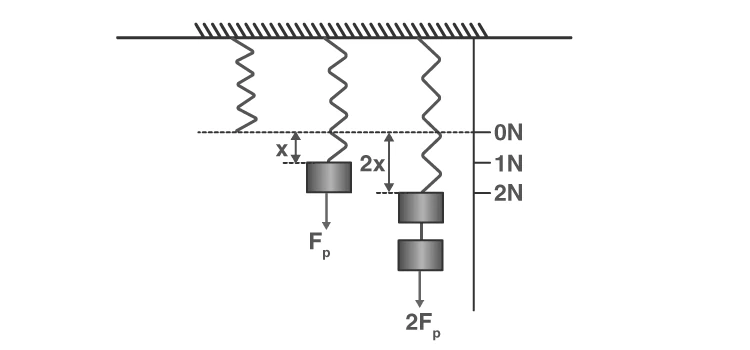
Different springs have unique spring constants depending on their material and construction. By measuring the force and extension, the spring constant \(k\) can be calculated using the formula:
\[ k = \frac{F}{x} \]
Practical Calculation of Spring Constant
Determining the Stiffness of a Spring from Force and Displacement
Consider a spring stretched by 7 cm when a force of 350 N is applied. To find the spring constant, first convert the extension to meters:
\[ 7 \text{ cm} = 0.07 \text{ m} \]
Using Hooke’s Law magnitude:
\[ F = k x \implies k = \frac{F}{x} = \frac{350 \text{ N}}{0.07 \text{ m}} = 5000 \text{ N/m} \]
Thus, the spring constant for this spring is \(5000 \text{ N/m}\), indicating the force required to stretch the spring by one meter.
Graphical Representation of Elastic Behavior
Interpreting the Stress-Strain Curve for Metals
The stress-strain graph for materials like low carbon steel illustrates the elastic and plastic regions of deformation. Initially, the graph is a straight line from the origin to the proportional limit, indicating that stress and strain are proportional and Hooke’s Law is valid.
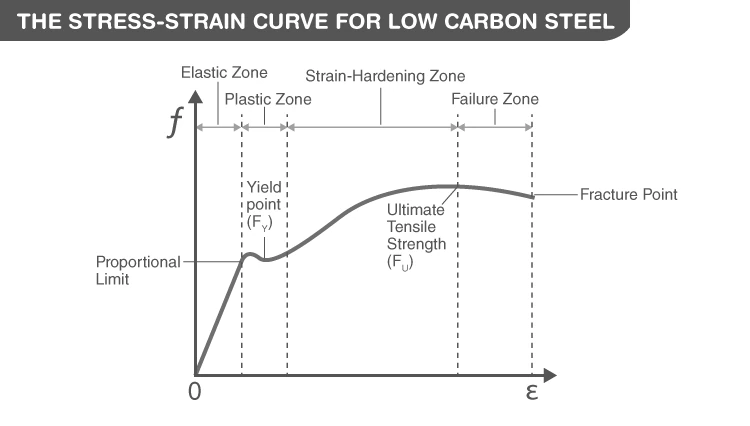
Beyond the proportional limit and up to the yield strength, the material still behaves elastically but may not strictly follow Hooke’s Law. Past the yield point, permanent deformation occurs, and the material enters the plastic region where it no longer returns to its original shape.
The ultimate tensile strength is the maximum stress the material can withstand before rupture, as indicated by the highest point on the curve.
Real-World Uses of Hooke’s Law
Applications in Measurement and Engineering
Hooke’s Law is fundamental in designing devices that rely on elastic deformation, such as:
- Spring scales and balances for measuring weight
- Manometers for pressure measurement
- Balance wheels in mechanical clocks for time regulation
- Foundations in seismology to detect earth vibrations
- Acoustic devices and molecular mechanics modeling
Limitations and Constraints of Hooke’s Law
Understanding the Boundaries of Elastic Behavior
While Hooke’s Law provides a useful approximation, it has certain limitations:
- It applies only within the elastic limit; beyond this, materials exhibit plastic deformation.
- Accurate primarily for small deformations and forces in solid materials.
- Not universally applicable to all materials, especially those that do not exhibit linear elasticity.
Summary Table for Quick Review
| Concept | Description | Formula/Value |
|---|---|---|
| Hooke’s Law | Force proportional to extension within elastic limit | \(F = -k x\) |
| Spring Constant (\(k\)) | Measure of spring stiffness | Units: \(\text{N/m}\) |
| Elastic Limit | Maximum stress before permanent deformation | Material dependent |
| Proportional Limit | Stress up to which Hooke’s Law is valid | Up to yield strength |
| Plastic Region | Permanent deformation beyond elastic limit | Non-linear behavior |
Glossary of Key Terms
| Term | Definition |
|---|---|
| Elastic Limit | The maximum stress a material can withstand without permanent deformation. |
| Spring Constant | A constant \(k\) that quantifies the stiffness of a spring. |
| Stress | Force applied per unit area within materials. |
| Strain | Measure of deformation representing the displacement between particles. |
| Proportional Limit | The highest stress at which stress and strain remain proportional. |
| Plastic Deformation | Permanent change in shape after stress removal. |
| Yield Strength | The stress at which a material begins to deform plastically. |
| Ultimate Tensile Strength | The maximum stress a material can endure before failure. |
| Elastic Fatigue | Loss of elasticity due to repeated stress cycles. |
| Restoring Force | Force exerted by a spring that opposes displacement. |
Frequently Asked Questions
Does Hooke’s Law apply to all materials?
Hooke’s Law is valid only for materials that exhibit elastic behavior within their elastic limit. It does not apply to materials that deform plastically or non-linearly under stress.
Is the relationship in Hooke’s Law always linear?
Yes, within the elastic limit, the force and extension are linearly related. Beyond this limit, the relationship becomes non-linear.
When does Hooke’s Law cease to be valid?
Hooke’s Law fails when the material is stretched beyond its elastic limit, causing permanent deformation or plasticity.
Why is there a negative sign in Hooke’s Law formula?
The negative sign indicates that the restoring force exerted by the spring acts in the opposite direction to the displacement.
Why is Hooke’s Law important in engineering?
It helps predict how materials will respond to forces, enabling the design of safe and efficient mechanical systems and structures.