Understanding Electrical Resistivity and Conductivity
Fundamentals of Electrical Conductivity
Concept and Measurement of Electrical Conductivity
Electrical conductivity is an inherent characteristic of materials that quantifies their ability to allow electric current to flow through them. It is also referred to as specific conductance. The standard unit for measuring conductivity is Siemens per meter (S/m). Mathematically, conductivity is defined as the ratio of current density to the applied electric field strength and is symbolized by the Greek letter \( \sigma \).
This property helps distinguish materials based on how easily they permit the passage of electric charges, which is crucial in selecting materials for electrical applications.
Example Problem
A material has a current density of \( 5 \, \text{A/m}^2 \) when subjected to an electric field of \( 2 \, \text{V/m} \). Calculate its electrical conductivity.
Solution:
Given, current density \( J = 5 \, \text{A/m}^2 \), electric field \( E = 2 \, \text{V/m} \).
Electrical conductivity \( \sigma = \frac{J}{E} = \frac{5}{2} = 2.5 \, \text{S/m} \).
Therefore, the material's conductivity is \( 2.5 \, \text{S/m} \).
Electrical Resistivity: Definition and Characteristics
Understanding Resistivity and Its Relation to Conductivity
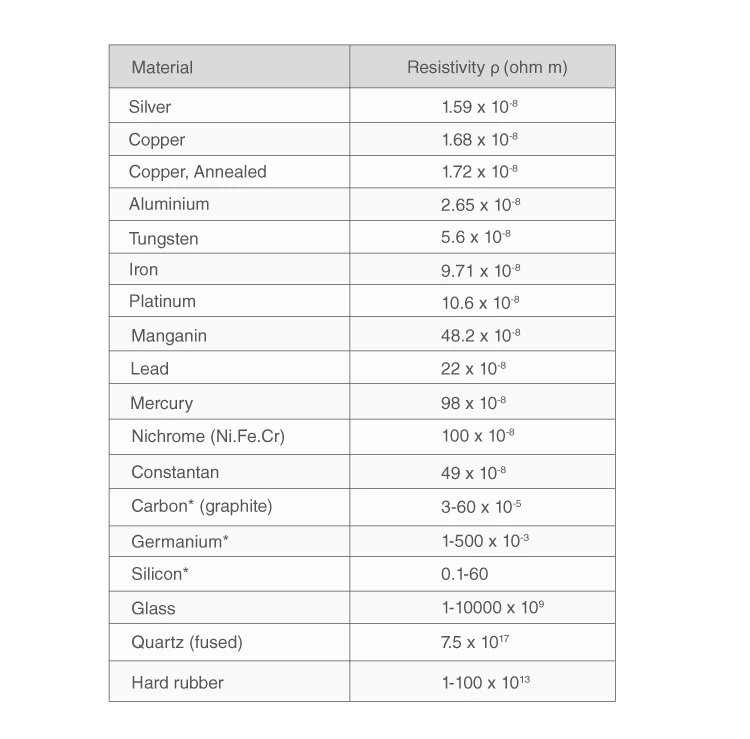
Electrical resistivity is a fundamental property that measures how strongly a material opposes the flow of electric current. It is the inverse of electrical conductivity and is denoted by the Greek letter \( \rho \). Materials with low resistivity, such as metals, allow current to pass easily, whereas insulators have very high resistivity values.
Semiconductors possess resistivity values between conductors and insulators, and their resistivity typically decreases as temperature rises or when impurities are introduced.
Example Problem
A metal wire has an electrical conductivity of \( 4 \times 10^7 \, \text{S/m} \). Find its resistivity.
Solution:
Resistivity \( \rho = \frac{1}{\sigma} = \frac{1}{4 \times 10^7} = 2.5 \times 10^{-8} \, \Omega \cdot \text{m} \).
Hence, the resistivity of the metal wire is \( 2.5 \times 10^{-8} \, \Omega \cdot \text{m} \).
Calculating Resistivity and Its Units
Formulas and Units for Electrical Resistivity
Resistivity can be calculated using two main formulas depending on the context:
When electric field \( E \) and current density \( J \) are known, resistivity is given by:
\[ \rho = \frac{E}{J} \]
Where:
- \( \rho \) is resistivity in \( \Omega \cdot \text{m} \)
- \( E \) is electric field strength in \( \text{V/m} \)
- \( J \) is current density in \( \text{A/m}^2 \)
For a uniform conductor with length \( l \), cross-sectional area \( A \), and resistance \( R \), resistivity is:
\[ \rho = R \frac{A}{l} \]
Where:
- \( R \) is resistance in \( \Omega \)
- \( A \) is cross-sectional area in \( \text{m}^2 \)
- \( l \) is length in meters
The SI unit of resistivity is ohm meter (\( \Omega \cdot \text{m} \)).
Example Problem
A copper wire of length \( 3 \, \text{m} \) and cross-sectional area \( 1 \times 10^{-6} \, \text{m}^2 \) has a resistance of \( 0.05 \, \Omega \). Calculate its resistivity.
Solution:
Given, \( R = 0.05 \, \Omega \), \( l = 3 \, \text{m} \), \( A = 1 \times 10^{-6} \, \text{m}^2 \).
Using the formula:
\[ \rho = R \frac{A}{l} = 0.05 \times \frac{1 \times 10^{-6}}{3} = 1.67 \times 10^{-8} \, \Omega \cdot \text{m} \]
Therefore, the resistivity of the copper wire is \( 1.67 \times 10^{-8} \, \Omega \cdot \text{m} \).
Resistor Colour Coding and Its Interpretation
Decoding Resistance Values Using Colour Bands
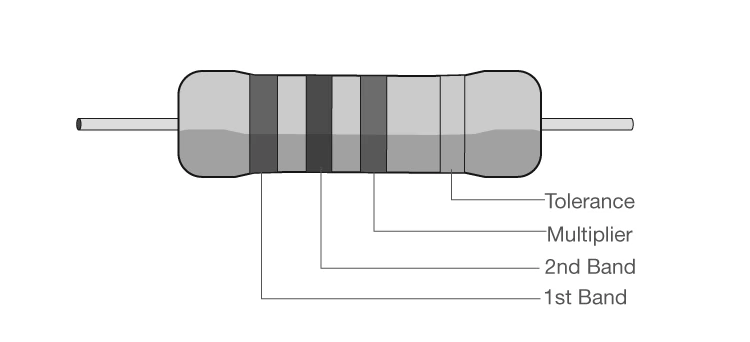
Resistors are essential components in electrical circuits used to regulate current flow. Their resistance values are indicated by coloured bands painted on their bodies. Typically, a resistor has four colour bands:
- The first band represents the first significant digit.
- The second band indicates the second significant digit.
- The third band is the multiplier, which scales the number.
- The fourth band shows the tolerance, or the permissible variation in resistance.
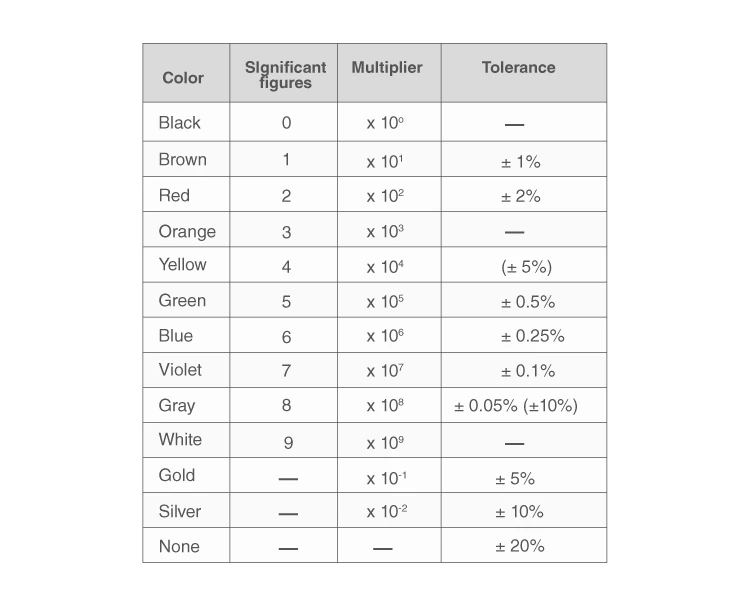
If the fourth band is missing, a default tolerance of 20% is assumed.
Example Problem
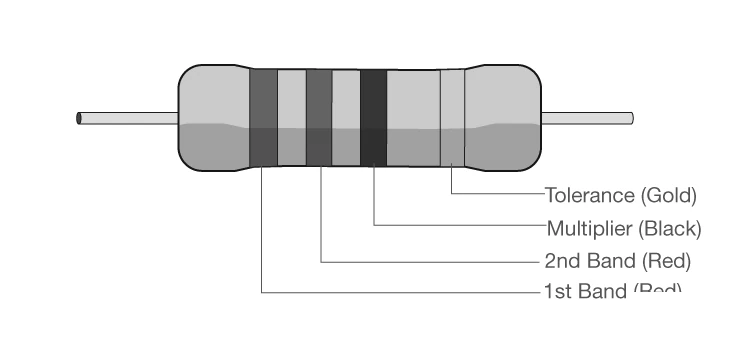
A resistor has four colour bands: red, red, black, and gold. Determine its resistance and tolerance.
Solution:
- First band (red) = 2 (first significant digit)
- Second band (red) = 2 (second significant digit)
- Third band (black) = multiplier \( \times 1 \)
- Fourth band (gold) = tolerance ±5%
Resistance value = \( 22 \times 1 = 22 \, \Omega \) with ±5% tolerance.
Summary Table: Key Electrical Properties
| Property | Symbol | Definition | Unit |
|---|---|---|---|
| Electrical Conductivity | \( \sigma \) | Ability of a material to conduct electric current | Siemens per meter (S/m) |
| Electrical Resistivity | \( \rho \) | Measure of a material's opposition to current flow | Ohm meter (\( \Omega \cdot \text{m} \)) |
| Resistance | \( R \) | Resistance offered by a conductor to current | Ohm (\( \Omega \)) |
| Current Density | \( J \) | Electric current per unit area | Amperes per square meter (A/m²) |
| Electric Field | \( E \) | Force per unit charge in a field | Volts per meter (V/m) |
Glossary of Important Terms
| Term | Meaning |
|---|---|
| Conductors | Materials that allow electric current to flow easily |
| Insulators | Materials that resist the flow of electric current |
| Semiconductors | Materials with conductivity between conductors and insulators |
| Electrical Conductivity (\( \sigma \)) | Measure of a material's ability to conduct electricity |
| Electrical Resistivity (\( \rho \)) | Measure of how much a material opposes electric current |
| Resistance (\( R \)) | Opposition to current flow in a conductor |
| Current Density (\( J \)) | Electric current per unit cross-sectional area |
| Electric Field (\( E \)) | Force experienced by a charge per unit charge |
| Resistor Colour Code | Colour bands on resistors indicating resistance value and tolerance |
| Tolerance | Permissible variation in resistor's resistance value |
Frequently Asked Questions
What is the SI unit of electrical resistivity?
The SI unit of electrical resistivity is ohm meter (\( \Omega \cdot \text{m} \)).
How are electrical conductivity and resistivity related?
They are inversely related, expressed as \( \sigma = \frac{1}{\rho} \), where \( \sigma \) is conductivity and \( \rho \) is resistivity.
Is rubber a good conductor of electricity?
No, rubber is an insulator and does not conduct electricity effectively.
How does temperature affect the resistivity of semiconductors?
In semiconductors, resistivity decreases as temperature increases due to increased charge carrier availability.
Can you name some common good conductors?
Examples include silver, copper, gold, aluminum, zinc, and brass.