Understanding the Electric Field Generated by a Dipole
Fundamentals of Electric Dipoles and Their Fields
Defining the Electric Dipole and Its Moment
An electric dipole consists of two equal but opposite charges separated by a certain distance. The characteristic quantity describing this system is the electric dipole moment, a vector defined as the product of the magnitude of one charge and the distance between the charges. This vector points from the negative charge toward the positive charge along the line joining them.
This concept is crucial in understanding the behavior of materials like dielectrics and plays a significant role in various physical and chemical phenomena involving electric fields.
Solution:
The dipole moment \( \vec{p} \) is given by:
\[ p = q \times d = 4 \times 10^{-6} \text{ C} \times 0.03 \text{ m} = 1.2 \times 10^{-7} \text{ C·m} \]
The direction of \( \vec{p} \) is from the negative charge to the positive charge along the line joining them.Visualizing the Dipole's Electric Field
The electric field created by a dipole varies depending on the position relative to the dipole. Two important locations to analyze are points along the axis of the dipole and points along the perpendicular bisector. These positions help simplify calculations and provide insight into the field's spatial behavior.
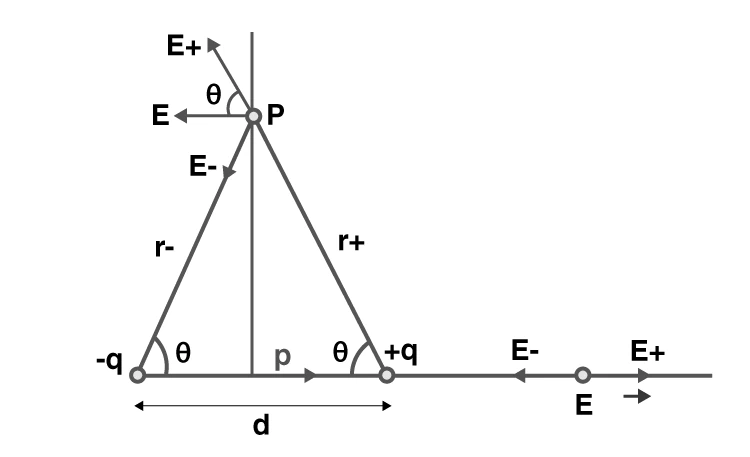
Calculating the Electric Field at the Perpendicular Bisector
Field Components and Resultant at the Midpoint
At a point located on the perpendicular bisector of the dipole, the distances to both charges are equal. The electric fields due to each charge have components that partially cancel out, leaving a net field perpendicular to the dipole axis.
Using Coulomb’s law, the magnitude of the electric field from each charge at a distance \( r \) is:
\[ E = \frac{1}{4 \pi \epsilon_0} \frac{q}{r^2} \]
Because the vertical components cancel, the net field is the sum of the horizontal components, which can be expressed as:
\[ E_{\perp} = 2E \sin \theta \]
where \( \theta \) is the angle between the line joining the charge to the point and the dipole axis.
For distances much larger than the separation \( d \), the electric field simplifies to:
\[ E = \frac{1}{4 \pi \epsilon_0} \frac{p}{r^3} \]
where \( p = qd \) is the dipole moment.
Solution:
Dipole moment:
\[ p = q \times d = 2 \times 10^{-6} \times 0.04 = 8 \times 10^{-8} \text{ C·m} \]
Electric field magnitude:\[ E = \frac{1}{4 \pi \epsilon_0} \frac{p}{r^3} = 9 \times 10^9 \times \frac{8 \times 10^{-8}}{(0.5)^3} = 9 \times 10^9 \times \frac{8 \times 10^{-8}}{0.125} = 5760 \text{ N/C} \]
The direction of the field is opposite to the dipole moment vector.Determining the Electric Field Along the Dipole Axis
Field Calculation at Points Along the Dipole Line
At a point along the axis of the dipole, the electric fields from the positive and negative charges act along the same line but in opposite directions. The net field is the algebraic sum of these two fields.
The electric field at a distance \( r \) from the midpoint on the axis is:
\[ E = \frac{1}{4 \pi \epsilon_0} \left( \frac{q}{(r - \frac{d}{2})^2} - \frac{q}{(r + \frac{d}{2})^2} \right) \]
For \( r \gg d \), this expression simplifies to:
\[ E = \frac{1}{4 \pi \epsilon_0} \frac{2 p}{r^3} \]
Here, the electric field points in the same direction as the dipole moment.
Solution:
Calculate dipole moment:
\[ p = 3 \times 10^{-6} \times 0.05 = 1.5 \times 10^{-7} \text{ C·m} \]
Electric field magnitude:\[ E = \frac{1}{4 \pi \epsilon_0} \frac{2p}{r^3} = 9 \times 10^9 \times \frac{2 \times 1.5 \times 10^{-7}}{(0.6)^3} = 9 \times 10^9 \times \frac{3 \times 10^{-7}}{0.216} \approx 12500 \text{ N/C} \]
The field direction aligns with the dipole moment vector.Comparing Dipole Field Decay with Point Charges
Unlike a single point charge whose electric field decreases with the square of the distance (\( 1/r^2 \)), the dipole’s electric field diminishes more rapidly, following an inverse cube law (\( 1/r^3 \)). This faster decay occurs because the positive and negative charges partially cancel each other's fields at large distances.
Summary Table for Quick Review
| Concept | Formula | Direction of Electric Field |
|---|---|---|
| Dipole Moment \( \vec{p} \) | \( p = q \times d \) | From negative to positive charge |
| Field on Perpendicular Bisector | \( E = \frac{1}{4 \pi \epsilon_0} \frac{p}{r^3} \) | Opposite to dipole moment |
| Field on Dipole Axis | \( E = \frac{1}{4 \pi \epsilon_0} \frac{2p}{r^3} \) | Along dipole moment |
| Field Decay Rate | Dipole: \( \propto \frac{1}{r^3} \), Point charge: \( \propto \frac{1}{r^2} \) | — |
Key Terms and Definitions
| Term | Meaning |
|---|---|
| Electric Dipole | A pair of equal and opposite charges separated by a distance |
| Dipole Moment | Vector quantity equal to charge times separation distance, direction from negative to positive charge |
| Coulomb’s Law | Law describing the force or field between two point charges |
| Perpendicular Bisector | Line perpendicular to the dipole axis passing through its midpoint |
| Electric Field | Force per unit charge exerted by a charge distribution |
| Inverse Cube Law | Dependence of dipole field strength on distance as \( 1/r^3 \) |
| Vector Quantity | A quantity having both magnitude and direction |
| Dielectric | Insulating material that can be polarized by an electric field |
| Electric Charge | Property of matter causing it to experience force in an electric field |
| Midpoint | Point exactly halfway between two charges in a dipole |
Frequently Asked Questions
What defines an electric dipole?
An electric dipole is formed by two equal and opposite charges separated by a fixed distance, creating a system with a characteristic dipole moment.
What is the SI unit of the dipole moment?
The dipole moment is measured in coulomb-meters (C·m).
Can you give a common example of an electric dipole?
A water molecule is a typical example, where the oxygen and hydrogen atoms create a dipole due to uneven charge distribution.
How does the electric field of a dipole differ from that of a single charge?
The dipole’s electric field decreases with the cube of the distance (\(1/r^3\)), whereas a single charge’s field decreases with the square of the distance (\(1/r^2\)).
Why is the direction of the dipole moment from negative to positive charge?
This convention helps in defining the vector direction consistently and is useful in analyzing electric fields and potentials.