Exploring the Dual Characteristics of Matter and Radiation
Fundamentals of Matter's Dual Behavior
Understanding Particle and Wave Aspects of Matter
Matter exhibits two fundamental characteristics: it behaves both as discrete particles and as waves. Initially, phenomena like light were explained solely by particle theories such as the corpuscular model. However, subsequent experiments revealed wave-like properties in matter, leading to the concept of dual nature. This duality is a cornerstone of quantum mechanics, bridging gaps left by classical physics in describing microscopic behavior.
Maxwell’s electromagnetic equations and Hertz’s experiments in the late 19th century provided strong evidence for light’s wave nature, while later studies confirmed that particles like electrons also display wave properties.
Example Problem
An electron is accelerated through a potential difference of 150 V. Calculate its de Broglie wavelength. (Given: Planck’s constant \( h = 6.626 \times 10^{-34} \text{Js} \), electron mass \( m = 9.11 \times 10^{-31} \text{kg} \), electron charge \( e = 1.6 \times 10^{-19} \text{C} \))
Solution:
The kinetic energy gained by the electron is \( K = eV = 1.6 \times 10^{-19} \times 150 = 2.4 \times 10^{-17} \text{J} \).
Momentum \( P = \sqrt{2mK} = \sqrt{2 \times 9.11 \times 10^{-31} \times 2.4 \times 10^{-17}} = \sqrt{4.37 \times 10^{-47}} = 6.61 \times 10^{-24} \text{kg m/s} \).
De Broglie wavelength \( \lambda = \frac{h}{P} = \frac{6.626 \times 10^{-34}}{6.61 \times 10^{-24}} = 1.00 \times 10^{-10} \text{m} \).
Thus, the electron’s wavelength is approximately \( 0.1 \text{nm} \), which is comparable to atomic dimensions.
Photoelectric Phenomenon and Electron Emission
Mechanisms of Electron Release from Metals
Electrons can be emitted from metal surfaces through various processes depending on the energy supplied. These include:
- Thermionic Emission: Heating the metal provides thermal energy to free electrons, enabling their escape.
- Field Emission: A strong electric field extracts electrons by lowering the potential barrier.
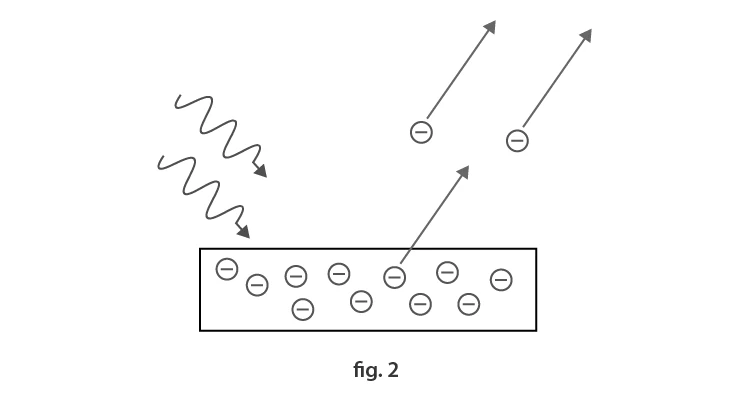
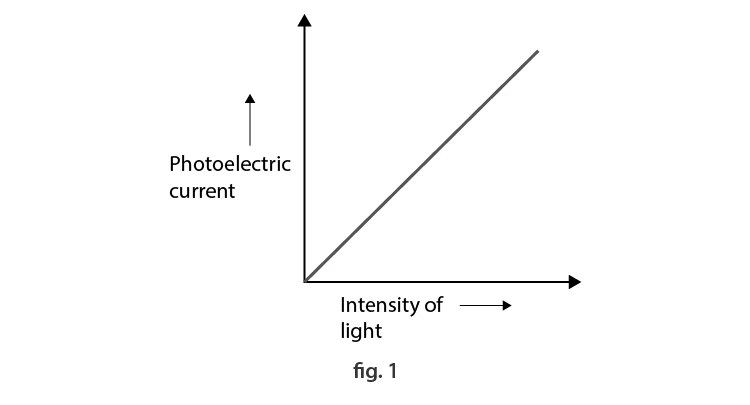
- Photoelectric Emission: Incident light of sufficient frequency causes electrons to absorb energy and escape the metal surface.
The photoelectric effect is a key demonstration of light’s particle nature, where photons transfer energy to electrons, overcoming the metal’s work function.
Example Problem
Light of wavelength \( 400 \text{nm} \) falls on a metal surface with a work function of \( 2.5 \text{eV} \). Calculate the maximum kinetic energy of the emitted electrons. (Given: \( h = 6.626 \times 10^{-34} \text{Js} \), \( c = 3 \times 10^{8} \text{m/s} \), \( 1 \text{eV} = 1.6 \times 10^{-19} \text{J} \))
Solution:
Energy of incident photon: \( E = \frac{hc}{\lambda} = \frac{6.626 \times 10^{-34} \times 3 \times 10^{8}}{400 \times 10^{-9}} = 4.97 \times 10^{-19} \text{J} \).
Convert work function to joules: \( W = 2.5 \times 1.6 \times 10^{-19} = 4.0 \times 10^{-19} \text{J} \).
Maximum kinetic energy: \( KE = E - W = 4.97 \times 10^{-19} - 4.0 \times 10^{-19} = 0.97 \times 10^{-19} \text{J} \).
In electron volts, \( KE = \frac{0.97 \times 10^{-19}}{1.6 \times 10^{-19}} = 0.61 \text{eV} \).
Therefore, the emitted electrons have a maximum kinetic energy of \( 0.61 \text{eV} \).
De Broglie Waves and Quantum Insights
Wave-Particle Relationship and Experimental Confirmation
Louis de Broglie proposed that particles such as electrons possess wave-like properties, characterized by a wavelength inversely proportional to their momentum. This is expressed as:
\[ \lambda = \frac{h}{p} \]
where \( \lambda \) is the wavelength, \( h \) is Planck’s constant, and \( p \) is the particle’s momentum.
This hypothesis was experimentally validated by Davisson and Germer, who observed electron diffraction patterns consistent with wave behavior when electrons scattered off a nickel crystal.
Example Problem
An electron beam is accelerated through a potential difference of 100 V and directed at a crystal. Calculate the de Broglie wavelength of the electrons.
Solution:
Using the formula for de Broglie wavelength:
\[ \lambda = \frac{h}{\sqrt{2 m e V}} \]
Substituting values:
\[ \lambda = \frac{6.626 \times 10^{-34}}{\sqrt{2 \times 9.11 \times 10^{-31} \times 1.6 \times 10^{-19} \times 100}} = \frac{6.626 \times 10^{-34}}{\sqrt{2.91 \times 10^{-47}}} = \frac{6.626 \times 10^{-34}}{5.4 \times 10^{-24}} = 1.23 \times 10^{-10} \text{m} \]
The wavelength is approximately \( 0.123 \text{nm} \), confirming wave-like behavior at atomic scales.
Principles Governing Quantum Uncertainty and Energy Quanta
Heisenberg’s Uncertainty and Planck’s Quantum Hypothesis
Heisenberg’s Uncertainty Principle states that it is impossible to simultaneously determine the exact position and momentum of a particle. This is mathematically expressed as:
\[ \Delta x \Delta p \geq \frac{h}{4\pi} \]
where \( \Delta x \) and \( \Delta p \) represent uncertainties in position and momentum respectively.
Planck’s Quantum Theory introduced the idea that energy is emitted or absorbed in discrete packets called quanta. The energy of each quantum is proportional to the frequency of radiation:
\[ E = nhf \]
where \( n \) is an integer, \( h \) is Planck’s constant, and \( f \) is the frequency.
Example Problem
A black body emits radiation at a frequency of \( 5 \times 10^{14} \text{Hz} \). Calculate the energy of one quantum of this radiation.
Solution:
Using Planck’s relation:
\[ E = hf = 6.626 \times 10^{-34} \times 5 \times 10^{14} = 3.313 \times 10^{-19} \text{J} \]
This energy corresponds to a single photon emitted at the given frequency.
Summary Table for Quick Review
| Concept | Key Formula/Definition | Significance |
|---|---|---|
| De Broglie Wavelength | \( \lambda = \frac{h}{p} \) | Relates particle momentum to wave nature |
| Photoelectric Effect | \( KE_{max} = hf - W \) | Explains electron emission by light |
| Heisenberg’s Uncertainty | \( \Delta x \Delta p \geq \frac{h}{4\pi} \) | Limits simultaneous knowledge of position and momentum |
| Planck’s Quantum Theory | \( E = nhf \) | Energy quantization in radiation |
| Stopping Potential | \( eV_0 = h(f - f_0) \) | Relates cutoff voltage to frequency in photoelectric effect |
Glossary of Key Terms
| Term | Meaning |
|---|---|
| Work Function | Minimum energy needed to eject an electron from a metal |
| Threshold Frequency | Lowest frequency of light that can cause photoemission |
| Stopping Potential | Voltage that stops photoelectric current by halting electrons |
| Quantum | Smallest discrete unit of energy |
| Photon | Quantum of light energy |
| Electron Diffraction | Wave-like scattering of electrons by crystals |
| Momentum | Product of mass and velocity of a particle |
| Thermionic Emission | Electron emission due to heating |
| Field Emission | Electron emission under strong electric field |
| De Broglie Hypothesis | Proposal that matter has wave properties |
Frequently Asked Questions
What are matter waves?
Matter waves are wave-like properties exhibited by particles such as electrons, described by their de Broglie wavelength.
State the de Broglie equation.
The de Broglie wavelength is given by \( \lambda = \frac{h}{mv} \), where \( m \) is mass and \( v \) is velocity of the particle.
Who experimentally confirmed de Broglie’s hypothesis?
The wave nature of electrons was confirmed by Davisson and Germer through electron diffraction experiments.
Do charged particles show wave behavior?
Yes, charged particles like electrons exhibit wave properties, which can be observed in diffraction and interference experiments.
What is the significance of the photoelectric effect?
It demonstrates the particle nature of light and supports the concept of photons transferring energy to electrons.