Understanding Image Formation by Concave and Convex Lenses
Fundamentals of Spherical Lenses and Ray Behavior
Classification and Basic Properties of Spherical Lenses
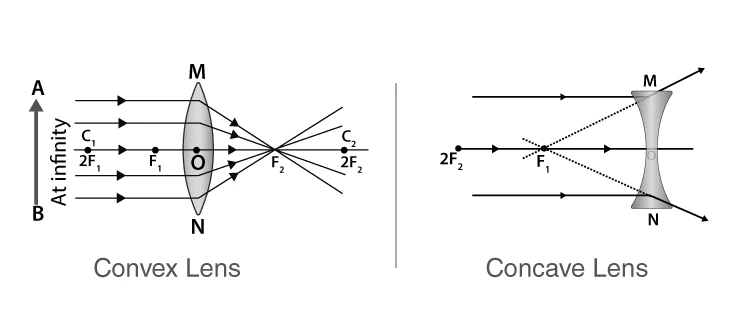
Spherical lenses are crafted by joining two curved transparent surfaces. They are primarily categorized into two types based on their curvature: lenses with outward bulging surfaces are termed convex lenses, while those with inward curving surfaces are called concave lenses. This fundamental distinction influences how they interact with light rays.
Convex lenses are often referred to as converging lenses because they cause parallel light rays to meet at a point after passing through the lens. Conversely, concave lenses are known as diverging lenses since they spread out light rays away from a common point.
Example:
Identify the type of lens that causes parallel rays of light to converge and explain why.
Solution:
- Convex lenses cause parallel rays to converge because their surfaces bulge outward, bending the rays towards the principal axis.
- This focusing effect is due to refraction, where light changes direction when passing through the lens material.
- Therefore, convex lenses are called converging lenses.
Rules Governing Ray Paths Through Lenses
When light rays pass through lenses, their paths follow specific predictable rules:
- A ray passing through the optical center of either lens continues straight without deviation.
- A ray traveling parallel to the principal axis refracts through the lens and passes through the focal point on the opposite side (for convex) or appears to diverge from the focal point (for concave).
- A ray directed towards the focal point before reaching the lens emerges parallel to the principal axis after refraction.
Remembering these ray rules is essential for accurately sketching ray diagrams and understanding image formation.
Image Formation Characteristics of Convex Lenses
Behavior of Images at Various Object Positions
Convex lenses produce different types of images depending on the object's location relative to the lens's focal point and center of curvature.
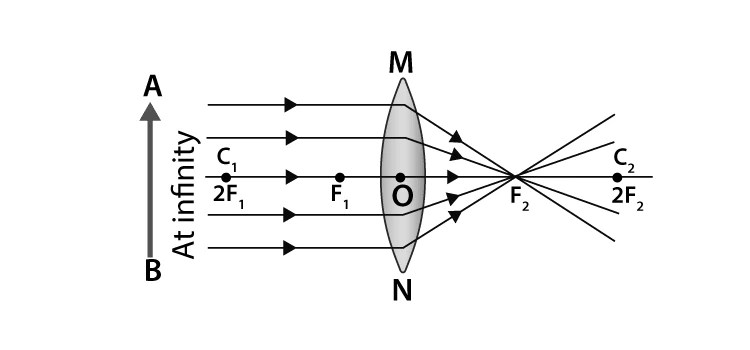
When the object is extremely far away (at infinity), the lens forms a highly diminished, point-sized real image at the focal point.
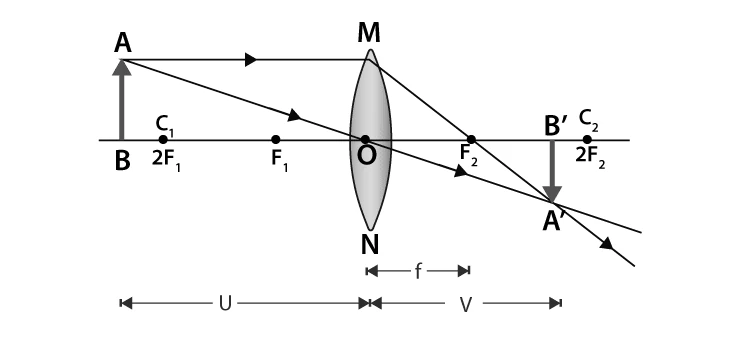
Placing the object beyond the center of curvature results in a real, inverted image located between the focal point and center of curvature, smaller than the object.
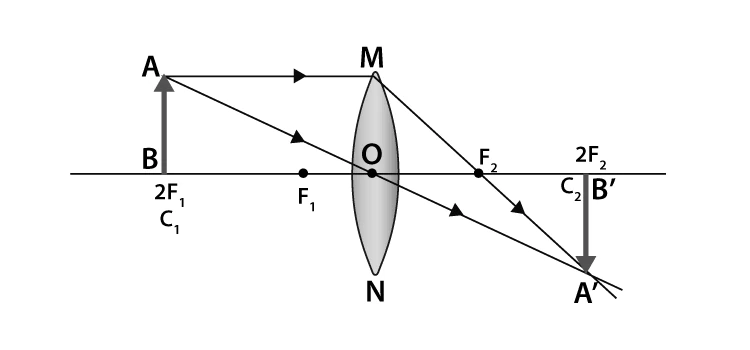
When the object is exactly at the center of curvature, the image forms at the center of curvature on the opposite side, maintaining the same size and inverted orientation.
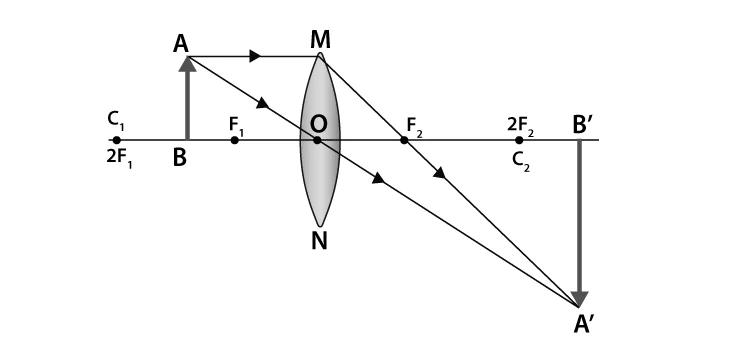
For an object positioned between the center of curvature and the focal point, the lens produces a real, inverted image beyond the center of curvature, larger than the object.
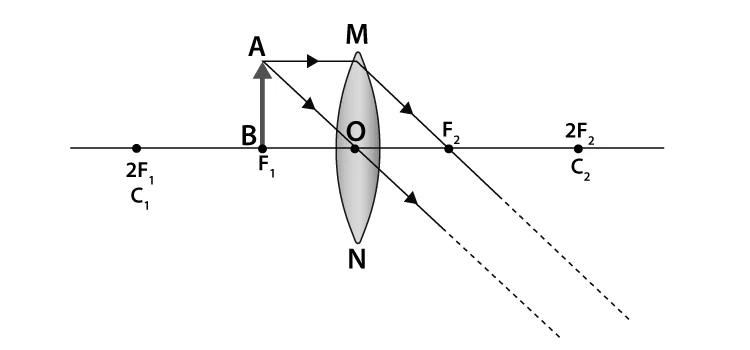
When the object is placed at the focal point, the refracted rays become parallel, and the image forms at infinity, appearing highly magnified.
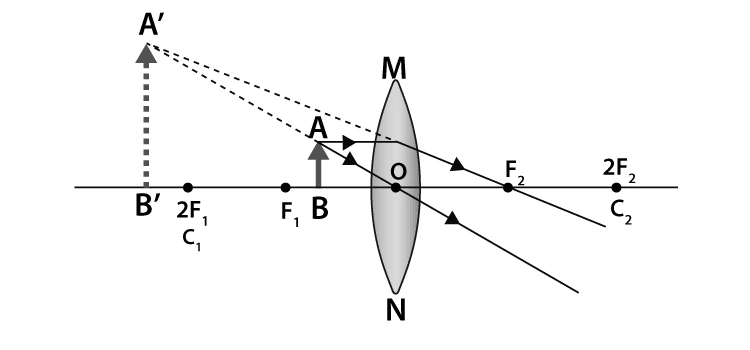
In this case, the lens creates a virtual, upright, and magnified image on the same side as the object.
Example:
An object is placed 30 cm from a convex lens with a focal length of 10 cm. Determine the position and nature of the image formed.
Solution:
Given: Object distance \( u = -30 \text{ cm} \) (object is on the left side), focal length \( f = +10 \text{ cm} \).
Using the lens formula:
\[ \frac{1}{f} = \frac{1}{v} - \frac{1}{u} \]
Rearranged to find image distance \( v \):
\[ \frac{1}{v} = \frac{1}{f} + \frac{1}{u} = \frac{1}{10} + \frac{1}{-30} = \frac{3 - 1}{30} = \frac{2}{30} = \frac{1}{15} \]
Therefore,
\[ v = +15 \text{ cm} \]
The positive value indicates the image is real and formed on the opposite side of the lens.
Magnification \( m = \frac{v}{u} = \frac{15}{-30} = -0.5 \), so the image is inverted and half the size of the object.
Image Formation by Concave Lenses and Their Applications
Characteristics of Images Formed by Concave Lenses
Concave lenses always produce virtual, upright, and diminished images regardless of the object's position. These images appear on the same side as the object.
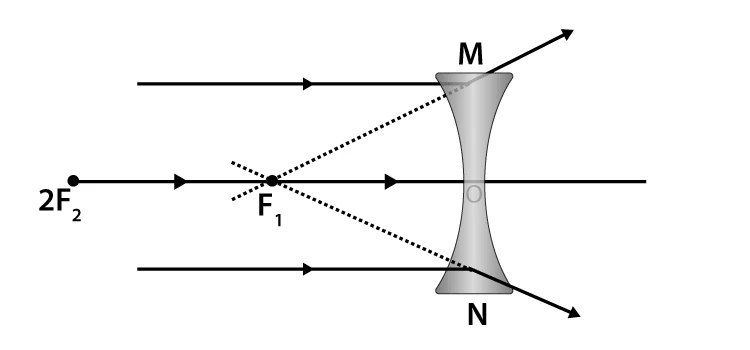
When the object is at a very large distance, the image forms at the focal point on the same side as the object, appearing as a highly reduced point.
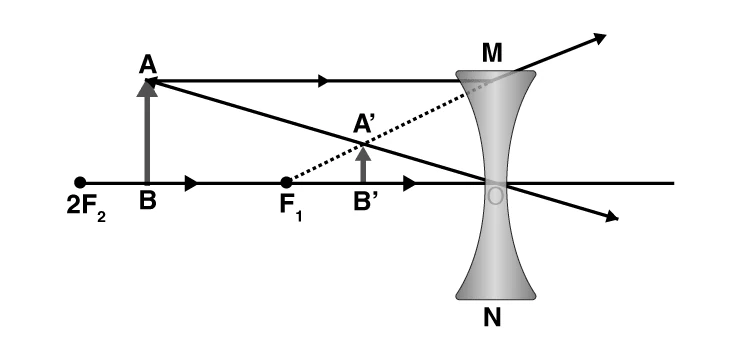
For objects placed at finite distances, the image is virtual, smaller than the object, and located between the optical center and the focal point on the same side as the object.
Example:
A concave lens has a focal length of 15 cm. An object is placed 20 cm from the lens. Find the image distance and magnification.
Solution:
Given: \( f = -15 \text{ cm} \), \( u = -20 \text{ cm} \).
Using the lens formula:
\[ \frac{1}{f} = \frac{1}{v} - \frac{1}{u} \]
Calculate \( v \):
\[ \frac{1}{v} = \frac{1}{f} + \frac{1}{u} = \frac{1}{-15} + \frac{1}{-20} = -\frac{4}{60} - \frac{3}{60} = -\frac{7}{60} \]
Thus,
\[ v = -\frac{60}{7} \approx -8.57 \text{ cm} \]
The negative sign indicates the image is virtual and on the same side as the object.
Magnification \( m = \frac{v}{u} = \frac{-8.57}{-20} = 0.43 \), so the image is upright and smaller than the object.
Practical Uses of Concave Lenses
Concave lenses are widely used in optical devices such as telescopes and peepholes in doors. Their ability to diverge light rays helps in correcting certain vision defects and in creating specific image effects in instruments.
Summary Table: Image Formation by Concave and Convex Lenses
| Lens Type | Object Position | Image Nature | Image Position | Image Size |
|---|---|---|---|---|
| Convex | At infinity | Real, inverted | At focus | Highly diminished |
| Convex | Beyond center of curvature | Real, inverted | Between focus and center of curvature | Diminished |
| Convex | At center of curvature | Real, inverted | At center of curvature | Same size |
| Convex | Between focus and center of curvature | Real, inverted | Beyond center of curvature | Magnified |
| Convex | At focus | Real, inverted | At infinity | Highly magnified |
| Convex | Between focus and optical center | Virtual, upright | Same side as object | Magnified |
| Concave | Any position | Virtual, upright | Between optical center and focus (same side) | Diminished |
Glossary of Key Terms
| Term | Definition |
|---|---|
| Convex Lens | A lens with outward bulging surfaces that converges light rays. |
| Concave Lens | A lens with inward curving surfaces that diverges light rays. |
| Principal Axis | The straight line passing through the centers of curvature of the lens surfaces. |
| Focus (Focal Point) | The point where parallel rays converge (convex) or appear to diverge from (concave). |
| Center of Curvature | The center of the sphere from which the lens surface is a part. |
| Optical Center | The point on the lens through which light passes without deviation. |
| Real Image | An image formed by actual convergence of rays, can be projected on a screen. |
| Virtual Image | An image formed by apparent divergence of rays, cannot be projected on a screen. |
| Magnification | The ratio of image size to object size. |
| Diverging Lens | Another term for concave lens, which spreads out light rays. |
Frequently Asked Questions
Which lens is called a converging lens and why?
Convex lenses are called converging lenses because they cause parallel light rays to meet at a focal point after refraction.
Why are concave lenses known as diverging lenses?
Concave lenses are termed diverging lenses since they spread out incoming parallel rays, making them appear to originate from the focal point on the same side.
Which lens has a negative focal length?
Concave lenses have a negative focal length because they diverge light rays.
What type of lens is thicker at the center and thinner at the edges?
Convex lenses are thicker in the middle and thinner at the edges, enabling them to converge light rays.
Where are concave lenses commonly used?
Concave lenses are used in devices like telescopes and peepholes to correct vision and control light divergence.