Understanding Electron Angular Momentum and De Broglie’s Explanation
Fundamentals of Electron Angular Momentum
Concept of Angular Momentum in Electron Orbits
In atomic physics, electrons revolve around the nucleus in specific paths called orbits. The angular momentum of an electron in such an orbit is a measure of its rotational motion and is a crucial parameter in understanding atomic structure. According to Bohr’s atomic theory, this angular momentum is not continuous but quantized, meaning electrons can only possess certain discrete values of angular momentum.
Bohr proposed that the angular momentum \( L \) of an electron moving in the \( n^{th} \) orbit is given by:
\[ L = mvr = \frac{nh}{2\pi} \]
where \( m \) is the electron’s mass, \( v \) its velocity, \( r \) the radius of the orbit, \( n \) a positive integer (orbit number), and \( h \) Planck’s constant. This quantization restricts electrons to specific orbits with fixed energies.
Illustrative Problem: Calculating Angular Momentum of an Electron
Problem: An electron moves in the third orbit of a hydrogen atom with a radius of \( 2.5 \times 10^{-10} \text{ m} \) and velocity \( 1.2 \times 10^{6} \text{ m/s} \). Calculate its angular momentum and verify if it satisfies Bohr’s quantization condition.
Solution:
Given:
- Mass of electron, \( m = 9.11 \times 10^{-31} \text{ kg} \)
- Velocity, \( v = 1.2 \times 10^{6} \text{ m/s} \)
- Radius, \( r = 2.5 \times 10^{-10} \text{ m} \)
- Orbit number, \( n = 3 \)
- Planck’s constant, \( h = 6.626 \times 10^{-34} \text{ Js} \)
Calculate angular momentum:
\[ L = mvr = (9.11 \times 10^{-31})(1.2 \times 10^{6})(2.5 \times 10^{-10}) = 2.73 \times 10^{-34} \text{ Js} \]
Calculate \( \frac{nh}{2\pi} \):
\[ \frac{3 \times 6.626 \times 10^{-34}}{2\pi} = \frac{1.9878 \times 10^{-33}}{6.283} = 3.16 \times 10^{-34} \text{ Js} \]
The calculated angular momentum \( 2.73 \times 10^{-34} \text{ Js} \) is close to the quantized value \( 3.16 \times 10^{-34} \text{ Js} \), confirming Bohr’s quantization principle within experimental approximations.
De Broglie’s Wave Interpretation of Electron Motion
Wave-Particle Duality and Electron Standing Waves
Louis de Broglie introduced the revolutionary idea that electrons exhibit wave-like properties in addition to particle characteristics. He proposed that an electron moving in a circular orbit behaves like a wave confined to that orbit, forming standing waves. This wave nature explains why only certain orbits are allowed: the circumference of the orbit must be an integer multiple of the electron’s wavelength to form a stable standing wave.
Mathematically, this condition is expressed as:
\[ 2\pi r_k = n \lambda \]
where \( r_k \) is the radius of the \( k^{th} \) orbit, \( \lambda \) is the de Broglie wavelength, and \( n \) is an integer.
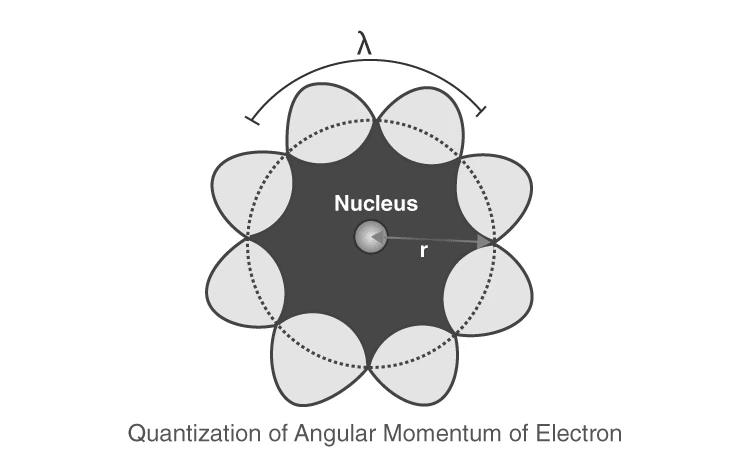
The de Broglie wavelength \( \lambda \) is related to the electron’s momentum \( p \) by:
\[ \lambda = \frac{h}{p} = \frac{h}{mv} \]
Substituting \( \lambda \) into the standing wave condition gives:
\[ 2\pi r_k = n \frac{h}{mv_k} \implies m v_k r_k = \frac{n h}{2\pi} \]
This equation matches Bohr’s quantization rule, providing a wave-based explanation for the discrete angular momentum values.
Example: Determining Electron Orbit Radius Using Wave Nature
Problem: An electron in the second orbit of a hydrogen atom forms a standing wave with wavelength \( 3.3 \times 10^{-10} \text{ m} \). Calculate the radius of this orbit.
Solution:
Given:
- Wavelength, \( \lambda = 3.3 \times 10^{-10} \text{ m} \)
- Orbit number, \( n = 2 \)
Using the standing wave condition:
\[ 2\pi r = n \lambda = 2 \times 3.3 \times 10^{-10} = 6.6 \times 10^{-10} \text{ m} \]
Solving for \( r \):
\[ r = \frac{6.6 \times 10^{-10}}{2\pi} = 1.05 \times 10^{-10} \text{ m} \]
This radius aligns with the known value of the second Bohr orbit, confirming the wave interpretation.
Connecting Quantum Concepts: Angular Momentum Quantization Explained
How De Broglie’s Hypothesis Supports Bohr’s Postulates
De Broglie’s wave theory provides a fundamental explanation for Bohr’s quantization of angular momentum. By treating electrons as waves, it becomes clear that only orbits where the electron’s wave fits perfectly (forming standing waves) are stable. This wave condition naturally leads to discrete angular momentum values, as the electron’s momentum and orbit radius must satisfy:
\[ m v r = \frac{n h}{2\pi} \]
This insight bridges classical and quantum physics, showing that the quantized nature of electron orbits arises from their intrinsic wave properties.
Practical Example: Verifying Quantized Angular Momentum for a Given Orbit
Problem: An electron in the fourth orbit has a velocity of \( 8.0 \times 10^{5} \text{ m/s} \) and mass \( 9.11 \times 10^{-31} \text{ kg} \). If the radius of this orbit is \( 5.3 \times 10^{-10} \text{ m} \), check if the angular momentum is quantized according to Bohr’s rule.
Solution:
Calculate angular momentum:
\[ L = m v r = (9.11 \times 10^{-31})(8.0 \times 10^{5})(5.3 \times 10^{-10}) = 3.86 \times 10^{-34} \text{ Js} \]
Calculate expected quantized value for \( n=4 \):
\[ \frac{4 \times 6.626 \times 10^{-34}}{2\pi} = \frac{2.6504 \times 10^{-33}}{6.283} = 4.22 \times 10^{-34} \text{ Js} \]
The computed angular momentum is close to the quantized value, confirming the electron’s angular momentum is quantized as per Bohr’s postulate and supported by de Broglie’s wave theory.
Quick Reference: Key Points on Electron Angular Momentum
| Concept | Definition / Formula | Significance |
|---|---|---|
| Angular Momentum of Electron | \( L = mvr = \frac{nh}{2\pi} \) | Quantized rotational momentum in electron orbits |
| de Broglie Wavelength | \( \lambda = \frac{h}{mv} \) | Wave nature of moving electrons |
| Standing Wave Condition | \( 2\pi r = n \lambda \) | Only certain orbits allow stable electron waves |
| Planck’s Constant | \( h = 6.626 \times 10^{-34} \text{ Js} \) | Fundamental constant in quantum mechanics |
| Orbit Number | \( n = 1, 2, 3, \ldots \) | Specifies discrete electron orbits |
Glossary of Important Terms
| Term | Meaning |
|---|---|
| Angular Momentum | Measure of rotational motion of an electron around the nucleus |
| Bohr’s Model | Atomic model proposing quantized electron orbits |
| de Broglie Wavelength | Wavelength associated with a moving particle, showing wave-particle duality |
| Planck’s Constant (h) | Fundamental constant used in quantum mechanics |
| Standing Wave | Wave pattern that remains stationary, formed by constructive interference |
| Quantization | Restriction of physical quantities to discrete values |
| Orbit Radius | Distance from nucleus to the electron’s path |
| Momentum (p) | Product of mass and velocity of a particle |
| Wave-Particle Duality | Concept that particles exhibit both wave and particle properties |
| Electron Velocity | Speed of electron moving in its orbit |
Frequently Asked Questions
Can electrons possess angular momentum?
Yes, electrons revolving around the nucleus have angular momentum, which is quantized according to Bohr’s atomic model.
How is the angular momentum of an electron calculated?
It is calculated using the formula \( L = mvr \), where \( m \) is electron mass, \( v \) its velocity, and \( r \) the orbit radius. According to Bohr, \( L \) must be an integral multiple of \( \frac{h}{2\pi} \).
Is the angular momentum of an electron continuous or quantized?
The angular momentum is quantized, meaning electrons can only have specific discrete values, not a continuous range.
What is the significance of Bohr’s atomic model?
Bohr’s model introduced the idea of quantized electron orbits, explaining atomic spectra and stability of atoms.
Who first explained the quantization of electron angular momentum?
Bohr proposed the quantization, and Louis de Broglie provided a wave-based explanation supporting this concept.