Comprehensive Guide to Amplitude Modulation in Communication
Fundamentals of Amplitude Modulation
Understanding the Principle of Amplitude Modulation
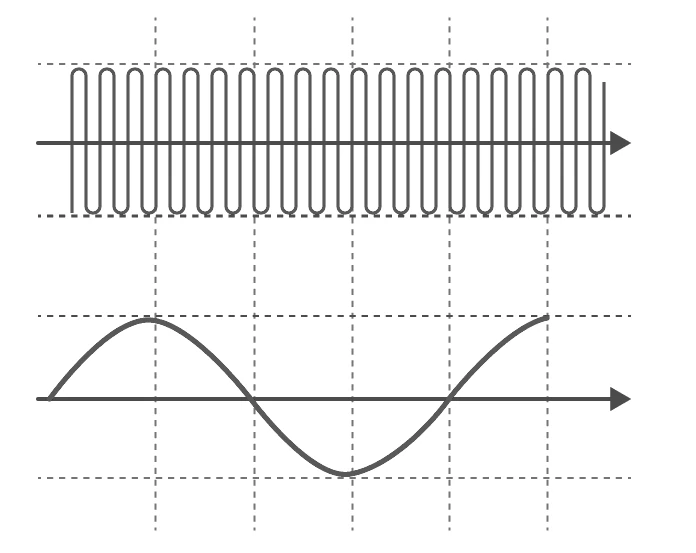
Amplitude modulation (AM) is a foundational technique in electronic communication where the amplitude of a high-frequency carrier wave is varied in direct proportion to the instantaneous amplitude of the input information signal. This method enables the transmission of audio, data, or other signals over long distances by superimposing the message onto a carrier wave, which remains at a constant frequency.
Unlike frequency or phase modulation, where the carrier's frequency or phase changes, AM strictly alters the carrier's amplitude while keeping its frequency steady. The variations in amplitude create sidebands that carry the actual information, making AM a straightforward yet effective modulation method.
Example: Calculating Modulation Index and Frequencies
A carrier wave with a frequency of 900 kHz and a peak voltage of 15 V is modulated by a signal of frequency 2 kHz and peak voltage 5 V. Determine:
- The modulation index \( \mu \).
- The frequencies present in the modulated wave.
- The bandwidth of the modulated signal.
Solution:
(i) Modulation index is the ratio of the modulating signal amplitude to the carrier amplitude:
\[ \mu = \frac{A_m}{A_c} = \frac{5 \text{ V}}{15 \text{ V}} = \frac{1}{3} \approx 0.33 \]
(ii) Frequencies in the modulated wave are:
Carrier frequency \( f_c = 900 \text{ kHz} \)
Upper sideband frequency \( f_c + f_m = 900 \text{ kHz} + 2 \text{ kHz} = 902 \text{ kHz} \)
Lower sideband frequency \( f_c - f_m = 900 \text{ kHz} - 2 \text{ kHz} = 898 \text{ kHz} \)
(iii) Bandwidth \( BW \) is twice the modulating frequency:
\[ BW = 2 f_m = 2 \times 2 \text{ kHz} = 4 \text{ kHz} \]
Varieties and Technical Aspects of Amplitude Modulation
Classification of Amplitude Modulation Types
Amplitude modulation encompasses several variants, each optimized for specific communication needs:
- Double Sideband Suppressed Carrier (DSB-SC): Both sidebands are transmitted but the carrier is suppressed to save power.
- Single Sideband (SSB): Only one sideband is transmitted, reducing bandwidth and power requirements.
- Vestigial Sideband (VSB): A partial sideband is transmitted, commonly used in television broadcasting.
The International Telecommunication Union (ITU) has standardized these types to ensure compatibility and efficiency in global communication systems.
Mathematical Expression of an Amplitude Modulated Wave
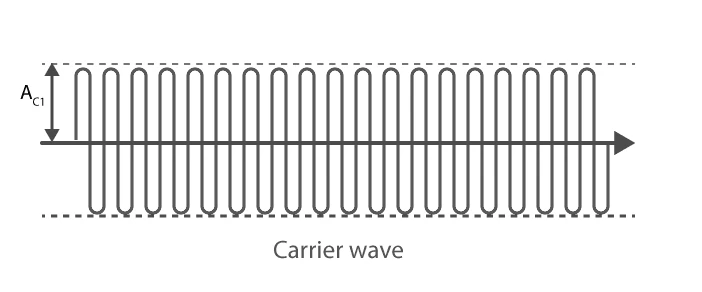
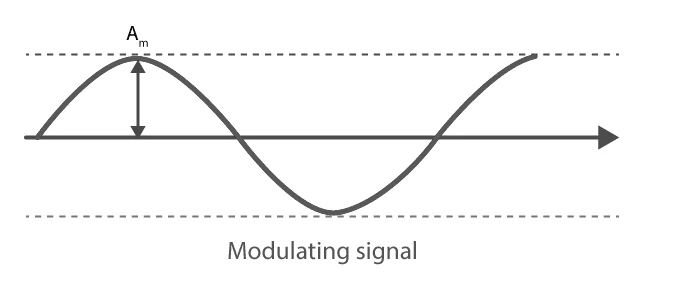
Consider a carrier wave \( c(t) = A_c \sin(\omega_c t) \) and a modulating signal \( m(t) = A_m \sin(\omega_m t) \). The amplitude modulated wave \( C_m(t) \) is expressed as:
\[ C_m(t) = \left( A_c + A_m \sin \omega_m t \right) \sin \omega_c t \]
This can be expanded using trigonometric identities to reveal the carrier and sideband components:
\[ C_m(t) = A_c \sin \omega_c t + \frac{A_m}{2} \left[ \cos(\omega_c - \omega_m) t - \cos(\omega_c + \omega_m) t \right] \]
Here, the first term is the carrier frequency, and the other two represent the lower and upper sidebands respectively.
Example: Deriving Modulation Index from a Composite Wave
Given the wave \( y = 8 \cos(1500 \pi t) + 16 \cos(1700 \pi t) + 8 \cos(1900 \pi t) \), find the modulation index \( \mu \).
Solution:
Rewrite the wave grouping sidebands:
\[ y = 8 [\cos(1500 \pi t) + \cos(1900 \pi t)] + 16 \cos(1700 \pi t) \]
Using the identity \( \cos A + \cos B = 2 \cos \frac{A+B}{2} \cos \frac{A-B}{2} \):
\[ \cos(1500 \pi t) + \cos(1900 \pi t) = 2 \cos(1700 \pi t) \cos(200 \pi t) \]
Substitute back:
\[ y = 16 \cos(1700 \pi t) \cos(200 \pi t) + 16 \cos(1700 \pi t) = \cos(1700 \pi t) [16 + 16 \cos(200 \pi t)] \]
Comparing with \( C_m(t) = (A_c + A_m \cos \omega_m t) \cos \omega_c t \), we identify:
\( A_c = 16 \), \( A_m = 16 \)
Therefore, modulation index:
\[ \mu = \frac{A_m}{A_c} = \frac{16}{16} = 1 \]
Significance and Practical Considerations of Modulation
Why Modulation is Essential in Communication Systems
Modulation is a critical process in communication that enables the transmission of signals over long distances with minimal loss and interference. The key reasons for employing modulation include:
- Extending Transmission Range: High-frequency carrier waves allow the use of smaller antennas and facilitate long-distance propagation.
- Improving Signal Quality: Modulation enhances the power efficiency and sharpness of the transmitted signal, improving reception clarity.
- Preventing Signal Overlap: By assigning different carrier frequencies to different signals, modulation avoids interference between multiple transmissions.
For example, transmitting a low-frequency signal directly would require an impractically large antenna. By modulating it onto a high-frequency carrier, the antenna size becomes manageable and transmission becomes feasible.
Example: Calculating Minimum Antenna Length for Transmission
Calculate the minimum antenna length required to transmit a signal of frequency 15 kHz directly, and then when modulated onto a 1 MHz carrier wave.
Solution:
The wavelength \( \lambda \) is given by:
\[ \lambda = \frac{c}{f} \]
where \( c = 3 \times 10^8 \text{ m/s} \).
For 15 kHz:
\[ \lambda = \frac{3 \times 10^8}{15 \times 10^3} = 2 \times 10^4 \text{ m} \]
Minimum antenna length \( H_{min} = \frac{\lambda}{4} = \frac{2 \times 10^4}{4} = 5000 \text{ m} \)
This is impractical.
For 1 MHz carrier:
\[ \lambda = \frac{3 \times 10^8}{1 \times 10^6} = 300 \text{ m} \]
Minimum antenna length:
\[ H_{min} = \frac{300}{4} = 75 \text{ m} \]
This is feasible, demonstrating the necessity of modulation.
Key Terminology in Amplitude Modulation
Understanding the following terms is vital for grasping AM concepts:
- Carrier Wave: A high-frequency sine wave with constant amplitude and frequency, used to carry the information.
- Modulating Signal: The input information signal that varies the carrier's amplitude.
- Sidebands: Frequency components generated above and below the carrier frequency due to modulation.
- Modulation Index (\( \mu \)): Ratio of the modulating signal amplitude to the carrier amplitude.
- Bandwidth: The range of frequencies occupied by the modulated signal, equal to twice the modulating frequency.

Applications and Limitations of Amplitude Modulation
Practical Uses of Amplitude Modulation
Despite the rise of advanced modulation techniques, AM remains relevant in several domains:
- Broadcast Radio: AM is widely used for medium and long-wave radio broadcasting due to its simplicity and cost-effectiveness.
- Airband Communications: VHF AM is standard for aircraft communication with ground control and between aircraft.
- Single Sideband Transmission: Used in HF radio links for efficient bandwidth and power usage.
- Data Transmission: Quadrature Amplitude Modulation (QAM), an extension of AM, is prevalent in digital communication systems like Wi-Fi and cellular networks.
Advantages and Drawbacks of Amplitude Modulation
Advantages:
- Simple transmitter and receiver design.
- Easy demodulation using envelope detectors.
- Effective for long-distance communication in certain frequency bands.
Disadvantages:
- Susceptible to noise and interference affecting amplitude.
- Inefficient power usage as carrier power does not carry information.
- Limited bandwidth efficiency compared to other modulation schemes.
Basic Demodulation Techniques
The simplest AM demodulator is the envelope detector, which uses a diode to extract the modulating signal from the amplitude variations of the carrier. More sophisticated methods like product detectors provide higher fidelity but require complex circuitry.
Example: Determining Modulation Parameters from a Given Wave
Given the wave \( y = 12 \cos(2200 \pi t) + 24 \cos(2400 \pi t) + 12 \cos(2600 \pi t) \), find the modulation index and the frequencies involved.
Solution:
Group sidebands:
\[ y = 12 [\cos(2200 \pi t) + \cos(2600 \pi t)] + 24 \cos(2400 \pi t) \]
Using the identity:
\[ \cos(2200 \pi t) + \cos(2600 \pi t) = 2 \cos(2400 \pi t) \cos(200 \pi t) \]
Rewrite:
\[ y = 24 \cos(2400 \pi t) \cos(200 \pi t) + 24 \cos(2400 \pi t) = \cos(2400 \pi t) [24 + 24 \cos(200 \pi t)] \]
Identify carrier and modulating amplitudes:
\( A_c = 24 \), \( A_m = 24 \)
Modulation index:
\[ \mu = \frac{A_m}{A_c} = \frac{24}{24} = 1 \]
Frequencies:
Carrier frequency \( f_c = \frac{2400 \pi}{2 \pi} = 1200 \text{ Hz} \)
Modulating frequency \( f_m = \frac{200 \pi}{2 \pi} = 100 \text{ Hz} \)
Sidebands at \( f_c \pm f_m = 1100 \text{ Hz} \) and \( 1300 \text{ Hz} \)
Summary and Key Concepts
| Concept | Definition / Formula | Remarks |
|---|---|---|
| Carrier Wave | \( c(t) = A_c \sin \omega_c t \) | High-frequency wave with constant amplitude and frequency |
| Modulating Signal | \( m(t) = A_m \sin \omega_m t \) | Information signal that varies the carrier amplitude |
| Amplitude Modulated Wave | \( C_m(t) = (A_c + A_m \sin \omega_m t) \sin \omega_c t \) | Combination of carrier and sidebands |
| Modulation Index | \( \mu = \frac{A_m}{A_c} \) | Indicates the extent of modulation; \( 0 < \mu \leq 1 \) for distortion-free |
| Bandwidth | \( BW = 2 f_m \) | Twice the modulating frequency |
| Sidebands | \( f_c \pm f_m \) | Frequencies carrying the modulating information |
| Minimum Antenna Length | \( H_{min} = \frac{\lambda}{4} = \frac{c}{4f} \) | Depends inversely on frequency; higher frequency means smaller antenna |
| Envelope Detector | Diode-based demodulator | Simple and effective for AM demodulation |
| DSB-SC | Double Sideband Suppressed Carrier | Carrier suppressed to save power |
| SSB | Single Sideband | Only one sideband transmitted for bandwidth efficiency |
Glossary of Essential Terms
| Term | Meaning |
|---|---|
| Amplitude Modulation (AM) | Technique of varying the amplitude of a carrier wave in proportion to the information signal |
| Carrier Wave | A high-frequency wave that carries the modulated information |
| Modulating Signal | The original information signal used to modulate the carrier |
| Sidebands | Frequencies generated above and below the carrier frequency due to modulation |
| Modulation Index (\( \mu \)) | Ratio of modulating signal amplitude to carrier amplitude |
| Bandwidth | Frequency range occupied by the modulated signal, equal to twice the modulating frequency |
| Envelope Detector | Simple circuit used to demodulate AM signals by detecting amplitude variations |
| DSB-SC | Double Sideband Suppressed Carrier modulation type |
| SSB | Single Sideband modulation type |
| VSB | Vestigial Sideband modulation, a compromise between DSB and SSB |
Frequently Asked Questions on Amplitude Modulation
What is amplitude modulation and how does it work?
Amplitude modulation is a process where the amplitude of a high-frequency carrier wave is varied in proportion to the instantaneous amplitude of the input signal, allowing the transmission of information over radio waves.
How does amplitude modulation differ from frequency modulation?
In amplitude modulation, the carrier wave's amplitude changes while its frequency remains constant. In frequency modulation, the carrier's frequency varies according to the input signal, with amplitude remaining constant.
Why is modulation necessary in communication systems?
Modulation enables the transmission of low-frequency signals over long distances by shifting them to higher frequencies, reducing antenna size, improving signal quality, and preventing interference between signals.
What happens if the modulation index exceeds 1?
If the modulation index \( \mu \) is greater than 1, overmodulation occurs, causing distortion in the transmitted signal and degrading the quality of reception.
What are the common applications of amplitude modulation today?
AM is used in medium and long-wave radio broadcasting, airband communications, HF radio links, and forms the basis for advanced modulation schemes like QAM used in digital data transmission.