Solving Systems of Linear Equations Using Determinants
Understanding Two-Variable Linear Systems with Determinants
Methodology for Solving Two-Variable Equations
Consider a pair of linear equations in two variables \(x\) and \(y\):
\[ a_1 x + b_1 y + c_1 = 0, \quad a_2 x + b_2 y + c_2 = 0 \]
The solution can be found using determinants defined as:
\[ \Delta = \begin{vmatrix} a_1 & b_1 \\ a_2 & b_2 \end{vmatrix}, \quad \Delta_1 = \begin{vmatrix} -c_1 & b_1 \\ -c_2 & b_2 \end{vmatrix}, \quad \Delta_2 = \begin{vmatrix} a_1 & -c_1 \\ a_2 & -c_2 \end{vmatrix} \]
Provided \(\Delta \neq 0\), the variables are:
\[ x = \frac{\Delta_1}{\Delta}, \quad y = \frac{\Delta_2}{\Delta} \]
Example: Solve a Two-Variable System Using Determinants
Solve the system:
\[ 3x + 4y = 10, \quad 5x - 2y = 1 \]
Solution:
Calculate determinants:
\[ \Delta = \begin{vmatrix} 3 & 4 \\ 5 & -2 \end{vmatrix} = 3 \times (-2) - 5 \times 4 = -6 - 20 = -26 \]
\[ \Delta_1 = \begin{vmatrix} 10 & 4 \\ 1 & -2 \end{vmatrix} = 10 \times (-2) - 1 \times 4 = -20 - 4 = -24 \]
\[ \Delta_2 = \begin{vmatrix} 3 & 10 \\ 5 & 1 \end{vmatrix} = 3 \times 1 - 5 \times 10 = 3 - 50 = -47 \]
Therefore,
\[ x = \frac{-24}{-26} = \frac{12}{13}, \quad y = \frac{-47}{-26} = \frac{47}{26} \]
Approach to Three-Variable Linear Systems via Determinants
Applying Cramer's Rule for Three Variables
For a system of three linear equations:
\[ \begin{cases} a_1 x + b_1 y + c_1 z = d_1 \\ a_2 x + b_2 y + c_2 z = d_2 \\ a_3 x + b_3 y + c_3 z = d_3 \end{cases} \]
Define the determinants:
\[ \Delta = \begin{vmatrix} a_1 & b_1 & c_1 \\ a_2 & b_2 & c_2 \\ a_3 & b_3 & c_3 \end{vmatrix}, \quad \Delta_1 = \begin{vmatrix} d_1 & b_1 & c_1 \\ d_2 & b_2 & c_2 \\ d_3 & b_3 & c_3 \end{vmatrix}, \quad \Delta_2 = \begin{vmatrix} a_1 & d_1 & c_1 \\ a_2 & d_2 & c_2 \\ a_3 & d_3 & c_3 \end{vmatrix}, \quad \Delta_3 = \begin{vmatrix} a_1 & b_1 & d_1 \\ a_2 & b_2 & d_2 \\ a_3 & b_3 & d_3 \end{vmatrix} \]
If \(\Delta \neq 0\), the unique solution is:
\[ x = \frac{\Delta_1}{\Delta}, \quad y = \frac{\Delta_2}{\Delta}, \quad z = \frac{\Delta_3}{\Delta} \]
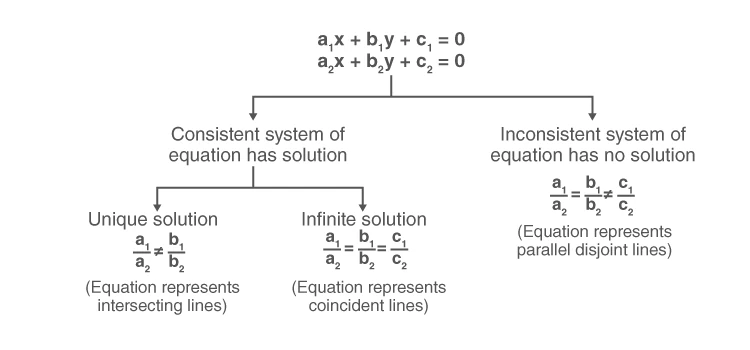
Visual representation of Cramer's rule for three-variable systems
Example: Solve a Three-Variable System Using Cramer's Rule
Find \(x, y, z\) for the system:
\[ \begin{cases} x + 2y + 3z = 14 \\ 2x - y + z = 3 \\ 3x + y - 2z = 1 \end{cases} \]
Solution:
Calculate \(\Delta\):
\[ \Delta = \begin{vmatrix} 1 & 2 & 3 \\ 2 & -1 & 1 \\ 3 & 1 & -2 \end{vmatrix} = 1 \times (-1 \times -2 - 1 \times 1) - 2 \times (2 \times -2 - 1 \times 3) + 3 \times (2 \times 1 - (-1) \times 3) \]
\[ = 1 \times (2 - 1) - 2 \times (-4 - 3) + 3 \times (2 + 3) = 1 \times 1 - 2 \times (-7) + 3 \times 5 = 1 + 14 + 15 = 30 \]
Calculate \(\Delta_1\):
\[ \Delta_1 = \begin{vmatrix} 14 & 2 & 3 \\ 3 & -1 & 1 \\ 1 & 1 & -2 \end{vmatrix} = 14 \times (-1 \times -2 - 1 \times 1) - 2 \times (3 \times -2 - 1 \times 1) + 3 \times (3 \times 1 - (-1) \times 1) \]
\[ = 14 \times (2 - 1) - 2 \times (-6 - 1) + 3 \times (3 + 1) = 14 \times 1 - 2 \times (-7) + 3 \times 4 = 14 + 14 + 12 = 40 \]
Calculate \(\Delta_2\):
\[ \Delta_2 = \begin{vmatrix} 1 & 14 & 3 \\ 2 & 3 & 1 \\ 3 & 1 & -2 \end{vmatrix} = 1 \times (3 \times -2 - 1 \times 1) - 14 \times (2 \times -2 - 1 \times 3) + 3 \times (2 \times 1 - 3 \times 3) \]
\[ = 1 \times (-6 - 1) - 14 \times (-4 - 3) + 3 \times (2 - 9) = -7 + 14 \times 7 + 3 \times (-7) = -7 + 98 - 21 = 70 \]
Calculate \(\Delta_3\):
\[ \Delta_3 = \begin{vmatrix} 1 & 2 & 14 \\ 2 & -1 & 3 \\ 3 & 1 & 1 \end{vmatrix} = 1 \times (-1 \times 1 - 3 \times 1) - 2 \times (2 \times 1 - 3 \times 3) + 14 \times (2 \times 1 - (-1) \times 3) \]
\[ = 1 \times (-1 - 3) - 2 \times (2 - 9) + 14 \times (2 + 3) = -4 - 2 \times (-7) + 14 \times 5 = -4 + 14 + 70 = 80 \]
Hence,
\[ x = \frac{40}{30} = \frac{4}{3}, \quad y = \frac{70}{30} = \frac{7}{3}, \quad z = \frac{80}{30} = \frac{8}{3} \]
Consistency and Special Cases in Linear Systems
Conditions for Infinite or No Solutions
When solving systems using determinants, the following cases arise:
If \(\Delta = 0\) and \(\Delta_1 = \Delta_2 = \Delta_3 = 0\), the system may have infinitely many solutions or none, depending on whether the parametric solutions satisfy all equations.
If \(\Delta = 0\) but not all \(\Delta_i\) are zero, the system has no solution (inconsistent).
For homogeneous systems where \(d_1 = d_2 = d_3 = 0\), the trivial solution \((0,0,0)\) always exists.
If a homogeneous system has nontrivial solutions, then \(\Delta = 0\) and infinite solutions exist.
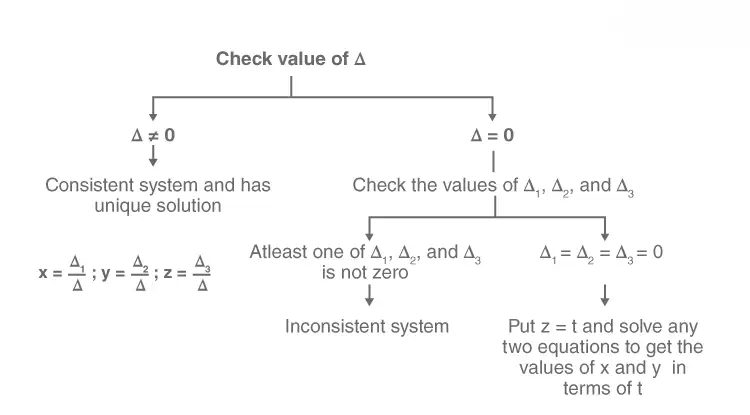
Flowchart illustrating solution conditions for linear systems
Example: Determine the Value of Parameter for Nontrivial Solutions
Find \(k\) such that the system has nontrivial solutions:
\[ \begin{cases} x + y - k z = 0 \\ 3x - y - 2z = 0 \\ x - y + 2z = 0 \end{cases} \]
Solution:
Calculate determinant \(\Delta\):
\[ \Delta = \begin{vmatrix} 1 & 1 & -k \\ 3 & -1 & -2 \\ 1 & -1 & 2 \end{vmatrix} \]
Perform row operations:
\[ R_1 \to R_1 + R_3, \quad R_2 \to R_2 - R_3 \]
Resulting matrix:
\[ \begin{vmatrix} 2 & 0 & -k + 2 \\ 2 & 0 & -4 \\ 1 & -1 & 2 \end{vmatrix} = 0 \]
Expanding along the second column:
\[ -(-1) \times \left( -8 - 2(2 - k) \right) = 0 \implies 2k - 12 = 0 \implies k = 6 \]
Substituting \(k=6\), the system becomes:
\[ \begin{cases} x + y - 6z = 0 \\ 3x - y - 2z = 0 \\ x - y + 2z = 0 \end{cases} \]
Adding first two equations:
\[ 4x - 8z = 0 \implies z = \frac{x}{2} \]
Substitute \(z\) into the first equation:
\[ x + y - 3x = 0 \implies y = 2x \]
General solution:
\[ x = t, \quad y = 2t, \quad z = \frac{t}{2}, \quad t \in \mathbb{R} \]
Matrix Inversion Method for Solving Linear Systems
Using Matrix Inverse to Find Solutions
A system of linear equations can be expressed in matrix form as:
\[ A X = B \]
where
\[ A = \begin{bmatrix} a_1 & b_1 & c_1 \\ a_2 & b_2 & c_2 \\ a_3 & b_3 & c_3 \end{bmatrix}, \quad X = \begin{bmatrix} x \\ y \\ z \end{bmatrix}, \quad B = \begin{bmatrix} d_1 \\ d_2 \\ d_3 \end{bmatrix} \]
If \(A\) is invertible, the solution is:
\[ X = A^{-1} B \]
Example: Solve Using Matrix Inversion
Solve the system:
\[ \begin{cases} 2x + y + 2z = 0 \\ 2x - y + z = 10 \\ x + 3y - z = 5 \end{cases} \]
Solution:
Matrix form:
\[ A = \begin{bmatrix} 2 & 1 & 2 \\ 2 & -1 & 1 \\ 1 & 3 & -1 \end{bmatrix}, \quad B = \begin{bmatrix} 0 \\ 10 \\ 5 \end{bmatrix} \]
Calculate \(|A|\):
\[ |A| = 2( -1 \times -1 - 1 \times 3 ) - 1( 2 \times -1 - 1 \times 1 ) + 2( 2 \times 3 - (-1) \times 1 ) = 2(1 - 3) - 1(-2 - 1) + 2(6 + 1) = -4 + 3 + 14 = 13 \]
Find adjoint of \(A\):
\[ \text{adj } A = \begin{bmatrix} -2 & 7 & 3 \\ 3 & -4 & 2 \\ 7 & -5 & -4 \end{bmatrix} \]
Compute inverse:
\[ A^{-1} = \frac{1}{13} \begin{bmatrix} -2 & 7 & 3 \\ 3 & -4 & 2 \\ 7 & -5 & -4 \end{bmatrix} \]
Multiply \(A^{-1} B\):
\[ X = \frac{1}{13} \begin{bmatrix} -2 & 7 & 3 \\ 3 & -4 & 2 \\ 7 & -5 & -4 \end{bmatrix} \begin{bmatrix} 0 \\ 10 \\ 5 \end{bmatrix} = \frac{1}{13} \begin{bmatrix} 0 + 70 + 15 \\ 0 - 40 + 10 \\ 0 - 50 - 20 \end{bmatrix} = \frac{1}{13} \begin{bmatrix} 85 \\ -30 \\ -70 \end{bmatrix} \]
Thus,
\[ x = \frac{85}{13}, \quad y = \frac{-30}{13}, \quad z = \frac{-70}{13} \]
Key Properties and Applications of Determinants
Important Theorems and Formulas
Three lines represented by equations \(a_i x + b_i y + c_i = 0\) for \(i=1,2,3\) are concurrent if the determinant \[ \begin{vmatrix} a_1 & b_1 & c_1 \\ a_2 & b_2 & c_2 \\ a_3 & b_3 & c_3 \end{vmatrix} = 0 \]
A second-degree equation \[ a x^2 + 2 h x y + b y^2 + 2 g x + 2 f y + c = 0 \] represents a pair of straight lines if \[ abc + 2 f g h - a f^2 - b g^2 - c h^2 = 0 \] which equals the determinant \[ \begin{vmatrix} a & h & g \\ h & b & f \\ g & f & c \end{vmatrix} = 0 \]
The area of a triangle with vertices \((x_r, y_r)\), \(r=1,2,3\), is \[ D = \frac{1}{2} \left| \begin{matrix} x_1 & y_1 & 1 \\ x_2 & y_2 & 1 \\ x_3 & y_3 & 1 \end{matrix} \right| \] If \(D=0\), the points are collinear.
The equation of a line passing through points \((x_1, y_1)\) and \((x_2, y_2)\) is given by \[ \left| \begin{matrix} x & y & 1 \\ x_1 & y_1 & 1 \\ x_2 & y_2 & 1 \end{matrix} \right| = 0 \]
If each element of a row or column is a sum of two terms, the determinant can be expressed as the sum of two determinants. For example, \[ \begin{vmatrix} a_1 + x & b_1 + y & c_1 + z \\ a_2 & b_2 & c_2 \\ a_3 & b_3 & c_3 \end{vmatrix} = \begin{vmatrix} a_1 & b_1 & c_1 \\ a_2 & b_2 & c_2 \\ a_3 & b_3 & c_3 \end{vmatrix} + \begin{vmatrix} x & y & z \\ a_2 & b_2 & c_2 \\ a_3 & b_3 & c_3 \end{vmatrix} \]
While performing operations on determinants, at least one row or column must remain unchanged. The maximum number of simultaneous operations is the order of the determinant minus one.
Summary Table: Determinants in Linear Systems
Concept | Definition/Formula | Condition |
|---|---|---|
Two-variable system determinant \(\Delta\) | \(\begin{vmatrix} a_1 & b_1 \\ a_2 & b_2 \end{vmatrix}\) | \(\Delta \neq 0\) for unique solution |
Three-variable system determinant \(\Delta\) | \(\begin{vmatrix} a_1 & b_1 & c_1 \\ a_2 & b_2 & c_2 \\ a_3 & b_3 & c_3 \end{vmatrix}\) | \(\Delta \neq 0\) for unique solution |
Infinite solutions condition | \(\Delta = 0\) and all \(\Delta_i = 0\) | Parametric solutions satisfy all equations |
No solution condition | \(\Delta = 0\) but some \(\Delta_i \neq 0\) | System inconsistent |
Area of triangle | \(D = \frac{1}{2} \left| \begin{matrix} x_1 & y_1 & 1 \\ x_2 & y_2 & 1 \\ x_3 & y_3 & 1 \end{matrix} \right|\) | \(D=0\) points are collinear |
Glossary of Key Terms
Term | Meaning |
|---|---|
Determinant | A scalar value computed from a square matrix, used to determine system solvability. |
Cramer's Rule | A method to solve linear systems using determinants. |
Homogeneous System | A system of linear equations with all constant terms zero. |
Trivial Solution | The zero solution \((0,0,0)\) for homogeneous systems. |
Nontrivial Solution | A solution other than the trivial one in homogeneous systems. |
Matrix Inverse | A matrix which, when multiplied by the original matrix, yields the identity matrix. |
Adjoint Matrix | The transpose of the cofactor matrix, used in finding the inverse. |
Consistency | Whether a system of equations has at least one solution. |
Concurrent Lines | Lines that intersect at a single point. |
Collinear Points | Points lying on the same straight line. |
Frequently Asked Questions
What condition ensures infinite solutions in a linear system?
If the ratios of coefficients satisfy \(\frac{a_1}{a_2} = \frac{b_1}{b_2} = \frac{c_1}{c_2}\), the system has infinitely many solutions.
How can we tell if a system has no solution?
If \(\frac{a_1}{a_2} = \frac{b_1}{b_2} \neq \frac{c_1}{c_2}\), the system is inconsistent and has no solution.
How to verify if three points are collinear?
Calculate the area determinant of the triangle formed by the points; if it equals zero, the points are collinear.
When is Cramer's rule applicable?
Cramer's rule applies when the determinant \(\Delta\) of the coefficient matrix is non-zero, ensuring a unique solution.
What is the significance of the matrix inverse in solving linear systems?
The matrix inverse allows solving \(AX = B\) by computing \(X = A^{-1}B\), provided \(A^{-1}\) exists.
Practice Problems on Systems of Linear Equations Using Determinants
Problem 1
Solve the system using Cramer's rule:
\[ \begin{cases} 2x + 3y + z = 7 \\ x - y + 4z = 3 \\ 3x + y - 2z = 4 \end{cases} \]
Solution: Calculate \(\Delta\), \(\Delta_1\), \(\Delta_2\), \(\Delta_3\) and find \(x, y, z\) accordingly.
Problem 2
Find \(x\) and \(y\) from:
\[ \frac{5}{x+2} + \frac{4}{y+3} = 2, \quad \frac{7}{x+2} - \frac{3}{y+3} = 1 \]
Solution: Substitute \(a = \frac{1}{x+2}\), \(b = \frac{1}{y+3}\), form linear equations in \(a, b\), then solve using determinants.
Problem 3
For what value of \(m\) does the system have nontrivial solutions?
\[ \begin{cases} x + 2y - m z = 0 \\ 4x - y + 3z = 0 \\ 2x - 3y + 5z = 0 \end{cases} \]
Solution: Set determinant of coefficients to zero and solve for \(m\).