Comprehensive Guide to Relations and Functions
Understanding Relations and Their Classifications
Fundamentals of Relations Between Sets
A relation establishes a connection between elements of two non-empty sets by pairing elements from the first set with those of the second. Formally, a relation from set \( A \) to set \( B \) is a subset of the Cartesian product \( A \times B \), where each ordered pair \((x, y)\) represents a link between \( x \in A \) and \( y \in B \).
When the relation is defined on a single set \( A \), it is a subset of \( A \times A \), and such relations can exhibit special properties that classify them further.
Categories of Relations and Their Properties
Relations on a set \( A \) can be categorized based on their characteristics:
Empty Relation: No elements of \( A \) relate to any other, i.e., \( R = \varnothing \subset A \times A \).
Universal Relation: Every element of \( A \) relates to every element, i.e., \( R = A \times A \).
Reflexive Relation: Every element relates to itself, meaning \((a, a) \in R\) for all \( a \in A \).
Symmetric Relation: If \((a, b) \in R\), then \((b, a) \in R\) for all \( a, b \in A \).
Transitive Relation: If \((a, b) \in R\) and \((b, c) \in R\), then \((a, c) \in R\) for all \( a, b, c \in A \).
Equivalence Relation: A relation that is reflexive, symmetric, and transitive simultaneously.
Example: Verifying an Equivalence Relation on Integers
Consider the relation \( R \) on the set of integers \( \mathbb{Z} \) defined by:
\[ R = \{(a, b) \in \mathbb{Z} \times \mathbb{Z} : 3 \text{ divides } (a - b)\} \]
Show that \( R \) is an equivalence relation.
Solution:
Reflexive: For any \( a \in \mathbb{Z} \), \( a - a = 0 \) which is divisible by 3, so \((a, a) \in R\).
Symmetric: If \((a, b) \in R\), then 3 divides \( a - b \). Hence, 3 divides \( b - a = -(a - b) \), so \((b, a) \in R\).
Transitive: If \((a, b) \in R\) and \((b, c) \in R\), then 3 divides both \( a - b \) and \( b - c \). Adding these, 3 divides \( (a - b) + (b - c) = a - c \), so \((a, c) \in R\).
Thus, \( R \) satisfies all three properties and is an equivalence relation.
Exploring Functions and Their Varieties
Defining Functions as Special Relations
A function is a particular type of relation where each element of the domain is associated with exactly one element in the codomain. Formally, a function \( f \) from set \( A \) to set \( B \) is a subset of \( A \times B \) such that for every \( a \in A \), there exists a unique \( b \in B \) with \((a, b) \in f\).
This uniqueness ensures that no two ordered pairs in \( f \) have the same first element but different second elements.
Classification of Functions Based on Mapping Characteristics
Functions can be categorized as follows:
Injective (One-to-One): Distinct elements in the domain map to distinct elements in the codomain. Formally, if \( f(x_1) = f(x_2) \), then \( x_1 = x_2 \).
Surjective (Onto): Every element in the codomain is an image of at least one element from the domain.
Bijective: A function that is both injective and surjective, establishing a perfect pairing between domain and codomain.
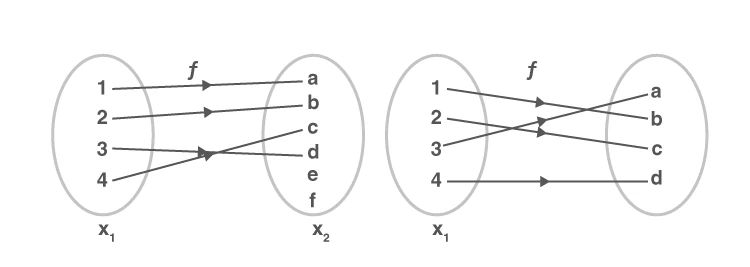
Illustration of a One-to-One Function
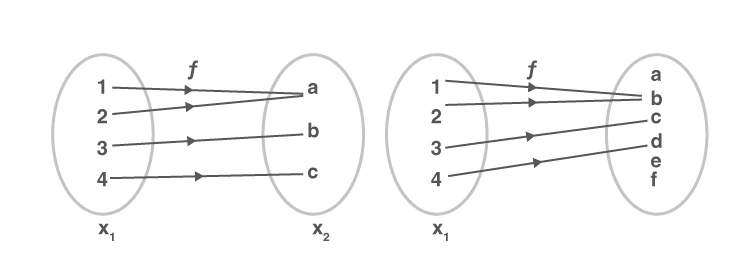
Representation of a Many-to-One Function
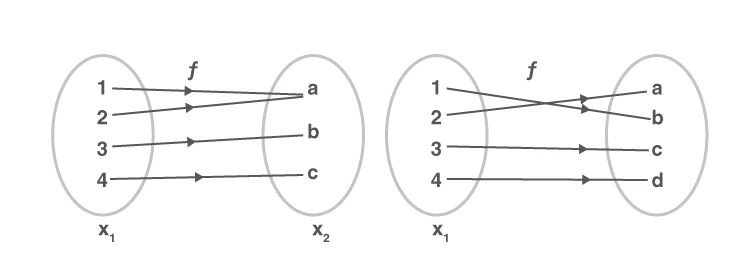
Example of an Onto Function

Bijective Function Illustration
Example: Identifying Function Types
Consider the function \( f: \{1, 2, 3, 4\} \to \{a, b, c, d\} \) defined by:
\[ f(1) = a, \quad f(2) = b, \quad f(3) = b, \quad f(4) = d \]
Determine whether \( f \) is injective, surjective, or bijective.
Solution:
Since \( f(2) = f(3) = b \), two distinct domain elements map to the same codomain element, so \( f \) is not injective.
The codomain elements \( a, b, d \) are images, but \( c \) is not mapped to by any domain element, so \( f \) is not surjective.
Therefore, \( f \) is neither injective nor surjective, and hence not bijective.
Function Composition, Invertibility, and Binary Operations
Combining Functions Through Composition
Given two functions \( f: A \to B \) and \( g: B \to C \), their composition \( g \circ f \) is a function from \( A \) to \( C \) defined by:
\[ (g \circ f)(x) = g(f(x)) \quad \text{for all } x \in A \]
This operation allows chaining of functions, where the output of \( f \) becomes the input of \( g \).
Example: Calculating a Composite Function
Let \( f: \{1, 2, 3\} \to \{4, 5, 6\} \) and \( g: \{4, 5, 6\} \to \{7, 8, 9\} \) be defined as:
\[ f(1) = 4, \quad f(2) = 5, \quad f(3) = 6 \]
\[ g(4) = 7, \quad g(5) = 8, \quad g(6) = 9 \]
Find \( (g \circ f)(2) \) and \( (g \circ f)(3) \).
Solution:
\( (g \circ f)(2) = g(f(2)) = g(5) = 8 \)
\( (g \circ f)(3) = g(f(3)) = g(6) = 9 \)
Invertible Functions and Their Characteristics
A function \( f: X \to Y \) is invertible if there exists a function \( g: Y \to X \) such that:
\[ g \circ f = I_X \quad \text{and} \quad f \circ g = I_Y \]
where \( I_X \) and \( I_Y \) are identity functions on \( X \) and \( Y \) respectively. The function \( g \) is called the inverse of \( f \), denoted \( f^{-1} \).
Invertibility implies that \( f \) is bijective, and conversely, every bijection has an inverse function.
Binary Operations on Sets
A binary operation on a set \( A \) is a function \( *: A \times A \to A \) that assigns to each ordered pair \((a, b)\) in \( A \times A \) an element \( a * b \) in \( A \). This operation combines two elements of the set to produce another element within the same set.
Example: Checking Binary Operations on Natural Numbers
Determine whether subtraction and division are binary operations on the set of natural numbers \( \mathbb{N} \).
Solution:
Subtraction: For \( (2, 5) \in \mathbb{N} \times \mathbb{N} \), \( 2 - 5 = -3 \notin \mathbb{N} \). Hence, subtraction is not a binary operation on \( \mathbb{N} \).
Division: For \( (2, 5) \in \mathbb{N} \times \mathbb{N} \), \( 2 \div 5 = \frac{2}{5} \notin \mathbb{N} \). Thus, division is not a binary operation on \( \mathbb{N} \).
Quick Reference Summary
Concept | Definition | Key Property |
|---|---|---|
Relation | Subset of \( A \times B \) linking elements of two sets | Can be reflexive, symmetric, transitive |
Function | Relation with unique output for each input | Each domain element maps to exactly one codomain element |
Injective | Distinct inputs have distinct outputs | One-to-one mapping |
Surjective | Every codomain element is an image of some domain element | Onto mapping |
Bijective | Both injective and surjective | Invertible function |
Composition | Combining two functions \( g \circ f \) | \( (g \circ f)(x) = g(f(x)) \) |
Invertible Function | Function with an inverse \( f^{-1} \) | Must be bijective |
Binary Operation | Function \( *: A \times A \to A \) | Combines two elements to produce another in the same set |
Glossary of Key Terms
Term | Meaning |
|---|---|
Relation | A set of ordered pairs linking elements of two sets |
Function | A relation with exactly one output for each input |
Domain | The set of all possible inputs of a function |
Codomain | The set into which all outputs of a function are constrained |
Range | The actual set of outputs produced by a function |
Injective | Function where distinct inputs map to distinct outputs |
Surjective | Function where every element of codomain is an output |
Bijective | Function that is both injective and surjective |
Composition | Applying one function to the result of another |
Binary Operation | Operation combining two elements of a set to produce another |
Frequently Asked Questions
What distinguishes a function from a general relation?
A function assigns exactly one output to each input, whereas a general relation may associate multiple outputs or none to an input.
How can we verify if a function is invertible?
A function is invertible if it is both one-to-one (injective) and onto (surjective), ensuring a unique inverse function exists.
What is the significance of equivalence relations?
Equivalence relations partition a set into disjoint classes where elements are related in a reflexive, symmetric, and transitive manner.
Can subtraction be considered a binary operation on integers?
Yes, subtraction is a binary operation on integers since subtracting any two integers results in another integer.
Why is function composition important in mathematics?
Function composition allows building complex functions from simpler ones, facilitating analysis and problem-solving in various fields.