Comprehensive Guide to Integral Calculus: Concepts, Methods, and Applications
Fundamentals of Integral Calculus and Its Relationship with Differentiation
Understanding the Concept of Integration as an Inverse Process
Integral calculus focuses on the study of integrals and their characteristics. It serves as the reverse operation of differentiation, allowing us to retrieve the original function from its derivative. The connection between integral and differential calculus is established through the fundamental theorem of calculus, which bridges these two branches seamlessly.
In essence, if a function \( f \) is differentiable within a certain domain, its derivative \( f' \) can be used to recover \( f \) by integration. This process of finding the original function from its derivative is called anti-differentiation or integration.
Example: Finding an Antiderivative
Suppose the derivative of a function is given by \( f'(x) = 4x^3 \). Determine the original function \( f(x) \).
Solution:
We know that integrating \( f'(x) \) will give us \( f(x) \):
\[ f(x) = \int 4x^3 \, dx = 4 \int x^3 \, dx \]
Using the power rule for integration:
\[ \int x^n \, dx = \frac{x^{n+1}}{n+1} + C \]
So,
\[ f(x) = 4 \times \frac{x^{4}}{4} + C = x^{4} + C \]
Here, \( C \) is the constant of integration representing infinitely many possible original functions differing by a constant.
Classification and Characteristics of Integrals
Distinguishing Between Definite and Indefinite Integrals
Integrals are broadly categorized into two types based on the presence or absence of limits:
Definite Integrals: These integrals have specified upper and lower limits, representing the accumulation of quantities over an interval. They are often used to calculate areas under curves and are also known as Riemann integrals when defined on the real line.
Indefinite Integrals: These integrals do not have limits and represent a family of functions whose derivatives equal the integrand. They include an arbitrary constant \( C \) to account for all possible antiderivatives.
The notation for a definite integral from \( a \) to \( b \) is:
\[ \int_{a}^{b} f(x) \, dx \]
While an indefinite integral is expressed as:
\[ \int f(x) \, dx = F(x) + C \]
where \( F(x) \) is an antiderivative of \( f(x) \).
Example: Evaluating a Definite Integral
Calculate the definite integral \( \int_{1}^{3} (2x + 1) \, dx \).
Solution:
First, find the antiderivative of the integrand:
\[ \int (2x + 1) \, dx = \int 2x \, dx + \int 1 \, dx = x^{2} + x + C \]
Now, apply the limits:
\[ \int_{1}^{3} (2x + 1) \, dx = \left[ x^{2} + x \right]_{1}^{3} = (3^{2} + 3) - (1^{2} + 1) = (9 + 3) - (1 + 1) = 12 - 2 = 10 \]
The value of the definite integral is 10.
Techniques for Computing Integrals
Common Methods to Determine Integrals of Functions
Integral calculus employs various strategies to evaluate integrals depending on the function's complexity. The most frequently used techniques include:
Integration by Substitution: Simplifies the integral by substituting a part of the integrand with a new variable.
Integration by Parts: Based on the product rule of differentiation, useful for integrating products of functions.
Partial Fraction Decomposition: Breaks down rational functions into simpler fractions to integrate easily.
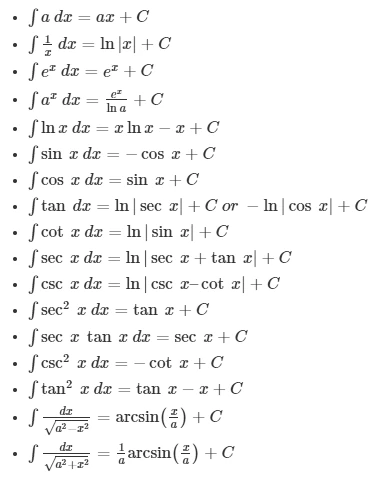
Key integral formulas and methods for integration
Example: Integration Using Substitution
Evaluate the integral \( \int x \cos(x^{2}) \, dx \).
Solution:
Let us use substitution:
Set \( u = x^{2} \), then \( du = 2x \, dx \) or \( \frac{du}{2} = x \, dx \).
Rewrite the integral:
\[ \int x \cos(x^{2}) \, dx = \int \cos(u) \times \frac{du}{2} = \frac{1}{2} \int \cos(u) \, du \]
Integrate:
\[ \frac{1}{2} \sin(u) + C = \frac{1}{2} \sin(x^{2}) + C \]
Practical Applications of Integral Calculus
Utilizing Integration in Real-World Problems
Integral calculus is instrumental in solving various practical problems, including:
Determining the original function from its derivative.
Calculating the area beneath curves, including signed areas.
Finding the area between two curves.
Computing the center of mass of objects.
Evaluating kinetic energy and work done by forces.
Calculating surface areas and volumes of solids.
Analyzing distance, velocity, and acceleration in motion.
Determining the average value of functions over intervals.
Example: Area Under a Curve Using Definite Integral
Find the area under the curve \( y = \sin x \) from \( x = 0 \) to \( x = \pi \).
Solution:
The area is given by the definite integral:
\[ \int_{0}^{\pi} \sin x \, dx \]
We know the antiderivative of \( \sin x \) is \( -\cos x \), so:
\[ \int_{0}^{\pi} \sin x \, dx = [-\cos x]_{0}^{\pi} = (-\cos \pi) - (-\cos 0) = -(-1) - (-1) = 1 + 1 = 2 \]
Thus, the area under the curve is 2 square units.
Illustrative Problems Demonstrating Integral Calculus Concepts
Step-by-Step Solutions to Typical Integral Calculus Questions
Example 1: Integrating a Power Function
Calculate the integral of \( f(x) = x^{\frac{3}{2}} \).
Solution:
Express the integral:
\[ \int x^{\frac{3}{2}} \, dx \]
Using the power rule:
\[ \int x^{n} \, dx = \frac{x^{n+1}}{n+1} + C \]
Here, \( n = \frac{3}{2} \), so:
\[ \int x^{\frac{3}{2}} \, dx = \frac{x^{\frac{3}{2} + 1}}{\frac{3}{2} + 1} + C = \frac{x^{\frac{5}{2}}}{\frac{5}{2}} + C = \frac{2}{5} x^{\frac{5}{2}} + C \]
Example 2: Integral of a Trigonometric Function
Find the integral of \( f(t) = \cos 3t \) with respect to \( t \).
Solution:
Recall the integral formula:
\[ \int \cos(at) \, dt = \frac{\sin(at)}{a} + C \]
Applying this,
\[ \int \cos 3t \, dt = \frac{\sin 3t}{3} + C \]
Example 3: Definite Integral of a Sine Function
Evaluate \( \int_{0}^{\frac{\pi}{2}} \sin 2x \, dx \).
Solution:
The antiderivative of \( \sin 2x \) is:
\[ \int \sin 2x \, dx = -\frac{\cos 2x}{2} + C \]
Applying the limits:
\[ \int_{0}^{\frac{\pi}{2}} \sin 2x \, dx = \left[-\frac{\cos 2x}{2}\right]_{0}^{\frac{\pi}{2}} = \left(-\frac{\cos \pi}{2}\right) - \left(-\frac{\cos 0}{2}\right) = \left(-\frac{-1}{2}\right) - \left(-\frac{1}{2}\right) = \frac{1}{2} + \frac{1}{2} = 1 \]
Quick Reference: Essential Integral Calculus Formulas
Function \( f(x) \) | Integral \( \int f(x) \, dx \) |
|---|---|
\( x^{n} \) (where \( n \neq -1 \)) | \( \frac{x^{n+1}}{n+1} + C \) |
\( \frac{1}{x} \) | \( \ln|x| + C \) |
\( e^{ax} \) | \( \frac{1}{a} e^{ax} + C \) |
\( \sin ax \) | \( -\frac{1}{a} \cos ax + C \) |
\( \cos ax \) | \( \frac{1}{a} \sin ax + C \) |
\( \sec^{2} x \) | \( \tan x + C \) |
\( \csc^{2} x \) | \( -\cot x + C \) |
\( \sec x \tan x \) | \( \sec x + C \) |
\( \csc x \cot x \) | \( -\csc x + C \) |
\( \frac{1}{\sqrt{a^{2} - x^{2}}} \) | \( \sin^{-1} \frac{x}{a} + C \) |
Glossary of Key Terms in Integral Calculus
Term | Definition |
|---|---|
Integral | The mathematical object representing the area under a curve or the antiderivative of a function. |
Antiderivative | A function whose derivative is the given function. |
Definite Integral | An integral with specified upper and lower limits, representing a numerical value. |
Indefinite Integral | An integral without limits, representing a family of functions plus a constant. |
Integrand | The function being integrated. |
Constant of Integration | An arbitrary constant added to indefinite integrals to represent all antiderivatives. |
Integration by Substitution | A method to simplify integrals by changing variables. |
Integration by Parts | A technique based on the product rule to integrate products of functions. |
Partial Fractions | A method to decompose rational functions into simpler fractions for integration. |
Fundamental Theorem of Calculus | Connects differentiation and integration, showing they are inverse processes. |
Frequently Asked Questions on Integral Calculus
What is the main purpose of integral calculus?
Integral calculus primarily helps in finding the original function from its derivative and calculating areas under curves.
How does a definite integral differ from an indefinite integral?
A definite integral has specific limits and results in a numerical value, while an indefinite integral represents a family of functions including a constant.
Why is the constant of integration important?
Because differentiation of a constant is zero, the constant of integration accounts for all possible antiderivatives differing by a constant.
What are common methods to solve integrals?
Common techniques include substitution, integration by parts, and partial fraction decomposition.
Can integral calculus be applied in physics?
Yes, it is widely used to calculate quantities like work, kinetic energy, and center of mass in physics.