Comprehensive Guide to Indefinite Integrals in Calculus
Fundamentals of Integration and Its Role in Calculus
Understanding the Concept of Antiderivatives and Integration
In calculus, differentiation and integration are two core operations that are inversely related. Differentiation involves finding the derivative of a function, which represents its rate of change. Conversely, integration is the process of determining the original function given its derivative, known as the antiderivative or primitive function. The collection of all such antiderivatives is expressed through the indefinite integral.
When a function \( f \) is differentiable over an interval \( I \), its derivative \( f' \) exists at every point within \( I \). The question arises: can we retrieve the original function from its derivative? The answer lies in integration, which provides the family of functions whose derivatives equal \( f' \). This family is represented as the indefinite integral of \( f \).
Example 1: Finding an Antiderivative
Determine the indefinite integral of the function \( f(x) = 4x^3 - 5x + 2 \).
Solution:
We integrate each term separately:
\[ \int (4x^3 - 5x + 2) \, dx = \int 4x^3 \, dx - \int 5x \, dx + \int 2 \, dx \]
\[ = 4 \cdot \frac{x^4}{4} - 5 \cdot \frac{x^2}{2} + 2x + C = x^4 - \frac{5}{2}x^2 + 2x + C \]
Here, \( C \) is the constant of integration representing the infinite family of antiderivatives.
Key Properties of Indefinite Integrals
Inverse Relationship Between Differentiation and Integration
Integration and differentiation are inverse operations. If \( F(x) \) is an antiderivative of \( f(x) \), then differentiating \( F(x) \) returns \( f(x) \). This is expressed as:
\[ \frac{d}{dx} \left( \int f(x) \, dx \right) = f(x) \]
and conversely,
\[ \int \frac{d}{dx} F(x) \, dx = F(x) + C \]
where \( C \) is an arbitrary constant.
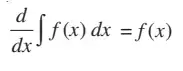
Illustration of differentiation and integration as inverse processes
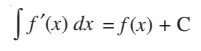
Integral of derivative equals original function plus constant
Example 2: Verifying the Inverse Property
Given \( F(x) = x^3 + 5 \), show that differentiating the indefinite integral of \( f(x) = 3x^2 \) returns \( f(x) \).
Solution:
Since \( F(x) \) is an antiderivative of \( f(x) \),
\[ \int 3x^2 \, dx = x^3 + C \]
Differentiating both sides with respect to \( x \):
\[ \frac{d}{dx} (x^3 + C) = 3x^2 \]
This confirms the inverse relationship, as the derivative of the integral returns the original function.
Equivalence of Indefinite Integrals with Identical Derivatives
If two functions \( f \) and \( g \) have the same derivative, their indefinite integrals differ only by a constant. Formally, if \( f'(x) = g'(x) \), then:
\[ \int f(x) \, dx = \int g(x) \, dx + C \]
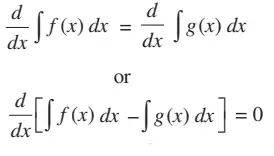
Functions with identical derivatives differ by a constant
Linearity of the Indefinite Integral
The integral of a sum of functions equals the sum of their integrals. For functions \( f \) and \( g \):
\[ \int [f(x) + g(x)] \, dx = \int f(x) \, dx + \int g(x) \, dx \]

Integral distributes over addition
Power Rule for Integration
For any real number \( p \neq -1 \), the integral of \( x^p \) is:
\[ \int x^p \, dx = \frac{x^{p+1}}{p+1} + C \]
In short, it shows how the probability is related to the integral of a function.
Power rule for indefinite integrals
Example 3: Applying the Power Rule
Calculate the indefinite integral of \( f(x) = 7x^4 \).
Solution:
Using the power rule:
\[ \int 7x^4 \, dx = 7 \int x^4 \, dx = 7 \cdot \frac{x^{5}}{5} + C = \frac{7}{5} x^{5} + C \]
Scalar Multiplication in Integration
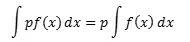
For constants \( p_1, p_2, \ldots, p_n \) and functions \( f_1, f_2, \ldots, f_n \), the integral of their linear combination is:
\[ \int \left( p_1 f_1(x) + p_2 f_2(x) + \cdots + p_n f_n(x) \right) dx = p_1 \int f_1(x) dx + p_2 \int f_2(x) dx + \cdots + p_n \int f_n(x) dx \]
Essential Indefinite Integral Formulas and Applications
Common Indefinite Integral Formulas
Below is a collection of frequently used indefinite integral formulas that serve as a foundation for solving integration problems:
Integral Expression | Result |
|---|---|
\( \int 1 \, dx \) | \( x + C \) |
\( \int a \, dx \) | \( a x + C \) |
\( \int x^n \, dx \), \( n \neq -1 \) | \( \frac{x^{n+1}}{n+1} + C \) |
\( \int \sin x \, dx \) | \( -\cos x + C \) |
\( \int \cos x \, dx \) | \( \sin x + C \) |
\( \int \sec^2 x \, dx \) | \( \tan x + C \) |
\( \int \csc^2 x \, dx \) | \( -\cot x + C \) |
\( \int \sec x \tan x \, dx \) | \( \sec x + C \) |
\( \int \csc x \cot x \, dx \) | \( -\csc x + C \) |
\( \int \frac{1}{x} \, dx \) | \( \ln |x| + C \) |
\( \int e^x \, dx \) | \( e^x + C \) |
\( \int a^x \, dx \), \( a > 0, a \neq 1 \) | \( \frac{a^x}{\ln a} + C \) |
Worked Examples Using Indefinite Integrals
Example 4: Integrating a Polynomial Expression
Evaluate the indefinite integral:
\[ \int (5x^4 - 12x + 9) \, dx \]
Solution:
Integrate each term individually:
\[ \int 5x^4 \, dx - \int 12x \, dx + \int 9 \, dx = 5 \cdot \frac{x^5}{5} - 12 \cdot \frac{x^2}{2} + 9x + C \]
Simplifying:
\[ x^5 - 6x^2 + 9x + C \]
Example 5: Finding a Function from Its Derivative
Given \( f'(x) = 8x^7 - 15x^3 + 4x + 10 \), find \( f(x) \).
Solution:
Since integration is the reverse of differentiation,
\[ f(x) = \int f'(x) \, dx = \int (8x^7 - 15x^3 + 4x + 10) \, dx \]
Integrate term-wise:
\[ = 8 \cdot \frac{x^8}{8} - 15 \cdot \frac{x^4}{4} + 4 \cdot \frac{x^2}{2} + 10x + C = x^8 - \frac{15}{4} x^4 + 2x^2 + 10x + C \]
Distinguishing Indefinite and Definite Integrals
An indefinite integral represents a family of functions and includes an arbitrary constant \( C \). In contrast, a definite integral calculates the exact area under a curve between two specified limits and results in a numerical value. The figure below visually contrasts these two integral types.
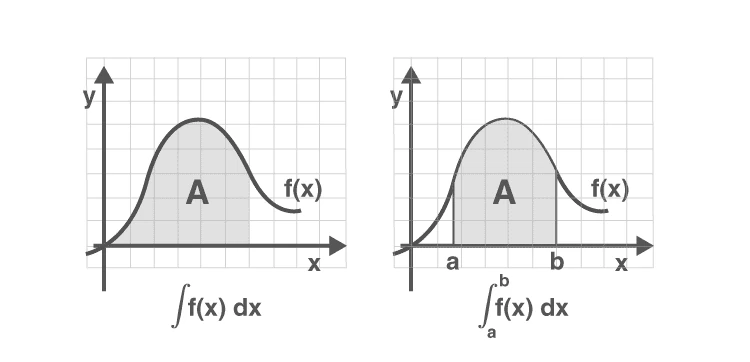
Visual comparison of definite and indefinite integrals
Summary Table: Quick Reference for Indefinite Integrals
Concept | Explanation | Formula/Example |
|---|---|---|
Indefinite Integral | Integral without limits representing antiderivatives | \( \int f(x) \, dx = F(x) + C \) |
Inverse Property | Differentiation reverses integration | \( \frac{d}{dx} \left( \int f(x) \, dx \right) = f(x) \) |
Linearity | Integral of sum equals sum of integrals | \( \int (f + g) \, dx = \int f \, dx + \int g \, dx \) |
Power Rule | Integral of \( x^n \) for \( n \neq -1 \) | \( \int x^n \, dx = \frac{x^{n+1}}{n+1} + C \) |
Constant Multiple | Constants factor out of integrals | \( \int a f(x) \, dx = a \int f(x) \, dx \) |
Trigonometric Integrals | Integrals of sine, cosine, and related functions | \( \int \sin x \, dx = -\cos x + C \) |
Logarithmic Integral | Integral of reciprocal function | \( \int \frac{1}{x} \, dx = \ln |x| + C \) |
Exponential Integral | Integral of exponential functions | \( \int e^x \, dx = e^x + C \) |
Arbitrary Constant | Represents infinite family of antiderivatives | \( + C \) |
Glossary of Key Terms in Integration
Term | Definition |
|---|---|
Antiderivative | A function whose derivative is the given function. |
Indefinite Integral | Integral without limits representing all antiderivatives of a function. |
Definite Integral | Integral with upper and lower limits giving a numerical value. |
Integration Constant (C) | An arbitrary constant added to indefinite integrals. |
Power Rule | Formula for integrating functions of the form \( x^n \). |
Linearity | Property that integral of sum equals sum of integrals. |
Primitive Function | Another term for antiderivative. |
Derivative | Rate of change of a function with respect to a variable. |
Trigonometric Integral | Integral involving sine, cosine, and related functions. |
Exponential Function | Function of the form \( e^x \) or \( a^x \). |
Frequently Asked Questions on Indefinite Integrals
How is the indefinite integral of a function determined?
The indefinite integral is found by identifying the antiderivative of the function, often using standard integration formulas and adding an arbitrary constant \( C \).
What does the indefinite integral represent?
It represents a family of functions whose derivatives equal the original function, differing only by a constant.
Are indefinite integrals and antiderivatives the same?
Yes, the indefinite integral is the general form of the antiderivative, including the constant of integration.
Do definite integrals include the constant \( C \)?
No, definite integrals evaluate to a specific numerical value and do not include the constant of integration.
Why do indefinite integrals not have limits?
Because they represent a general family of functions rather than a specific area or value, indefinite integrals do not have upper or lower bounds.