Understanding Exponential and Logarithmic Functions
Fundamentals of Exponential Functions
Defining Exponential Functions and Their Characteristics
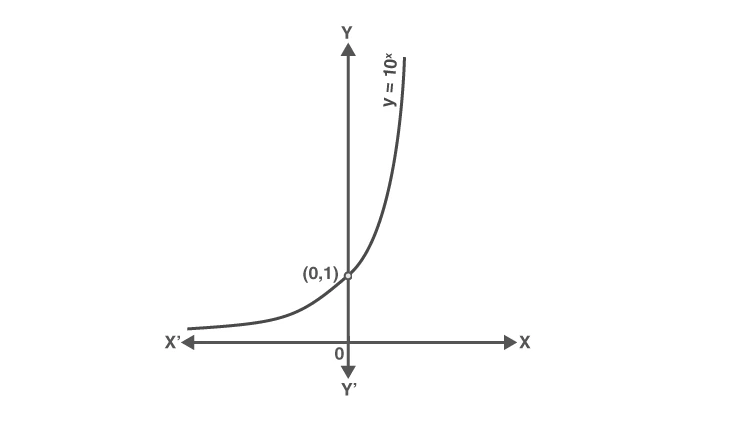
An exponential function is expressed as \( y = f(x) = b^x \), where \( x \) is the variable and \( b \) is a constant base greater than 1. The base \( b \) determines the growth rate of the function. A special and widely used base is the transcendental number \( e \approx 2.71828 \), which leads to the natural exponential function \( y = e^x \). When the base is 10, the function is known as the common exponential function.
Key features of exponential functions include:
- The domain encompasses all real numbers \( \mathbb{R} \).
- The range consists of all positive real numbers \( (0, \infty) \).
- The graph always passes through the point \( (0,1) \) since \( b^0 = 1 \) for any valid base \( b \).
- The function is strictly increasing, meaning the graph rises as \( x \) increases.
- For large negative values of \( x \), the function approaches zero but never touches the x-axis, indicating a horizontal asymptote at \( y=0 \).
Example:
Calculate the value of the exponential function \( y = 3^x \) at \( x = 4 \).
Solution:
Substitute \( x = 4 \) into the function:
\[ y = 3^4 = 3 \times 3 \times 3 \times 3 = 81 \]
Therefore, \( y = 81 \) when \( x = 4 \).
Exploring Logarithmic Functions and Their Properties
Understanding Logarithms as Inverses of Exponentials
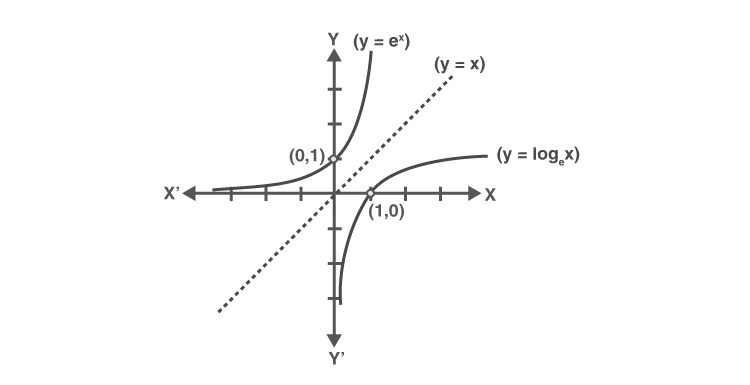
A logarithmic function is the inverse of an exponential function. For a base \( b > 1 \), the logarithm of a positive number \( a \) to the base \( b \) is the exponent \( x \) such that \( b^x = a \). This is written as \( \log_b a = x \).
Formally, the logarithmic function is defined as:
\[ \log_b : \mathbb{R}^+ \to \mathbb{R}, \quad x \mapsto \log_b x = y \text{ if } b^y = x \]
Special cases include the common logarithm with base 10 and the natural logarithm with base \( e \), denoted as \( \ln x \).
Important characteristics of logarithmic functions are:
- The domain is the set of positive real numbers \( \mathbb{R}^+ \).
- The range covers all real numbers \( \mathbb{R} \).
- The graph passes through the point \( (1,0) \) since \( \log_b 1 = 0 \).
- The function is strictly increasing.
- As \( x \) approaches zero from the right, the function decreases without bound, approaching negative infinity, indicating a vertical asymptote at \( x=0 \).
Example:
Find \( \log_2 16 \).
Solution:
We want to find \( x \) such that \( 2^x = 16 \).
Since \( 16 = 2^4 \), it follows that \( x = 4 \).
Therefore, \( \log_2 16 = 4 \).
Rules and Differentiation of Exponential and Logarithmic Functions
Essential Formulas and Derivatives
Exponential and logarithmic functions follow specific algebraic rules that simplify calculations:
- \( a^x \cdot a^y = a^{x+y} \)
- \( \frac{a^x}{a^y} = a^{x-y} \)
- \( (a^x)^y = a^{xy} \)
- \( a^x \cdot b^x = (ab)^x \)
- \( \left(\frac{a}{b}\right)^x = \frac{a^x}{b^x} \)
- \( a^0 = 1 \)
- \( a^{-x} = \frac{1}{a^x} \)
- \( \log_b (xy) = \log_b x + \log_b y \)
- \( \log_b \left(\frac{x}{y}\right) = \log_b x - \log_b y \)
- \( \log_b (x^m) = m \log_b x \)
- \( \log_a p = \frac{\log_b p}{\log_b a} \)
- \( \log_b 1 = 0 \)
- \( \log_b b = 1 \)
- \( \log_b b^x = x \)
The derivatives of these functions are fundamental in calculus:
- The derivative of the natural exponential function \( e^x \) with respect to \( x \) is:
\[ \frac{d}{dx} e^x = e^x \]
- The derivative of the natural logarithm \( \ln x \) for \( x > 0 \) is:
\[ \frac{d}{dx} \ln x = \frac{1}{x} \]
Using these, derivatives of more complex functions can be found by applying chain and product rules.
Example:
Find the derivative of \( y = \ln(\ln x) \) for \( x > 1 \).
Solution:
Let \( u = \ln x \), then \( y = \ln u \).
Using the chain rule:
\[ \frac{dy}{dx} = \frac{1}{u} \cdot \frac{du}{dx} = \frac{1}{\ln x} \cdot \frac{1}{x} = \frac{1}{x \ln x} \]
Example:
Compute the derivative of \( y = e^{x^3} \).
Solution:
Apply the chain rule:
\[ \frac{dy}{dx} = e^{x^3} \cdot \frac{d}{dx} (x^3) = e^{x^3} \cdot 3x^2 \]
Summary of Key Concepts
| Concept | Domain | Range | Key Point |
|---|---|---|---|
| Exponential Function \( b^x \) | \( \mathbb{R} \) | \( (0, \infty) \) | Passes through (0,1), strictly increasing, horizontal asymptote at \( y=0 \) |
| Logarithmic Function \( \log_b x \) | \( (0, \infty) \) | \( \mathbb{R} \) | Passes through (1,0), strictly increasing, vertical asymptote at \( x=0 \) |
| Derivative of \( e^x \) | \( \mathbb{R} \) | \( (0, \infty) \) | \( \frac{d}{dx} e^x = e^x \) |
| Derivative of \( \ln x \) | \( (0, \infty) \) | \( \mathbb{R} \) | \( \frac{d}{dx} \ln x = \frac{1}{x} \) |
Glossary of Important Terms
| Term | Definition |
|---|---|
| Exponential Function | A function of the form \( y = b^x \) where \( b > 1 \). |
| Logarithm | The inverse operation of exponentiation, \( \log_b a = x \) if \( b^x = a \). |
| Natural Exponential | Exponential function with base \( e \), written as \( e^x \). |
| Natural Logarithm | Logarithm with base \( e \), denoted as \( \ln x \). |
| Domain | The set of all possible input values for a function. |
| Range | The set of all possible output values of a function. |
| Derivative | The rate at which a function changes with respect to its variable. |
| Horizontal Asymptote | A horizontal line that the graph of a function approaches but never touches. |
| Vertical Asymptote | A vertical line that the graph of a function approaches but never crosses. |
| Chain Rule | A differentiation rule for composite functions. |
Frequently Asked Questions
What is the difference between exponential and logarithmic functions?
Exponential functions involve raising a base to a variable exponent, while logarithmic functions are the inverse, finding the exponent given the base and result.
Why is the base \( e \) important in exponential functions?
The base \( e \) is a natural constant that simplifies calculus operations, especially differentiation and integration of exponential and logarithmic functions.
Can logarithms be defined for zero or negative numbers?
No, logarithms are only defined for positive real numbers because the exponential function's range is positive real numbers.
How do you differentiate \( e^{ax} \) where \( a \) is a constant?
The derivative is \( a e^{ax} \), applying the chain rule to the exponential function.
What is the significance of the point (0,1) on exponential graphs?
This point shows that any base raised to the zero power equals one, a fundamental property of exponents.