Comprehensive Guide to Definite Integrals
Understanding the Concept of Definite Integrals
Fundamentals of Integration and Definite Integrals
Integration is a mathematical process that assigns numerical values to functions, enabling the calculation of quantities such as displacement, area, and volume by aggregating infinitesimal elements. When the limits of integration are specified, the integral is termed a definite integral, producing a unique numerical result. Conversely, indefinite integrals lack specified boundaries and represent a family of functions.
Specifically, if a function's independent variable is integrated over a closed interval with defined lower and upper bounds, the resulting integral is a definite integral. Various integral formulas assist in solving definite integral problems efficiently.

Notation of a Definite Integral
The definite integral of a function \( f(x) \) over the interval \([a, b]\) is denoted as:
\[ \int_a^b f(x) \, dx \]
Here, \( \int \) represents the integration symbol, \( a \) and \( b \) are the lower and upper limits respectively, \( f(x) \) is the integrand, and \( dx \) indicates the variable of integration.
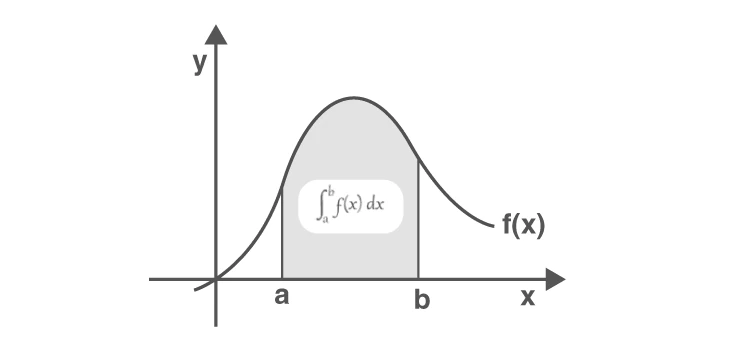
Components of Definite Integral Notation
Definite Integral as a Limit of Summation
Interpreting Definite Integrals Through Riemann Sums
A definite integral can be understood as the limit of a sum of areas of rectangles approximating the region under a curve. Consider a continuous function \( f(x) \) defined on the closed interval \([a, b]\) where \( f(x) > 0 \). The area under the curve \( y = f(x) \) between \( a \) and \( b \) can be approximated by dividing the interval into \( n \) subintervals of equal width \( h \), where \( h = \frac{b - a}{n} \).
As \( n \to \infty \) and \( h \to 0 \), the sum of the areas of these rectangles converges to the exact area under the curve, which is the definite integral.
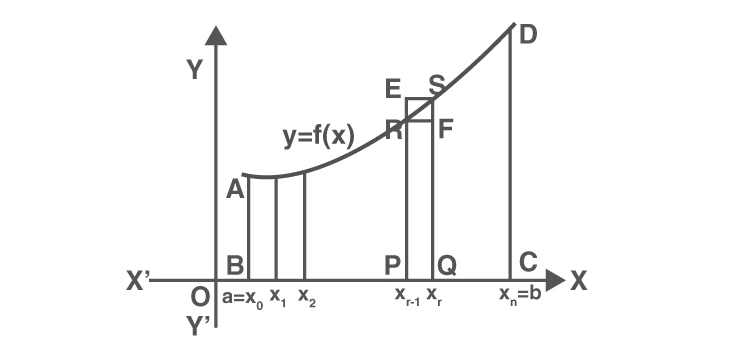
Graphical Representation of Area Under Curve
Let the points dividing the interval be \( x_0 = a, x_1 = a + h, x_2 = a + 2h, \ldots, x_n = b \). The sum of areas of rectangles using left endpoints is:
\[ S_n = \sum_{r=1}^n f(x_{r-1}) h \]
Similarly, the sum using right endpoints is:
\[ s_n = \sum_{r=1}^n f(x_r) h \]
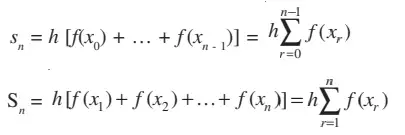
Inequalities Relating Rectangle Areas and Region
As the width \( h \to 0 \), the sums \( S_n \) and \( s_n \) approach the same limit, which equals the area under the curve:
\[ \lim_{n \to \infty} S_n = \lim_{n \to \infty} s_n = \text{Area under } y = f(x) \text{ from } a \text{ to } b \]

Definite Integral as Limit of Sums
This limit defines the definite integral as the exact area under the curve between the limits \( a \) and \( b \).
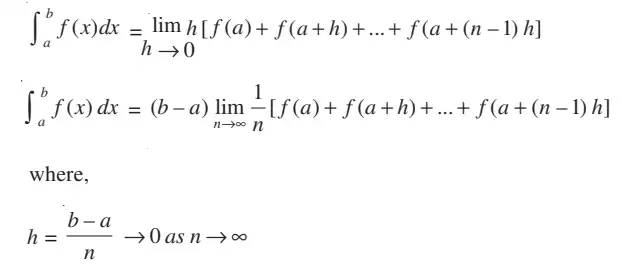
Definite Integral and Limit of Sum Equivalence
Key Properties and Techniques for Definite Integrals
Essential Properties to Simplify Definite Integrals
Several fundamental properties of definite integrals facilitate their evaluation:
\( \displaystyle \int_a^b f(x) \, dx = \int_a^b f(t) \, dt \) (Change of variable name does not affect the integral)
\( \displaystyle \int_a^b f(x) \, dx = -\int_b^a f(x) \, dx \) (Reversing limits changes the sign)
\( \displaystyle \int_a^a f(x) \, dx = 0 \) (Integral over zero-length interval is zero)
\( \displaystyle \int_a^b f(x) \, dx = \int_a^c f(x) \, dx + \int_c^b f(x) \, dx \) (Additivity over intervals)
\( \displaystyle \int_a^b f(x) \, dx = \int_a^b f(a + b - x) \, dx \) (Symmetry property)
\( \displaystyle \int_0^a f(x) \, dx = \int_0^a f(a - x) \, dx \) (Reflection about midpoint)
Stepwise Approach to Evaluate Definite Integrals
To compute \( \int_a^b f(x) \, dx \), follow these steps:
Find the indefinite integral \( \int f(x) \, dx = F(x) + C \). The constant \( C \) can be ignored for definite integrals.
Evaluate the difference \( F(b) - F(a) \) to obtain the definite integral value.
This works because the constant terms cancel out when subtracting the antiderivative values at the limits.
Integration by Parts for Definite Integrals
Some useful formulas involving definite integrals and symmetry include:
\( \displaystyle \int_0^{2a} f(x) \, dx = \int_0^a f(x) \, dx + \int_0^a f(2a - x) \, dx \)
If \( f(2a - x) = f(x) \), then \( \displaystyle \int_0^{2a} f(x) \, dx = 2 \int_0^a f(x) \, dx \)
If \( f(2a - x) = -f(x) \), then \( \displaystyle \int_0^{2a} f(x) \, dx = 0 \)
If \( f(-x) = f(x) \) (even function), then \( \displaystyle \int_{-a}^a f(x) \, dx = 2 \int_0^a f(x) \, dx \)
If \( f(-x) = -f(x) \) (odd function), then \( \displaystyle \int_{-a}^a f(x) \, dx = 0 \)
Practical Applications: Solved Examples of Definite Integrals
Example 1: Calculating a Polynomial Integral
Problem: Find the value of \( \displaystyle \int_1^4 3x^2 \, dx \).
Solution:
Let \( I = \int_1^4 3x^2 \, dx \).
First, compute the indefinite integral:
\[ \int 3x^2 \, dx = 3 \cdot \frac{x^3}{3} = x^3 \]
Evaluate at the limits:
\[ I = [x^3]_1^4 = 4^3 - 1^3 = 64 - 1 = 63 \]
Therefore, \( \displaystyle \int_1^4 3x^2 \, dx = 63 \).
Example 2: Integrating a Trigonometric Function
Problem: Evaluate \( \displaystyle \int_0^{\pi/6} \sin 3x \, dx \).
Solution:
Let \( I = \int_0^{\pi/6} \sin 3x \, dx \).
Find the indefinite integral:
\[ \int \sin 3x \, dx = -\frac{1}{3} \cos 3x + C \]
Evaluate at the limits:
\[ I = \left[-\frac{1}{3} \cos 3x \right]_0^{\pi/6} = -\frac{1}{3} \cos \frac{\pi}{2} + \frac{1}{3} \cos 0 = -\frac{1}{3} \cdot 0 + \frac{1}{3} \cdot 1 = \frac{1}{3} \]
Hence, \( \displaystyle \int_0^{\pi/6} \sin 3x \, dx = \frac{1}{3} \).
Quick Reference: Summary of Definite Integral Essentials
Concept | Key Points |
|---|---|
Definite Integral Notation | \( \int_a^b f(x) \, dx \) represents integration of \( f(x) \) from \( a \) to \( b \) |
Limit of Sum Definition | Definite integral equals the limit of Riemann sums as subinterval width approaches zero |
Properties | Linearity, additivity, reversal of limits, symmetry for even/odd functions |
Evaluation Method | Find antiderivative \( F(x) \), then compute \( F(b) - F(a) \) |
Integration by Parts (Definite) | Use symmetry properties to simplify integrals over symmetric intervals |
Glossary of Important Terms
Term | Definition |
|---|---|
Integral | A mathematical operation that accumulates quantities such as area or volume |
Definite Integral | Integral with specified upper and lower limits producing a unique value |
Indefinite Integral | Integral without limits representing a family of functions plus constant |
Integrand | The function being integrated in an integral expression |
Limits of Integration | The lower and upper bounds \( a \) and \( b \) in a definite integral |
Riemann Sum | Sum of areas of rectangles approximating the area under a curve |
Antiderivative | A function whose derivative is the given function |
Even Function | A function satisfying \( f(-x) = f(x) \) |
Odd Function | A function satisfying \( f(-x) = -f(x) \) |
Integration by Parts | A technique to integrate products of functions by splitting into parts |
Frequently Asked Questions on Definite Integrals
What defines a definite integral?
A definite integral is an integral with specified lower and upper limits, yielding a unique numerical value representing the accumulation of the function over that interval.
How is a definite integral calculated?
By finding the antiderivative \( F(x) \) of the integrand \( f(x) \) and evaluating the difference \( F(b) - F(a) \) where \( a \) and \( b \) are the limits.
What practical uses do definite integrals have?
They are used to compute areas under curves, total displacement, volumes, and other quantities that accumulate over an interval.
Can the value of a definite integral be negative?
Yes, if the function is negative over the interval, the definite integral value can be negative, zero, or positive depending on the function's behavior.
Is the constant of integration included in definite integrals?
No, the constant of integration cancels out when evaluating definite integrals, so it is not included.