Understanding Conditional Probability: Concepts and Applications
Fundamentals of Conditional Probability
Conceptualizing Conditional Probability
Conditional probability measures the chance of an event occurring given that another related event has already taken place. It refines the sample space to the subset where the known event happens, focusing on the likelihood of the subsequent event within this reduced context. This concept is essential when the occurrence of one event influences the probability of another.
For instance, consider a student who takes leave twice a week except Sundays. If it is confirmed that the student is absent on Tuesday, what is the probability that they will also be absent on Saturday? Such scenarios, where one event affects the probability of another, are classic examples of conditional probability.
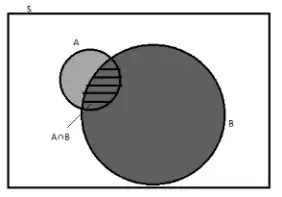
Visual representation of conditional probability with events A and B
Example Problem
In a deck of cards, what is the probability of drawing a red card given that the card drawn is a heart?
Solution:
Event A: Drawing a red card (hearts or diamonds).
Event B: Drawing a heart.
Since all hearts are red cards, the probability of drawing a red card given the card is a heart is:
\[ P(\text{Red}|\text{Heart}) = \frac{P(\text{Red} \cap \text{Heart})}{P(\text{Heart})} = \frac{P(\text{Heart})}{P(\text{Heart})} = 1 \]
Thus, the conditional probability is 1, meaning it is certain.
Exploring Marginal and Joint Probabilities
Understanding Marginal Probability
Marginal probability refers to the likelihood of a single event occurring without any conditions or dependencies on other events. It is the basic probability of an event happening in the entire sample space. For example, the chance of drawing a black card from a standard deck is \( P(\text{Black}) = 0.5 \), and the probability of drawing a 7 is \( P(7) = \frac{1}{13} \). These probabilities are independent of each other.
Defining Joint Probability
Joint probability calculates the chance of two or more events happening simultaneously. It is the probability of the intersection of these events. For example, the probability of drawing a card that is both black and a 7 is the probability of the intersection of these two events.
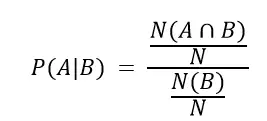
Formula illustrating conditional probability
In a deck of 52 cards, there are two black 7s (7 of clubs and 7 of spades), so:
\[ P(\text{Black and 7}) = \frac{2}{52} = \frac{1}{26} \]
Example Problem
What is the probability of drawing a card that is either a king or a heart from a standard deck?
Solution:
Let event A be drawing a king, and event B be drawing a heart.
\[ P(A) = \frac{4}{52} = \frac{1}{13}, \quad P(B) = \frac{13}{52} = \frac{1}{4} \]
There is one card that is both a king and a heart (king of hearts), so:
\[ P(A \cap B) = \frac{1}{52} \]
Using the formula for union of two events:
\[ P(A \cup B) = P(A) + P(B) - P(A \cap B) = \frac{1}{13} + \frac{1}{4} - \frac{1}{52} = \frac{4}{52} + \frac{13}{52} - \frac{1}{52} = \frac{16}{52} = \frac{4}{13} \]
Therefore, the probability is \( \frac{4}{13} \).
Conditional Probability Formulas and Bayes’ Theorem
Deriving the Conditional Probability Formula
When two events A and B occur together, the conditional probability of A given B is calculated by dividing the probability of both events happening by the probability of event B alone. Mathematically, this is expressed as:
\[ P(A|B) = \frac{P(A \cap B)}{P(B)}, \quad \text{provided } P(B) \neq 0 \]
Similarly, the probability of B given A is:
\[ P(B|A) = \frac{P(B \cap A)}{P(A)}, \quad \text{provided } P(A) \neq 0 \]
This formula helps in updating probabilities when new information about the occurrence of an event is available.
Tree diagram for visualizing conditional probabilities
Applying Bayes’ Theorem
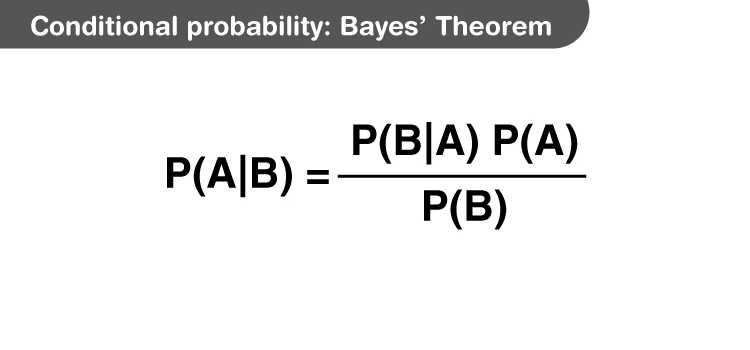
Bayes’ theorem provides a way to reverse conditional probabilities, allowing us to find the probability of a cause given an observed effect. It is particularly useful when dealing with multiple conditions and is stated as:
\[ P(A|B) = \frac{P(B|A) \times P(A)}{P(B)} \]
This theorem is widely used in decision-making and statistical inference.
Example Problem
In a group of 120 shoppers, 50 bought a laptop, 40 bought a tablet, and 15 bought both. If a shopper is selected who bought a laptop, what is the probability that they also purchased a tablet?
Solution:
Let event A be buying a laptop, and event B be buying a tablet.
\[ P(A) = \frac{50}{120} = \frac{5}{12}, \quad P(A \cap B) = \frac{15}{120} = \frac{1}{8} \]
Using conditional probability formula:
\[ P(B|A) = \frac{P(A \cap B)}{P(A)} = \frac{\frac{1}{8}}{\frac{5}{12}} = \frac{1}{8} \times \frac{12}{5} = \frac{3}{10} = 0.3 \]
Hence, there is a 30% chance that a laptop buyer also purchased a tablet.
Key Properties of Conditional Probability
Essential Characteristics
Property 1: For any event F in sample space S, the probability of S given F or F given F is always 1, i.e., \( P(S|F) = P(F|F) = 1 \).
Property 2: For events A and B, and event F with \( P(F) \neq 0 \), the conditional probability of the union is:
\[ P((A \cup B)|F) = P(A|F) + P(B|F) - P((A \cap B)|F) \]Property 3: The complement rule applies conditionally as well:
\[ P(A'|B) = 1 - P(A|B) \]
Practical Problems on Conditional Probability
Example 1: Dice Roll Scenario
Two dice are rolled simultaneously, and it is known that the sum of the numbers is 8. What is the probability that at least one die shows a 4?
Solution:
The total possible outcomes when two dice are rolled is \( 6 \times 6 = 36 \).
Event A: At least one die shows 4.
Event B: Sum of dice is 8.
Possible outcomes for B are: (2,6), (3,5), (4,4), (5,3), (6,2) — total 5 outcomes.
Outcomes in B where at least one die is 4: (4,4) only — 1 outcome.
Therefore,
\[ P(A|B) = \frac{P(A \cap B)}{P(B)} = \frac{\frac{1}{36}}{\frac{5}{36}} = \frac{1}{5} = 0.2 \]
Example 2: Electronics Purchase Analysis
In a survey of 150 customers, 60 bought smartphones, 50 bought tablets, and 25 bought both. If a customer is randomly selected who bought a smartphone, what is the probability they also bought a tablet?
Solution:
Let event A be buying a smartphone, and event B be buying a tablet.
\[ P(A) = \frac{60}{150} = 0.4, \quad P(A \cap B) = \frac{25}{150} = \frac{1}{6} \approx 0.1667 \]
Using conditional probability:
\[ P(B|A) = \frac{P(A \cap B)}{P(A)} = \frac{0.1667}{0.4} = 0.4167 \]
So, there is approximately a 41.67% chance that a smartphone buyer also purchased a tablet.
Quick Reference: Summary of Key Formulas
Concept | Formula | Description |
|---|---|---|
Marginal Probability | \( P(A) \) | Probability of event A occurring independently |
Joint Probability | \( P(A \cap B) \) | Probability of both events A and B occurring together |
Conditional Probability | \( P(A|B) = \frac{P(A \cap B)}{P(B)} \) | Probability of A given B has occurred |
Bayes’ Theorem | \( P(A|B) = \frac{P(B|A) \times P(A)}{P(B)} \) | Reverses conditional probabilities to find causes |
Union of Events (Conditional) | \( P((A \cup B)|F) = P(A|F) + P(B|F) - P((A \cap B)|F) \) | Probability of A or B given F |
Complement Rule (Conditional) | \( P(A'|B) = 1 - P(A|B) \) | Probability of A not occurring given B |
Glossary of Important Terms
Term | Definition |
|---|---|
Conditional Probability | Probability of an event occurring given another event has already occurred |
Marginal Probability | Probability of a single event without any conditions |
Joint Probability | Probability of two or more events happening simultaneously |
Sample Space | The set of all possible outcomes of an experiment |
Intersection | The set of outcomes common to two events |
Union | The set of outcomes belonging to either of two events |
Complement | The set of outcomes where an event does not occur |
Bayes’ Theorem | A formula to update probabilities based on new evidence |
Independent Events | Events where the occurrence of one does not affect the other |
Dependent Events | Events where the occurrence of one affects the probability of the other |
Frequently Asked Questions
How is conditional probability calculated?
It is calculated by dividing the probability of both events occurring together by the probability of the given event, expressed as \( P(A|B) = \frac{P(A \cap B)}{P(B)} \).
What distinguishes conditional probability from regular probability?
Regular probability measures the chance of an event independently, while conditional probability considers the occurrence of another related event.
Why is conditional probability important?
It helps in understanding and calculating probabilities in situations where events influence each other, which is common in real-world scenarios.
What does the symbol "|" mean in \( P(A|B) \)?
The "|" symbol means "given that," indicating the probability of A occurring given that B has already occurred.
Can you give a simple example of conditional probability?
If a card drawn from a deck is known to be a face card, the probability that it is a king is a conditional probability.