Understanding Composite Functions and Their Properties
Fundamentals of Composite Functions
Concept and Definition of Composite Functions
In mathematics, combining two functions to form a new function is known as the composition of functions. If we have two functions, say \( f \) and \( g \), their composition creates a function \( h \) such that for every input \( x \), \( h(x) = g(f(x)) \). This means the function \( f \) is applied first to \( x \), and then \( g \) is applied to the result of \( f(x) \).
Formally, if \( f: A \to B \) and \( g: B \to C \) are functions, the composite function \( g \circ f \) is defined as a function from \( A \) to \( C \) given by:
\[ (g \circ f)(x) = g(f(x)), \quad \forall x \in A. \]
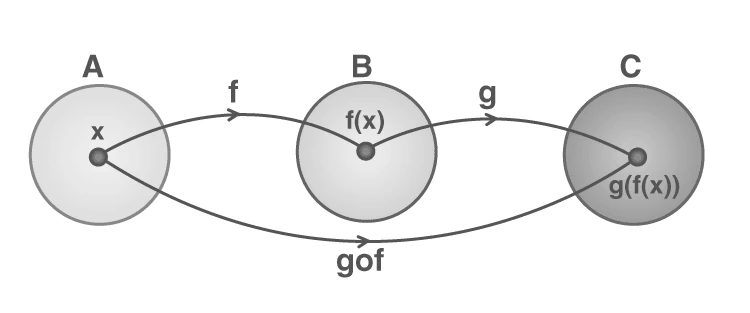
Visual representation of composite functions
It is crucial to note that the order of composition matters; generally, \( f \circ g \neq g \circ f \). The symbol \( \circ \) denotes composition and should not be confused with multiplication.
Example: Constructing a Composite Function
Let \( f(x) = 2x + 3 \) and \( g(x) = x^2 \). Find \( (g \circ f)(x) \).
Solution:
By definition,
\[ (g \circ f)(x) = g(f(x)) = g(2x + 3) = (2x + 3)^2. \]
Thus, the composite function is \( (g \circ f)(x) = (2x + 3)^2 \).
Key Properties and Notations in Function Composition
Symbols, Domains, and Important Characteristics
The composition of functions is symbolized by \( g \circ f \), where the small circle \( \circ \) indicates composition. It is important not to replace this symbol with a dot, as that would imply multiplication of functions.
Regarding domains, the domain of the composite function \( g \circ f \) consists of all \( x \) in the domain of \( f \) such that \( f(x) \) lies in the domain of \( g \). In other words, the input values must be valid for both functions in sequence.
For example, if \( f(x) = 3x + 1 \) and \( g(x) = x^2 \), then:
\[ (g \circ f)(x) = g(f(x)) = g(3x + 1) = (3x + 1)^2. \]
Reversing the order,
\[ (f \circ g)(x) = f(g(x)) = f(x^2) = 3x^2 + 1, \]
which is generally different from \( (g \circ f)(x) \).
Example: Evaluating Composite Functions at a Specific Value
Given \( f(x) = 2x \) and \( g(x) = x + 1 \), find \( (f \circ g)(1) \).
Solution:
First, compute \( g(1) \):
\[ g(1) = 1 + 1 = 2. \]
Then, apply \( f \) to this result:
\[ (f \circ g)(1) = f(g(1)) = f(2) = 2 \times 2 = 4. \]
Advanced Concepts: Properties and Self-Composition of Functions
Associativity, Commutativity, and Composing a Function with Itself
Function composition has several important properties:
Associative Property: For functions \( f, g, h \), composition is associative, meaning:
\[ f \circ (g \circ h) = (f \circ g) \circ h. \]
Commutative Property: Two functions \( f \) and \( g \) commute if and only if:
\[ g \circ f = f \circ g, \]
which is generally not true for arbitrary functions.
Additional properties include:
The composition of two one-to-one (injective) functions is also one-to-one.
The composition of two onto (surjective) functions is onto.
The inverse of a composition satisfies:
\[ (f \circ g)^{-1} = g^{-1} \circ f^{-1}. \]
Moreover, a function can be composed with itself, denoted as \( f \circ f \), defined by:
\[ (f \circ f)(x) = f(f(x)). \]
Example: Computing Self-Composition of a Function
Let \( f(x) = 3x^2 \). Find \( (f \circ f)(x) \).
Solution:
Calculate \( f(f(x)) \):
\[ (f \circ f)(x) = f(f(x)) = f(3x^2) = 3(3x^2)^2 = 3 \times 9x^4 = 27x^4. \]
Example: Composition of Multiple Functions
Given \( f(x) = x \), \( g(x) = 2x \), and \( h(x) = 3x \), find \( (f \circ (g \circ h))(x) \) for \( x = -1 \).
Solution:
First, compute \( (g \circ h)(x) \):
\[ (g \circ h)(x) = g(h(x)) = g(3x) = 2 \times 3x = 6x. \]
Then, apply \( f \) to this result:
\[ (f \circ (g \circ h))(x) = f(6x) = 6x. \]
Substituting \( x = -1 \):
\[ (f \circ (g \circ h))(-1) = 6 \times (-1) = -6. \]
Summary of Composite Functions
Concept | Explanation | Formula/Example |
|---|---|---|
Composite Function | Applying one function to the result of another | \( (g \circ f)(x) = g(f(x)) \) |
Associative Property | Composition order grouping does not affect result | \( f \circ (g \circ h) = (f \circ g) \circ h \) |
Commutative Property | Functions commute if order of composition is interchangeable | Usually \( g \circ f \neq f \circ g \) |
Self-Composition | Function composed with itself | \( (f \circ f)(x) = f(f(x)) \) |
Inverse of Composition | Inverse of composite equals composition of inverses in reverse order | \( (f \circ g)^{-1} = g^{-1} \circ f^{-1} \) |
Glossary of Key Terms
Term | Definition |
|---|---|
Composite Function | A function formed by applying one function to the result of another. |
Domain | The set of all possible input values for a function. |
Codomain | The set into which all outputs of a function are constrained. |
Range | The actual set of output values a function produces. |
Associative Property | The property that allows grouping of functions in composition without changing the result. |
Commutative Property | The property where the order of function composition does not affect the outcome. |
One-to-One Function | A function where each input maps to a unique output. |
Onto Function | A function where every element in the codomain is mapped by some element in the domain. |
Inverse Function | A function that reverses the effect of the original function. |
Self-Composition | Composing a function with itself, denoted as \( f \circ f \). |
Frequently Asked Questions
What is the difference between \( f \circ g \) and \( g \circ f \)?
The order of composition matters; generally, \( f \circ g \neq g \circ f \) because the output of one function becomes the input of the other in a specific sequence.
How do I find the domain of a composite function?
The domain of \( g \circ f \) includes all \( x \) in the domain of \( f \) such that \( f(x) \) lies within the domain of \( g \).
Can a function be composed with itself?
Yes, composing a function with itself is valid and is expressed as \( (f \circ f)(x) = f(f(x)) \).
Is function composition associative?
Yes, function composition is associative, meaning \( f \circ (g \circ h) = (f \circ g) \circ h \).
Does the composition of two one-to-one functions remain one-to-one?
Yes, the composition of two injective (one-to-one) functions is also injective.