Understanding Area Calculation Beneath Curves
Fundamentals of Area Under Curves
Conceptualizing Area as a Measure of Change
Imagine two individuals sharing an umbrella; the extent to which they stay dry depends on the umbrella's coverage area. Similarly, in mathematics, the area beneath a curve represents the accumulation or change of a quantity over an interval. For a function \( y = f(x) \), the graph may extend above or below the x-axis, indicating positive or negative values respectively.
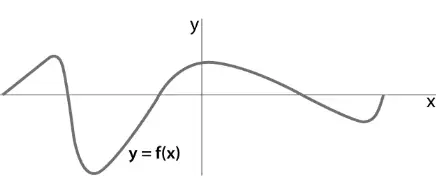
Graph illustrating a function with varying positive and negative values
Without specifying the interval for \( x \), the total area under the curve remains undefined, as the curve may extend infinitely.
Determining Area Between Specific Limits
The area under a curve is precisely defined when bounded by two values on the x-axis, say \( x = a \) and \( x = b \). This area is calculated using definite integration:
\[ A = \int_{a}^{b} f(x) \, dx \]
If the curve lies above the x-axis between \( a \) and \( b \), the area is positive; if below, the area is considered negative.
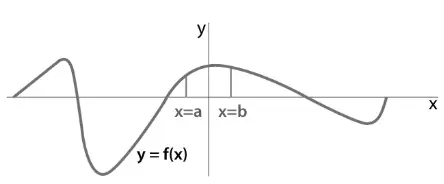
Area under the curve \( y = f(x) \) between \( x = a \) and \( x = b \)
Similarly, if the curve is expressed as \( x = \phi(y) \), the area between \( y = c \) and \( y = d \) along the y-axis is:
\[ B = \int_{c}^{d} \phi(y) \, dy \]
Calculating Area Between Two Curves
When two functions \( y = f(x) \) and \( y = g(x) \) are given over the interval \( [a, b] \), the area enclosed between them is found by integrating the difference:
\[ \text{Area} = \int_{a}^{b} |f(x) - g(x)| \, dx \]
This method helps in determining the region bounded by the two curves.
Example 1: Area Between a Logarithmic Curve and the X-axis
Problem: Find the area enclosed by the curve \( y = \log x \), the x-axis, and the vertical lines \( x = 1 \) and \( x = 3 \).
Solution: The area is given by the integral:
\[ A = \int_{1}^{3} \log x \, dx \]
Using integration by parts,
\[ \int \log x \, dx = x \log x - x + C \]
Evaluating from 1 to 3,
\[ A = \left[ x \log x - x \right]_1^3 = (3 \log 3 - 3) - (1 \cdot 0 - 1) = 3 \log 3 - 2 \]
Thus, the area enclosed is \( 3 \log 3 - 2 \) square units.
Symmetry and Properties of Curves Affecting Area
Identifying Symmetry in Curves
Symmetry plays a crucial role in simplifying area calculations. A curve is:
Symmetric about the x-axis if replacing \( y \) by \( -y \) leaves the curve unchanged.
Symmetric about the y-axis if replacing \( x \) by \( -x \) leaves the curve unchanged.
Symmetric about both axes if both substitutions leave the curve unchanged.
Symmetric about the line \( y = x \) if interchanging \( x \) and \( y \) does not alter the curve.
Recognizing these symmetries can reduce the complexity of integration by focusing on a portion of the curve and multiplying accordingly.
Steps to Analyze and Sketch Curves
To accurately sketch and analyze a curve, follow these steps:
Check for symmetry using the criteria above.
Identify points where the curve intersects the axes.
Calculate the derivative \( \frac{dy}{dx} \) to find stationary points and determine intervals of increase or decrease.
Evaluate the behavior of \( y \) as \( x \to \infty \) and \( x \to -\infty \).
Example 2: Finding the Symmetry of a Curve
Problem: Determine the symmetry of the curve defined by \( y^2 = 4ax \).
Solution: Replacing \( y \) by \( -y \) yields \( (-y)^2 = y^2 = 4ax \), so the curve remains unchanged, indicating symmetry about the x-axis.
Replacing \( x \) by \( -x \) gives \( y^2 = -4ax \), which is not the same curve, so no symmetry about the y-axis.
Hence, the curve is symmetric only about the x-axis.
Practical Applications: Calculating Areas Enclosed by Various Curves
Area Between Curves and Lines
Integration allows us to find areas enclosed by curves and lines by setting appropriate limits and integrating the difference of functions.
Example 3: Area Divided by a Vertical Line
Problem: The curve \( y = 1 + \frac{6}{x^2} \) is bounded by the x-axis and vertical lines \( x = 3 \) and \( x = 6 \). Find the value of \( a \) such that the vertical line \( x = a \) divides the area into two equal parts.
Solution: Total area \( A \) is:
\[ A = \int_{3}^{6} \left(1 + \frac{6}{x^2}\right) dx = \left[ x - \frac{6}{x} \right]_3^6 = (6 - 1) - (3 - 2) = 5 - 1 = 4 \]
We want \( a \) such that:
\[ \int_{3}^{a} \left(1 + \frac{6}{x^2}\right) dx = 2 \]
Evaluating,
\[ \left[ x - \frac{6}{x} \right]_3^a = 2 \implies \left(a - \frac{6}{a}\right) - (3 - 2) = 2 \implies a - \frac{6}{a} - 1 = 2 \]
\[ a - \frac{6}{a} = 3 \implies a^2 - 6 = 3a \implies a^2 - 3a - 6 = 0 \]
Solving the quadratic,
\[ a = \frac{3 \pm \sqrt{9 + 24}}{2} = \frac{3 \pm \sqrt{33}}{2} \]
Since \( a > 0 \),
\[ a = \frac{3 + \sqrt{33}}{2} \]
Example 4: Area Between a Circle and a Vertical Line
Problem: Find the area of the smaller segment of the circle \( x^2 + y^2 = 9 \) cut off by the line \( x = 1 \).
Solution: The area of the segment is twice the integral from \( x = 1 \) to \( x = 3 \) of the upper semicircle:
\[ A = 2 \int_{1}^{3} \sqrt{9 - x^2} \, dx \]
Using the formula for the integral,
\[ \int \sqrt{a^2 - x^2} \, dx = \frac{x}{2} \sqrt{a^2 - x^2} + \frac{a^2}{2} \sin^{-1} \frac{x}{a} + C \]
Evaluating,
\[ A = 2 \left[ \frac{x}{2} \sqrt{9 - x^2} + \frac{9}{2} \sin^{-1} \frac{x}{3} \right]_1^3 = 2 \left[ \frac{3}{2} \cdot 0 + \frac{9}{2} \cdot \frac{\pi}{2} - \left( \frac{1}{2} \sqrt{8} + \frac{9}{2} \sin^{-1} \frac{1}{3} \right) \right] \]
Simplifying,
\[ A = 2 \left[ \frac{9\pi}{4} - \left( \frac{\sqrt{8}}{2} + \frac{9}{2} \sin^{-1} \frac{1}{3} \right) \right] = \frac{9\pi}{2} - \sqrt{8} - 9 \sin^{-1} \frac{1}{3} \]
This is the area of the smaller segment.
Example 5: Area Between Trigonometric Curves
Problem: Calculate the area enclosed between \( y = \sin x + \cos x \) and \( y = |\cos x - \sin x| \) over \( x \in [0, \frac{\pi}{2}] \).
Solution: Break the integral at \( x = \frac{\pi}{4} \) where the expressions inside the absolute value change sign.
\[ A = \int_0^{\frac{\pi}{4}} \left( (\sin x + \cos x) - (\cos x - \sin x) \right) dx + \int_{\frac{\pi}{4}}^{\frac{\pi}{2}} \left( (\sin x + \cos x) - (\sin x - \cos x) \right) dx \]
Simplify integrands:
\[ = \int_0^{\frac{\pi}{4}} (2 \sin x) dx + \int_{\frac{\pi}{4}}^{\frac{\pi}{2}} (2 \cos x) dx \]
Evaluating integrals,
\[ = 2[-\cos x]_0^{\frac{\pi}{4}} + 2[\sin x]_{\frac{\pi}{4}}^{\frac{\pi}{2}} = 2(1 - \frac{\sqrt{2}}{2}) + 2 \left(1 - \frac{\sqrt{2}}{2} \right) = 4 \left(1 - \frac{\sqrt{2}}{2} \right) = 2 \sqrt{2} (\sqrt{2} - 1) \]
Summary Table for Area Under Curves
Concept | Formula | Remarks |
|---|---|---|
Area under \( y = f(x) \) from \( a \) to \( b \) | \( \displaystyle \int_a^b f(x) \, dx \) | Positive if curve above x-axis, negative if below |
Area under \( x = \phi(y) \) from \( c \) to \( d \) | \( \displaystyle \int_c^d \phi(y) \, dy \) | Area with respect to y-axis |
Area between two curves \( y = f(x) \) and \( y = g(x) \) | \( \displaystyle \int_a^b |f(x) - g(x)| \, dx \) | Difference of functions over interval |
Area of ellipse with semi-axes \( a \) and \( b \) | \( \pi a b \) | Standard geometric formula |
Symmetry about x-axis | Replace \( y \) by \( -y \) | Curve unchanged if symmetric |
Symmetry about y-axis | Replace \( x \) by \( -x \) | Curve unchanged if symmetric |
Symmetry about line \( y = x \) | Interchange \( x \) and \( y \) | Curve unchanged if symmetric |
Glossary of Key Terms
Term | Definition |
|---|---|
Definite Integral | Integral with specified upper and lower limits representing area under curve |
Indefinite Integral | Integral without limits representing family of antiderivatives |
Symmetry | Property where a curve remains unchanged under certain transformations |
Stationary Point | Point where derivative \( \frac{dy}{dx} = 0 \), indicating maxima, minima, or inflection |
Area Between Curves | Region enclosed by two functions over an interval |
Ellipse | Closed curve shaped like an elongated circle with two axes |
Ordinate | Vertical line or y-coordinate in Cartesian plane |
Abscissa | Horizontal line or x-coordinate in Cartesian plane |
Integration by Parts | Technique to integrate products of functions |
Quadratic Equation | Polynomial equation of degree two |
Frequently Asked Questions
How is the area under a curve with respect to the x-axis calculated?
The area is found using the definite integral \( A = \int_a^b f(x) \, dx \), where \( a \) and \( b \) are the limits on the x-axis.
What formula is used to find the area under a curve with respect to the y-axis?
When the curve is expressed as \( x = \phi(y) \), the area between \( y = c \) and \( y = d \) is \( A = \int_c^d \phi(y) \, dy \).
What is the formula for the area of an ellipse?
The area of an ellipse with semi-major axis \( a \) and semi-minor axis \( b \) is \( A = \pi a b \).
How can symmetry simplify area calculations under curves?
Symmetry allows calculation over a portion of the curve and then multiplying the result, reducing the integration effort.
What steps should be followed to sketch a curve accurately?
Check for symmetry, find intercepts, determine stationary points via derivatives, and analyze behavior as \( x \to \pm \infty \).