Calculating the Area Between Two Curves Using Integration
Understanding the Concept of Area Between Curves
Defining the Area Enclosed by Two Functions
In geometry, area quantifies the extent of a two-dimensional surface. When dealing with curves in calculus, the area between two functions is found by integrating the difference of their values over a specified interval. If we have two functions \( f(x) \) and \( g(x) \) defined on the interval \([a, b]\), where \( f(x) \geq g(x) \), the area enclosed between these curves is given by the definite integral:
\[ A = \int_{a}^{b} [f(x) - g(x)] \, dx \]
This integral sums up the vertical distances between the curves across the interval, effectively calculating the total enclosed area.
Example: Suppose \( f(x) = 3x + 2 \) and \( g(x) = x^2 \) on the interval \([0, 1]\). The area between these curves is:
\[ A = \int_0^1 (3x + 2 - x^2) \, dx = \int_0^1 (3x + 2 - x^2) \, dx \]
Calculating the integral:
\[ = \left[ \frac{3x^2}{2} + 2x - \frac{x^3}{3} \right]_0^1 = \left( \frac{3}{2} + 2 - \frac{1}{3} \right) - 0 = \frac{3}{2} + 2 - \frac{1}{3} = \frac{17}{6} \]
Thus, the enclosed area is \( \frac{17}{6} \text{ square units} \).
Methods to Calculate Area Between Curves
Case 1: When One Curve Lies Above the Other Throughout
Consider two functions \( y = f(x) \) and \( y = g(x) \) such that \( f(x) \geq g(x) \) for all \( x \) in the interval \([a, b]\). The points \( x = a \) and \( x = b \) are the intersection points of the curves. To find the area between them, imagine slicing the region into thin vertical strips of width \( dx \). The height of each strip is the difference \( f(x) - g(x) \), so the area of each strip is \( [f(x) - g(x)] dx \). Summing these strips from \( a \) to \( b \) gives the total area:
\[ A = \int_a^b [f(x) - g(x)] \, dx \]
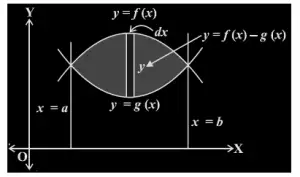
Alternatively, the area can be computed as the difference between the area under the upper curve and the area under the lower curve:
\[ A = \int_a^b f(x) \, dx - \int_a^b g(x) \, dx \]
Example: Find the area between \( y = \sqrt{x} \) and \( y = x^2 \) from \( x=0 \) to \( x=1 \).
Here, \( f(x) = \sqrt{x} \) and \( g(x) = x^2 \). The area is:
\[ A = \int_0^1 (\sqrt{x} - x^2) \, dx = \int_0^1 (x^{1/2} - x^2) \, dx \]
Calculating the integral:
\[ = \left[ \frac{2}{3} x^{3/2} - \frac{x^3}{3} \right]_0^1 = \frac{2}{3} - \frac{1}{3} = \frac{1}{3} \]
The enclosed area is \( \frac{1}{3} \text{ square units} \).
Handling Areas When Curves Intersect Multiple Times
Case 2: When the Upper and Lower Curves Switch Positions
Sometimes, two curves intersect more than twice, causing the roles of upper and lower curves to swap within the interval \([a, b]\). Suppose \( f(x) \geq g(x) \) on \([a, c]\) and \( f(x) \leq g(x) \) on \([c, b]\), where \( c \) is an intersection point between \( a \) and \( b \). To find the total area between the curves, calculate the sum of the absolute differences in each sub-interval:
\[ A = \int_a^c [f(x) - g(x)] \, dx + \int_c^b [g(x) - f(x)] \, dx \]
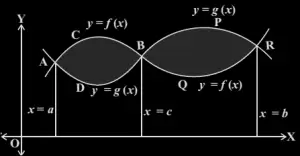
Area calculation when curves intersect and switch positions
This approach ensures the area is always positive, reflecting the true enclosed region.
Example: Calculate the area between the circles defined by \( x^2 + y^2 = 1 \) and \( (x - 1)^2 + y^2 = 1 \).
First, find their intersection points by solving:
\[ x^2 + y^2 = 1 \quad (1) \]
\[ (x - 1)^2 + y^2 = 1 \quad (2) \]
Subtracting (1) from (2):
\[ (x - 1)^2 - x^2 = 0 \implies (x - 1 - x)(x - 1 + x) = 0 \implies -1 (2x - 1) = 0 \]
Solving for \( x \):
\[ 2x = 1 \implies x = \frac{1}{2} \]
Substitute back to find \( y \):
\[ y = \pm \sqrt{1 - \left(\frac{1}{2}\right)^2} = \pm \frac{\sqrt{3}}{2} \]
Thus, the circles intersect at points \( \left(\frac{1}{2}, \frac{\sqrt{3}}{2}\right) \) and \( \left(\frac{1}{2}, -\frac{\sqrt{3}}{2}\right) \).
Because the circles are symmetric about the x-axis, the total enclosed area is twice the area above the x-axis:
\[ \text{Area} = 2 \times \text{Area of segment OAC} = 2 \times (\text{Area OAD} + \text{Area DCA}) \]
Calculating these areas involves integrating the difference of the circle equations over the appropriate intervals.
Alternative Integration Along the y-Axis
Using Horizontal Slices to Find Area
Instead of integrating with respect to \( x \), sometimes it is easier to integrate with respect to \( y \). If the functions are expressed as \( x = u(y) \) and \( x = v(y) \), where \( u(y) \geq v(y) \) for \( y \in [y_1, y_2] \), the area between the curves is:
\[ A = \int_{y_1}^{y_2} [u(y) - v(y)] \, dy \]
Here, the width of each horizontal strip is \( u(y) - v(y) \) and the thickness is \( dy \). This method is particularly useful when the curves are functions of \( y \) or when the region is bounded vertically.
Example: Find the area enclosed by the parabolas \( y = x^2 \) and \( x = y^2 \).
Rearranging \( x = y^2 \) gives \( y = \sqrt{x} \), so the functions can be expressed as:
\[ y = x^2 \quad \text{and} \quad y = \sqrt{x} \]
The points of intersection are at \( (0,0) \) and \( (1,1) \). Using integration with respect to \( x \), the area is:
\[ A = \int_0^1 (\sqrt{x} - x^2) \, dx = \frac{1}{3} \text{ square units} \]
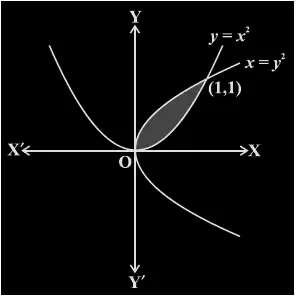
Area between the parabolas \( y = x^2 \) and \( x = y^2 \)
Practice Problems to Strengthen Understanding
Try Solving These Area Calculation Questions
Determine the area enclosed by the curves \( x^2 = 6y \) and \( x^2 + y^2 = 16 \).
Find the area of the region bounded by the circles \( x^2 + y^2 = 4 \) and \( (x - 2)^2 + y^2 = 4 \).
Sketch the region defined by \( y^2 \leq 3x \) and \( 3x^2 + 3y^2 \leq 16 \), then calculate the enclosed area using integration.
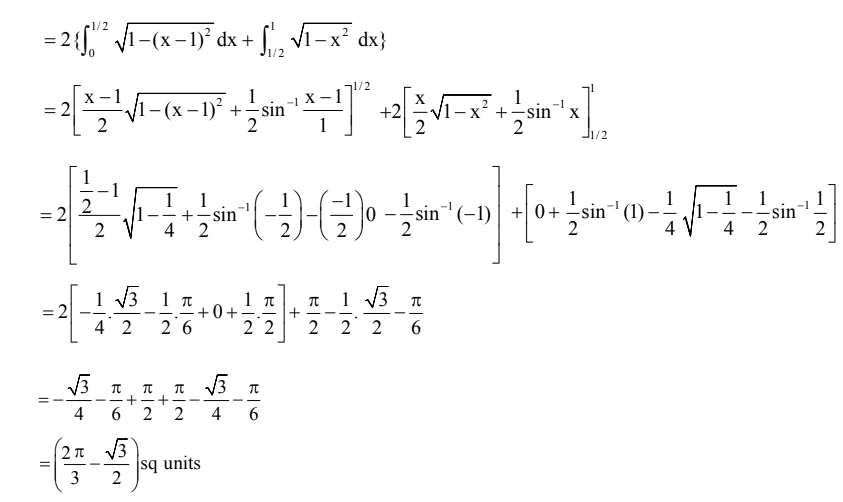
Visual aid for practice problems on areas between curves
Summary Table for Quick Revision
Concept | Formula | Condition |
|---|---|---|
Area between two curves (x-axis integration) | \( A = \int_{a}^{b} [f(x) - g(x)] \, dx \) | \( f(x) \geq g(x) \) on \([a,b]\) |
Area when curves switch order | \( A = \int_{a}^{c} [f(x) - g(x)] \, dx + \int_{c}^{b} [g(x) - f(x)] \, dx \) | Intersection at \( x = c \) within \([a,b]\) |
Area between curves (y-axis integration) | \( A = \int_{y_1}^{y_2} [u(y) - v(y)] \, dy \) | \( u(y) \geq v(y) \) on \([y_1,y_2]\) |
Glossary of Key Terms
Term | Definition |
|---|---|
Definite Integral | Integral with specified upper and lower limits representing area under a curve. |
Curve | A continuous and smooth flowing line without sharp angles. |
Enclosed Area | The region bounded between two or more curves. |
Intersection Points | Points where two curves meet or cross each other. |
Upper Curve | The function with greater y-values over an interval. |
Lower Curve | The function with smaller y-values over an interval. |
Vertical Strip | A thin rectangle used to approximate area under curves in integration. |
Horizontal Strip | A thin rectangle used for integration with respect to y. |
Laminar Region | A flat, two-dimensional area bounded by curves. |
Integration Limits | The bounds \( a \) and \( b \) defining the interval of integration. |
Frequently Asked Questions
How do I determine which function is the upper curve?
Compare the y-values of the functions over the interval. The function with the larger y-value at each point is the upper curve.
What if the curves intersect multiple times?
Divide the interval at intersection points and calculate the area in each sub-interval, ensuring the upper and lower functions are correctly identified in each.
Can I integrate with respect to y instead of x?
Yes, if the functions are easier to express as \( x = u(y) \) and \( x = v(y) \), integrating with respect to y can simplify the calculation.
Why is the area between curves always positive?
Because area represents a physical quantity, we take the absolute difference between the functions to ensure the result is non-negative.
How do I find the points of intersection?
Set the two functions equal to each other and solve for the variable to find the intersection points.