Comprehensive Guide to Maxima and Minima in Calculus
Understanding Critical Points and Their Significance
Identifying Stationary and Turning Points
In calculus, maxima and minima are located by analyzing the derivative of a function. Points where the derivative equals zero are called stationary points, indicating a horizontal tangent line on the graph. These points often correspond to local peaks or valleys of the function.
Before a stationary point, if the slope (first derivative) is negative and after it becomes positive, the point is a local minimum. Conversely, if the slope changes from positive to negative, the point is a local maximum. This behavior is confirmed by the second derivative test, where a positive second derivative at the stationary point indicates a minimum, and a negative second derivative indicates a maximum.
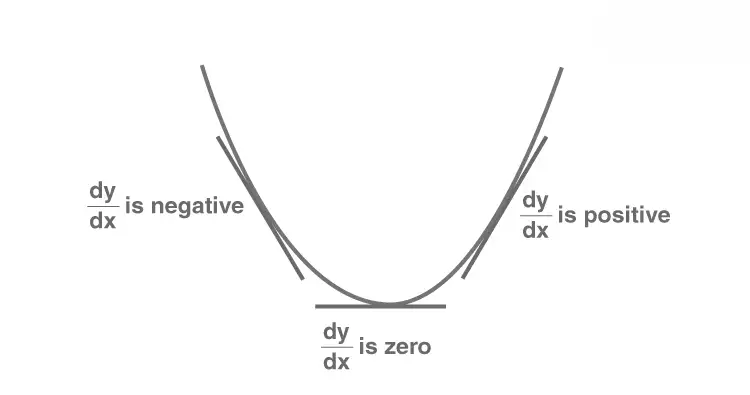
Illustration of stationary points with positive and negative curvature
Additionally, if the first derivative does not change sign around a critical point, that point is called a point of inflection, where the function's concavity changes but no local maxima or minima occur.
Example: Locating Stationary Points and Classifying Them
Find the stationary points of the function \( y = 5x^3 + 15x^2 + 18x + 7 \) and classify each point.
Solution:
First, compute the first derivative:
\[ \frac{dy}{dx} = 15x^2 + 30x + 18 \]
Set the derivative equal to zero to find stationary points:
\[ 15x^2 + 30x + 18 = 0 \implies 5x^2 + 10x + 6 = 0 \]
Using the quadratic formula:
\[ x = \frac{-10 \pm \sqrt{10^2 - 4 \times 5 \times 6}}{2 \times 5} = \frac{-10 \pm \sqrt{100 - 120}}{10} \]
Since the discriminant is negative, there are no real stationary points. Hence, the function has no local maxima or minima.
Distinguishing Between Stationary and Turning Points
Clarifying the Difference and Their Graphical Behavior
Stationary points occur where the slope of the function is zero, meaning the tangent is horizontal. However, not all stationary points are turning points. Turning points are stationary points where the function changes direction — from increasing to decreasing or vice versa.
For example, a stationary point where the function flattens but continues in the same direction is not a turning point but a point of inflection.
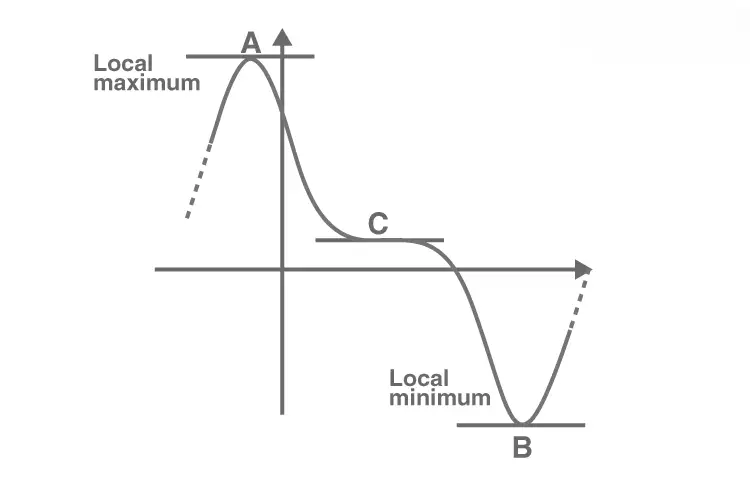
Graph illustrating turning points and a non-turning stationary point
Example: Identifying Turning Points on a Curve
Consider a function with stationary points at \( x = 2, 4, 6 \). At \( x=2 \) and \( x=4 \), the function changes from increasing to decreasing and decreasing to increasing respectively, but at \( x=6 \), the function remains decreasing before and after. Classify these points.
Solution:
Points at \( x=2 \) and \( x=4 \) are turning points because the function changes direction.
Point at \( x=6 \) is a stationary point but not a turning point since the function does not change its increasing/decreasing behavior.
Derivative Tests for Locating Maxima and Minima
Applying First and Second Derivative Criteria
The first derivative test involves analyzing the sign change of the derivative around critical points. If the derivative changes from positive to negative, the point is a local maximum; if it changes from negative to positive, it is a local minimum. If there is no sign change, the point is a point of inflection.
The second derivative test uses the value of the second derivative at the critical point. If \( f''(c) > 0 \), the function has a local minimum at \( c \). If \( f''(c) < 0 \), there is a local maximum. If \( f''(c) = 0 \), the test is inconclusive, and the first derivative test should be used.
Example: Using Derivative Tests to Find Local Extrema
Find the local maxima and minima of the function \( f(x) = 2x^4 - 8x^3 + 6x^2 + 1 \).
Solution:
First derivative:
\[ f'(x) = 8x^3 - 24x^2 + 12x \]
Set \( f'(x) = 0 \):
\[ 8x^3 - 24x^2 + 12x = 0 \implies 4x(2x^2 - 6x + 3) = 0 \]
So, \( x = 0 \) or solve \( 2x^2 - 6x + 3 = 0 \):
\[ x = \frac{6 \pm \sqrt{36 - 24}}{4} = \frac{6 \pm \sqrt{12}}{4} = \frac{6 \pm 2\sqrt{3}}{4} \]
Second derivative:
\[ f''(x) = 24x^2 - 48x + 12 \]
Evaluate at critical points:
At \( x=0 \): \( f''(0) = 12 > 0 \) → local minimum.
At \( x = \frac{6 + 2\sqrt{3}}{4} \approx 2.37 \): \( f''(2.37) > 0 \) → local minimum.
At \( x = \frac{6 - 2\sqrt{3}}{4} \approx 0.63 \): \( f''(0.63) < 0 \) → local maximum.
Key Characteristics and Patterns of Maxima and Minima
Fundamental Properties and Their Implications
Maxima and minima of continuous functions exhibit several important properties:
Between two points where the function has equal values, there must be at least one maximum or minimum.
Maxima and minima alternate along the function's domain; a maximum is always followed by a minimum and vice versa.
If the function tends to infinity at the domain's ends and has only one critical point, that point corresponds to the minimum value. Similarly, if the function tends to negative infinity, the critical point is a maximum.
Example: Verifying Maxima and Minima Properties
Consider the function \( g(x) = x^3 - 3x^2 + 4 \). Show that maxima and minima alternate and identify them.
Solution:
First derivative:
\[ g'(x) = 3x^2 - 6x \]
Set \( g'(x) = 0 \):
\[ 3x(x - 2) = 0 \implies x = 0, 2 \]
Second derivative:
\[ g''(x) = 6x - 6 \]
Evaluate at critical points:
At \( x=0 \): \( g''(0) = -6 < 0 \) → local maximum.
At \( x=2 \): \( g''(2) = 6 > 0 \) → local minimum.
This confirms the alternating pattern of maxima and minima.
Practical Applications and Problem Solving with Maxima and Minima
Step-by-Step Solutions to Representative Problems
Example 1: Finding Turning Points of a Cubic Function
Determine the turning points of \( y = 3x^3 + 9x^2 + 12x + 5 \).
Solution:
Calculate the first derivative:
\[ \frac{dy}{dx} = 9x^2 + 18x + 12 \]
Set derivative to zero:
\[ 9x^2 + 18x + 12 = 0 \implies 3x^2 + 6x + 4 = 0 \]
Discriminant:
\[ \Delta = 6^2 - 4 \times 3 \times 4 = 36 - 48 = -12 < 0 \]
No real roots, so no turning points exist.
Example 2: Identifying Local Extrema of a Quartic Function
Find the local maxima and minima of \( f(x) = x^4 - 4x^3 + 6x^2 - 4x + 1 \).
Solution:
First derivative:
\[ f'(x) = 4x^3 - 12x^2 + 12x - 4 \]
Set \( f'(x) = 0 \):
\[ 4x^3 - 12x^2 + 12x - 4 = 0 \implies x^3 - 3x^2 + 3x - 1 = 0 \]
This factors as:
\[ (x - 1)^3 = 0 \]
So, \( x = 1 \) is the only critical point.
Second derivative:
\[ f''(x) = 12x^2 - 24x + 12 \]
Evaluate at \( x=1 \):
\[ f''(1) = 12 - 24 + 12 = 0 \]
Since the second derivative is zero, the test is inconclusive. Using the first derivative test or analyzing the function shows \( x=1 \) is a point of inflection, not a maximum or minimum.
Example 3: Maximizing Curved Surface Area of a Cylinder in a Cone
Prove that the radius of the right circular cylinder with the greatest curved surface area inscribed in a cone is half the radius of the cone.
Solution:
Let the cone have radius \( R \) and height \( H \), and the cylinder have radius \( r \) and height \( h \).
The curved surface area of the cylinder is:
\[ S = 2\pi r h \]
From similar triangles, height of cylinder:
\[ h = H \frac{R - r}{R} \]
Substitute \( h \) into \( S \):
\[ S = 2\pi r \times H \frac{R - r}{R} = \frac{2\pi H}{R} (rR - r^2) \]
Differentiate \( S \) with respect to \( r \):
\[ \frac{dS}{dr} = \frac{2\pi H}{R} (R - 2r) \]
Set derivative to zero for maxima/minima:
\[ R - 2r = 0 \implies r = \frac{R}{2} \]
Second derivative:
\[ \frac{d^2S}{dr^2} = \frac{2\pi H}{R} (-2) = -\frac{4\pi H}{R} < 0 \]
Since second derivative is negative, \( r = \frac{R}{2} \) gives maximum curved surface area.
Example 4: Calculating Maximum Height of a Thrown Object
A ball is thrown vertically with height given by \( h = -6t^2 + 12t + 3 \). Find its maximum height.
Solution:
Differentiate height with respect to time:
\[ \frac{dh}{dt} = -12t + 12 \]
Set derivative to zero to find time at maximum height:
\[ -12t + 12 = 0 \implies t = 1 \text{ second} \]
Calculate height at \( t=1 \):
\[ h = -6(1)^2 + 12(1) + 3 = -6 + 12 + 3 = 9 \text{ meters} \]
The maximum height reached is 9 meters.
Example 5: Determining Local Maxima and Minima of a Cubic Polynomial
Find the local maxima and minima of \( f(x) = 3x^3 - 24x^2 + 45x - 10 \).
Solution:
First derivative:
\[ f'(x) = 9x^2 - 48x + 45 \]
Set \( f'(x) = 0 \):
\[ 9x^2 - 48x + 45 = 0 \implies x^2 - \frac{16}{3}x + 5 = 0 \]
Using quadratic formula:
\[ x = \frac{\frac{16}{3} \pm \sqrt{\left(\frac{16}{3}\right)^2 - 4 \times 1 \times 5}}{2} \]
\[ = \frac{\frac{16}{3} \pm \sqrt{\frac{256}{9} - 20}}{2} = \frac{\frac{16}{3} \pm \sqrt{\frac{256 - 180}{9}}}{2} = \frac{\frac{16}{3} \pm \frac{\sqrt{76}}{3}}{2} \]
Approximate roots:
\[ x \approx \frac{5.33 \pm 2.91}{2} \]
So, \( x_1 \approx 4.12 \), \( x_2 \approx 1.21 \).
Second derivative:
\[ f''(x) = 18x - 48 \]
Evaluate at critical points:
At \( x=1.21 \): \( f''(1.21) = 18(1.21) - 48 = 21.78 - 48 = -26.22 < 0 \) → local maximum.
At \( x=4.12 \): \( f''(4.12) = 18(4.12) - 48 = 74.16 - 48 = 26.16 > 0 \) → local minimum.

Graph showing local maxima and minima points on a function curve
Quick Reference: Summary of Maxima and Minima Concepts
Concept | Condition | Interpretation |
|---|---|---|
Stationary Point | \( f'(x) = 0 \) | Point where slope is zero; potential maxima, minima, or inflection |
Local Maximum | \( f'(x) = 0 \), \( f''(x) < 0 \) | Function attains a peak value locally |
Local Minimum | \( f'(x) = 0 \), \( f''(x) > 0 \) | Function attains a valley value locally |
Point of Inflection | \( f'(x) = 0 \), \( f''(x) = 0 \) and no sign change in \( f'(x) \) | Function changes concavity but no local extremum |
First Derivative Test | Sign change of \( f'(x) \) around critical point | Determines maxima or minima based on slope behavior |
Second Derivative Test | Value of \( f''(x) \) at critical point | Confirms nature of stationary point |
Maxima and Minima Alternation | Occurs alternately along the function | Ensures function oscillates between peaks and valleys |
Curved Surface Area Maximization | Optimal radius \( r = \frac{R}{2} \) for cylinder in cone | Application of maxima in geometry |
Height Maximization | Set derivative of height function to zero | Finds maximum height in projectile motion |
Critical Point | Where \( f'(x) \) is zero or undefined | Potential location of maxima, minima, or inflection |
Glossary of Important Terms
Term | Definition |
|---|---|
Maxima | The highest value of a function in a local neighborhood |
Minima | The lowest value of a function in a local neighborhood |
Stationary Point | A point where the first derivative is zero |
Turning Point | A stationary point where the function changes direction |
Point of Inflection | A point where the concavity of the function changes |
First Derivative Test | Method to determine maxima or minima by sign change of derivative |
Second Derivative Test | Method to classify stationary points using the second derivative |
Critical Point | Point where derivative is zero or undefined |
Concavity | The curvature direction of a function's graph |
Curved Surface Area | The lateral surface area of a 3D object excluding bases |
Frequently Asked Questions
What are maxima and minima in a function?
Maxima are points where a function reaches a local highest value, and minima are points where it attains a local lowest value within a certain interval.
How can maxima and minima be found using derivatives?
By finding points where the first derivative is zero and then using the second derivative test to classify these points as maxima or minima.
What is the difference between a stationary point and a turning point?
A stationary point has zero slope, but a turning point is a stationary point where the function changes direction from increasing to decreasing or vice versa.
When does the second derivative test fail?
The test fails when the second derivative at the critical point is zero; in such cases, the first derivative test or other methods must be used.
Why do maxima and minima alternate on a continuous function?
Because the function must change direction to move from a peak to a valley or vice versa, maxima and minima occur alternately along the curve.