Comprehensive Guide to the Adjoint of a Matrix
Understanding the Adjoint Matrix and Its Fundamentals
Introduction to Matrices and Their Structure
A matrix is a structured rectangular arrangement of numbers or functions organized in rows and columns. The individual elements within this array are called entries. When a matrix has m rows and n columns, it is referred to as an m × n matrix. Matrices are categorized based on their dimensions, and square matrices, where the number of rows equals the number of columns, play a crucial role in defining the adjoint.
The adjoint matrix is particularly significant in linear algebra for operations such as finding the inverse of a square matrix.
Defining the Adjoint of a Matrix
The adjoint (or adjugate) of a square matrix is the transpose of its cofactor matrix. It is essential for calculating the inverse of matrices that are invertible. The adjoint exists only for square matrices, and its computation involves determining cofactors for each element and then transposing the resulting matrix.
Example: Basic Matrix and Its Adjoint Concept
Problem: Consider a 2 × 2 matrix \( B = \begin{bmatrix} 4 & 7 \\ 2 & 5 \end{bmatrix} \). Find the adjoint of matrix \( B \).
Solution:
First, calculate the cofactors:
\[ A_{11} = 5, \quad A_{12} = -7, \quad A_{21} = -2, \quad A_{22} = 4 \]
The cofactor matrix is:
\[ \begin{bmatrix} 5 & -7 \\ -2 & 4 \end{bmatrix} \]
Transpose this matrix to get the adjoint:
\[ \text{adj } B = \begin{bmatrix} 5 & -2 \\ -7 & 4 \end{bmatrix} \]
Methods to Compute the Adjoint for Different Matrix Sizes
Adjoint Calculation for 2 × 2 Matrices
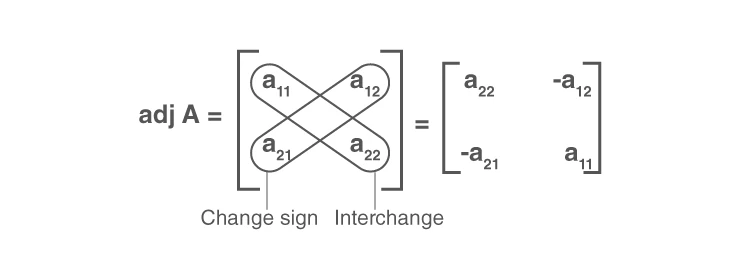
For a 2 × 2 matrix \( A = \begin{bmatrix} a & b \\ c & d \end{bmatrix} \), the adjoint is found by swapping the elements on the main diagonal and changing the signs of the off-diagonal elements. This yields:
\[ \text{adj } A = \begin{bmatrix} d & -b \\ -c & a \end{bmatrix} \]
This method is straightforward and does not require calculating minors or cofactors explicitly.
Example: Finding the Adjoint of a 2 × 2 Matrix
Problem: Determine the adjoint of matrix \( C = \begin{bmatrix} 3 & 8 \\ 4 & 6 \end{bmatrix} \).
Solution:
Swap the diagonal elements and change the signs of the off-diagonal elements:
\[ \text{adj } C = \begin{bmatrix} 6 & -8 \\ -4 & 3 \end{bmatrix} \]
Adjoint Computation for 3 × 3 Matrices
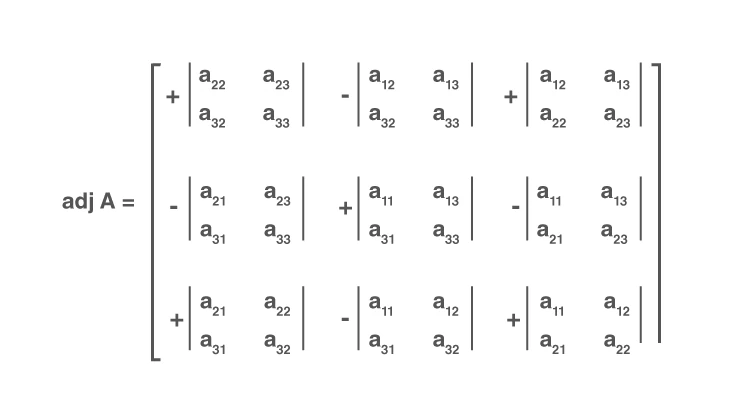
For a 3 × 3 matrix \( A = \begin{bmatrix} a_{11} & a_{12} & a_{13} \\ a_{21} & a_{22} & a_{23} \\ a_{31} & a_{32} & a_{33} \end{bmatrix} \), the adjoint is the transpose of the cofactor matrix. Each cofactor \( C_{ij} \) is calculated as:
\[ C_{ij} = (-1)^{i+j} \det(M_{ij}) \]
where \( M_{ij} \) is the minor matrix formed by removing the \( i^{th} \) row and \( j^{th} \) column from \( A \).
Example: Calculating the Adjoint of a 3 × 3 Matrix
Problem: Find the adjoint of matrix \( D = \begin{bmatrix} 2 & 0 & 1 \\ 3 & 4 & 5 \\ 1 & 0 & 6 \end{bmatrix} \).
Solution:
Calculate cofactors for each element of \( D \):
For example, cofactor \( C_{11} \):
\[ M_{11} = \begin{bmatrix} 4 & 5 \\ 0 & 6 \end{bmatrix}, \quad \det(M_{11}) = (4)(6) - (5)(0) = 24 \]
Since \( i+j = 1+1 = 2 \) is even, \( C_{11} = (+1) \times 24 = 24 \).
Similarly, calculate all cofactors and form the cofactor matrix:
\[ \begin{bmatrix} 24 & -3 & -12 \\ 0 & 11 & -2 \\ -5 & 3 & 8 \end{bmatrix} \]
Transpose this matrix to get the adjoint:
\[ \text{adj } D = \begin{bmatrix} 24 & 0 & -5 \\ -3 & 11 & 3 \\ -12 & -2 & 8 \end{bmatrix} \]
Key Properties and Practical Applications of the Adjoint Matrix
Fundamental Properties of the Adjoint Matrix
The adjoint matrix has several important characteristics that are useful in matrix algebra:
- For any square matrix \( A \) of order \( n \), the product of \( A \) and its adjoint satisfies: \( A \times \text{adj } A = \text{adj } A \times A = (\det A) I \), where \( I \) is the identity matrix.
- The adjoint of the zero matrix is the zero matrix: \( \text{adj } 0 = 0 \).
- The adjoint of the identity matrix is the identity matrix itself: \( \text{adj } I = I \).
- For any scalar \( k \), \( \text{adj } (kA) = k^{n-1} \text{adj } A \).
- The adjoint of the transpose equals the transpose of the adjoint: \( \text{adj } (A^T) = (\text{adj } A)^T \).
- The determinant of the adjoint matrix is related to the determinant of the original matrix by: \( \det(\text{adj } A) = (\det A)^{n-1} \).
- If \( A \) is invertible, then \( \text{adj } A = (\det A) A^{-1} \), and the inverse of the adjoint is \( (\det A)^{-1} A \).
- For two matrices \( A \) and \( B \) of order \( n \), \( \text{adj } (AB) = \text{adj } B \times \text{adj } A \).
- For any integer \( p \geq 0 \), \( \text{adj } (A^p) = (\text{adj } A)^p \). This also holds for negative powers if \( A \) is invertible.
Example: Verifying a Property of the Adjoint Matrix
Problem: Let \( E = \begin{bmatrix} 1 & 2 \\ 3 & 4 \end{bmatrix} \). Verify that \( E \times \text{adj } E = (\det E) I \).
Solution:
Calculate the determinant:
\[ \det E = (1)(4) - (2)(3) = 4 - 6 = -2 \]
Find the adjoint of \( E \):
\[ \text{adj } E = \begin{bmatrix} 4 & -2 \\ -3 & 1 \end{bmatrix} \]
Multiply \( E \) and \( \text{adj } E \):
\[ E \times \text{adj } E = \begin{bmatrix} 1 & 2 \\ 3 & 4 \end{bmatrix} \times \begin{bmatrix} 4 & -2 \\ -3 & 1 \end{bmatrix} = \begin{bmatrix} (1)(4)+(2)(-3) & (1)(-2)+(2)(1) \\ (3)(4)+(4)(-3) & (3)(-2)+(4)(1) \end{bmatrix} = \begin{bmatrix} 4 - 6 & -2 + 2 \\ 12 - 12 & -6 + 4 \end{bmatrix} = \begin{bmatrix} -2 & 0 \\ 0 & -2 \end{bmatrix} \]
This equals \( (\det E) I = -2 \times \begin{bmatrix} 1 & 0 \\ 0 & 1 \end{bmatrix} \), confirming the property.
Practical Steps to Compute the Adjoint Matrix
To find the adjoint of any square matrix:
- Calculate the minor for each element by deleting the corresponding row and column.
- Determine the cofactor by applying the sign \( (-1)^{i+j} \) to each minor.
- Form the cofactor matrix using these cofactors.
- Transpose the cofactor matrix to obtain the adjoint matrix.
Summary Table: Quick Reference for Adjoint Matrix Concepts
| Concept | Details |
|---|---|
| Matrix Order | Number of rows × Number of columns (e.g., 2 × 2, 3 × 3) |
| Adjoint Definition | Transpose of the cofactor matrix of a square matrix |
| Adjoint of 2 × 2 Matrix | \( \text{adj } \begin{bmatrix} a & b \\ c & d \end{bmatrix} = \begin{bmatrix} d & -b \\ -c & a \end{bmatrix} \) |
| Cofactor Formula | \( C_{ij} = (-1)^{i+j} \det(M_{ij}) \) |
| Minor | Determinant of matrix after removing \( i^{th} \) row and \( j^{th} \) column |
| Key Property | \( A \times \text{adj } A = (\det A) I \) |
| Adjoint of Zero Matrix | Zero matrix |
| Adjoint of Identity Matrix | Identity matrix |
| Scalar Multiplication | \( \text{adj } (kA) = k^{n-1} \text{adj } A \) |
| Inverse Relation | \( \text{adj } A = (\det A) A^{-1} \) if \( A \) is invertible |
Glossary of Important Terms Related to Adjoint Matrices
| Term | Explanation |
|---|---|
| Matrix | A rectangular array of numbers arranged in rows and columns. |
| Square Matrix | A matrix with equal number of rows and columns. |
| Order of Matrix | Dimensions of a matrix expressed as rows × columns. |
| Minor | Determinant of the submatrix formed by deleting one row and one column. |
| Cofactor | Minor multiplied by \( (-1)^{i+j} \) depending on element position. |
| Adjoint (Adjugate) | Transpose of the cofactor matrix of a square matrix. |
| Determinant | A scalar value representing certain properties of a square matrix. |
| Identity Matrix | A square matrix with 1s on the diagonal and 0s elsewhere. |
| Inverse Matrix | A matrix which when multiplied with the original matrix yields the identity matrix. |
| Transpose | Matrix obtained by swapping rows and columns of the original matrix. |
Frequently Asked Questions on the Adjoint of a Matrix
What is the main use of the adjoint matrix?
The adjoint matrix is primarily used to find the inverse of a square matrix when the determinant is non-zero.
Can the adjoint be found for non-square matrices?
No, the adjoint is defined only for square matrices because cofactors and determinants require square matrices.
How is the cofactor different from the minor?
The minor is the determinant of a submatrix, while the cofactor is the minor multiplied by \( (-1)^{i+j} \) to include the sign based on position.
Is the adjoint matrix always invertible?
The adjoint matrix is invertible if and only if the original matrix is invertible (i.e., its determinant is non-zero).
How does the adjoint relate to the transpose?
The adjoint is the transpose of the cofactor matrix, combining both cofactor calculation and transposition.