Understanding the Dynamics of Chemical Reaction Rates
Fundamentals of Reaction Speed in Chemistry
Defining the Speed of Chemical Transformations
The speed at which reactants convert into products during a chemical process is known as the reaction rate. This rate indicates how quickly a reaction proceeds to completion. For instance, the combustion of paper occurs rapidly, completing in a fraction of a second, whereas the rusting of iron is a much slower process.
Reaction rates vary widely; some reactions happen almost instantly, while others take considerable time to reach equilibrium. Understanding this rate helps in predicting and controlling chemical processes effectively.
Example: Consider the burning of dry leaves, which happens swiftly due to rapid oxidation, compared to the gradual tarnishing of silver over months. This illustrates how reaction rates differ based on the nature of the reaction.
Key Elements Influencing How Fast Reactions Occur
Several factors determine the pace of a chemical reaction. These include the physical state of reactants, their concentration, temperature, pressure, and the presence of catalysts. For example, reactions involving gases generally proceed faster than those involving solids due to increased particle mobility.
Additionally, smaller particle sizes increase surface area, enhancing reaction speed. The solvent type and electromagnetic radiation can also impact the rate by altering energy availability or reactant interactions.
Example: When powdered sugar dissolves in water, it reacts faster than sugar cubes because the powder has a larger surface area exposed to the solvent.
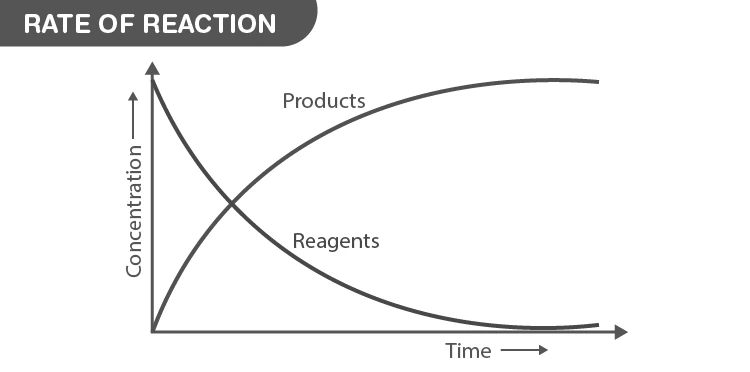
Illustration of various factors influencing reaction speed
Role of Catalysts and Energy in Reaction Progress
Catalysts accelerate reactions by providing an alternative pathway with lower activation energy, without being consumed. Activation energy is the minimum energy required for reactants to transform into products. Higher temperatures increase particle energy, leading to more effective collisions and faster reactions.
However, some reactions proceed independently of temperature, especially those without an activation barrier. The intensity of light and electromagnetic radiation can also supply energy, enhancing reaction rates.
Example: The decomposition of hydrogen peroxide speeds up in the presence of manganese dioxide catalyst, which lowers the activation energy needed.
Mathematical Representation of Reaction Rates
Expressing Reaction Rate Using Concentration Changes
Consider a general reaction:
\[ aA + bB \rightarrow pP + qQ \]
Here, \(A\) and \(B\) are reactants, \(P\) and \(Q\) are products, and \(a, b, p, q\) are their stoichiometric coefficients. The rate of reaction is defined as the change in concentration of reactants or products per unit time, adjusted by their coefficients.
Mathematically, the rate can be expressed as:
\[ \text{Rate} = -\frac{1}{a} \frac{d[A]}{dt} = -\frac{1}{b} \frac{d[B]}{dt} = \frac{1}{p} \frac{d[P]}{dt} = \frac{1}{q} \frac{d[Q]}{dt} \]
The negative signs indicate the decrease in reactant concentrations over time.

Formula depicting the rate of reaction in terms of concentration changes
Example: For the reaction \(2X \rightarrow 3Y\), if the concentration of \(X\) decreases by 0.04 mol/L in 10 seconds, calculate the rate of reaction.
Solution:
Rate = \(-\frac{1}{2} \times \frac{\Delta [X]}{\Delta t} = -\frac{1}{2} \times \frac{-0.04}{10} = 0.002 \text{ mol/L/s}\)
The positive value indicates the reaction rate.
Average Versus Instantaneous Reaction Rates
The average rate measures the change in concentration over a finite time interval, while the instantaneous rate refers to the rate at a specific moment. Instantaneous rate is found by taking the limit as the time interval approaches zero.
For a reaction \(A \rightarrow B\), if the concentration of \(A\) changes from \([A]_1\) at time \(t_1\) to \([A]_2\) at time \(t_2\), the average rate is:
\[ \text{Average rate} = -\frac{[A]_2 - [A]_1}{t_2 - t_1} \]
The instantaneous rate at time \(t\) is:
\[ \text{Instantaneous rate} = -\frac{d[A]}{dt} \]
Example: In a reaction, the concentration of reactant \(C\) decreases from 0.50 mol/L at 20 seconds to 0.30 mol/L at 40 seconds. Calculate the average rate of disappearance of \(C\).
Solution:
\[ \text{Average rate} = -\frac{0.30 - 0.50}{40 - 20} = -\frac{-0.20}{20} = 0.01 \text{ mol/L/s} \]
This means \(C\) is consumed at a rate of 0.01 mol/L per second on average during this interval.
Essential Concepts and Applications in Reaction Kinetics
Understanding Reactants, Products, and Activation Energy
Reactants are the starting substances in a chemical reaction, which transform into products, the new substances formed. The transformation requires overcoming an energy barrier known as activation energy, the minimum energy needed for molecules to react.
Effective collisions between reactant molecules, proper orientation, and sufficient energy are necessary for product formation. As the reaction proceeds, reactant concentration decreases while product concentration increases.
Example: In the reaction of hydrogen and oxygen to form water, hydrogen and oxygen are reactants, water is the product, and the activation energy is the energy needed to break bonds before new ones form.
Influence of External Conditions on Reaction Progress
Temperature, pressure, and light intensity can significantly affect reaction rates. Higher temperatures increase particle energy, leading to more frequent and energetic collisions. Increased pressure raises gas concentration, accelerating reactions involving gases.
Light intensity can provide energy to reactants, enhancing reaction speed, especially in photochemical reactions. The solvent's nature and ionic strength also play roles in determining how fast reactions proceed.
Example: The rate of photosynthesis in plants increases with light intensity up to a certain point, demonstrating the effect of electromagnetic radiation on reaction rates.
Practical Importance of Reaction Rate Studies
Studying reaction rates is crucial in industries to optimize conditions for maximum efficiency and safety. Chemical kinetics helps engineers design reactors and control processes to achieve desired product yields economically.
Advances in reaction engineering and biochemical engineering rely heavily on understanding and manipulating reaction rates.
Exam Tip: Remember that catalysts speed up both forward and reverse reactions by lowering activation energy but are not consumed in the process.
Quick Reference: Summary of Reaction Rate Essentials
Concept | Key Point |
|---|---|
Reaction Rate | Speed at which reactants convert to products |
Factors Affecting Rate | Nature of reactants, concentration, temperature, pressure, catalysts, surface area |
Activation Energy | Minimum energy required for reaction to occur |
Rate Formula | \(\text{Rate} = -\frac{1}{a} \frac{d[A]}{dt} = \frac{1}{p} \frac{d[P]}{dt}\) |
Average Rate | Change in concentration over a time interval |
Instantaneous Rate | Rate at a specific moment, \(-\frac{d[A]}{dt}\) |
Catalyst | Speeds up reaction by lowering activation energy without being consumed |
Effect of Temperature | Higher temperature increases reaction rate by providing energy |
Effect of Pressure | Increased pressure speeds up reactions involving gases |
Surface Area | Smaller particle size increases reaction rate |
Glossary of Key Terms in Reaction Kinetics
Term | Definition |
|---|---|
Activation Energy | Minimum energy needed for reactants to transform into products |
Catalyst | Substance that increases reaction rate without being consumed |
Concentration | Amount of substance per unit volume |
Instantaneous Rate | Reaction rate at a specific instant in time |
Average Rate | Reaction rate over a finite time interval |
Collision Theory | Theory stating reactions occur when particles collide with sufficient energy and proper orientation |
Reactants | Starting substances in a chemical reaction |
Products | Substances formed as a result of a chemical reaction |
Stoichiometric Coefficients | Numbers indicating the proportions of reactants and products in a reaction |
Surface Area | Total area exposed by particles, affecting reaction speed |
Frequently Asked Questions on Reaction Rates
What determines the speed of a chemical reaction?
The reaction speed depends on factors like reactant nature, concentration, temperature, pressure, catalysts, and surface area.
How does a catalyst affect a reaction?
A catalyst lowers the activation energy, increasing the reaction rate without being consumed.
What is the difference between average and instantaneous reaction rates?
Average rate is over a time interval; instantaneous rate is at a specific moment, found by taking the derivative of concentration with respect to time.
Why does increasing temperature speed up reactions?
Higher temperature increases particle energy, leading to more frequent and effective collisions.
How is reaction rate expressed mathematically?
Reaction rate is expressed as the change in concentration of reactants or products per unit time, adjusted by stoichiometric coefficients, e.g., \(\text{Rate} = -\frac{1}{a} \frac{d[A]}{dt}\).