Understanding Radioactivity: Principles, Types, and Applications
Fundamentals of Radioactive Phenomena
Concept and Origin of Radioactivity
Radioactivity arises from the inherent instability within an atom's nucleus, causing it to emit energy spontaneously. This emission occurs because the nucleus is held together by two opposing forces: the electrostatic repulsion between protons and the strong nuclear force that binds nucleons. As the nucleus grows larger, the balance between these forces becomes delicate, increasing the likelihood of instability. Elements such as Uranium and Plutonium exhibit this instability prominently, leading to their radioactive nature.
The discovery of radioactivity was accidental, credited to Henri Becquerel, who observed that uranium compounds could expose photographic plates even when shielded from light. This observation led to the understanding that certain elements emit invisible radiation continuously.
Radioactive emissions are categorized mainly into three types:
Alpha decay: Emission of helium nuclei.
Beta decay: Emission of electrons or positrons.
Gamma decay: Emission of high-energy photons.
Visual representation of alpha, beta, and gamma radiations
Example: Identifying Radiation Types
A radioactive source emits particles that are helium nuclei. What type of radiation is this, and what is the charge of the emitted particle?
Solution:
The emission of helium nuclei corresponds to alpha radiation.
An alpha particle consists of 2 protons and 2 neutrons, giving it a charge of +2.
Principles Governing Radioactive Decay
Fundamental Laws of Radioactivity
The process of radioactivity follows several key principles that govern the behavior of unstable nuclei:
The decay of a nucleus is a spontaneous process independent of external conditions such as temperature and pressure.
Charge conservation is maintained during radioactive decay; the total charge before and after decay remains constant.
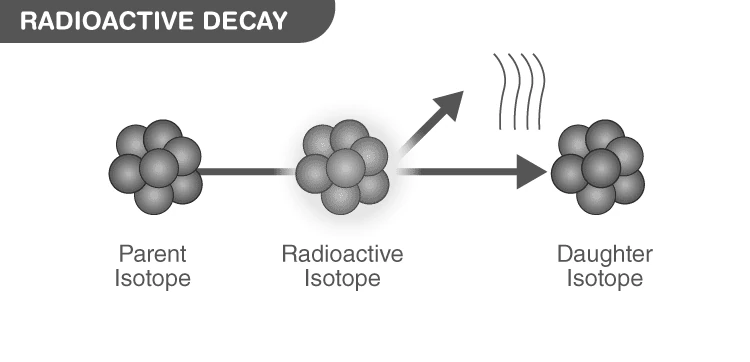
The daughter nucleus formed after decay has different physical and chemical properties compared to the original (parent) nucleus.
Radioactive decay involves the emission of alpha, beta, or gamma particles, often accompanied by energy release.
The rate of decay depends on the number of undecayed atoms present at any given time, following an exponential decay pattern.
Example: Decay Rate Dependence
If a sample contains 8000 radioactive atoms and the decay rate is proportional to the number of atoms, what happens to the decay rate when the number of atoms reduces to 4000?
Solution:
The decay rate is directly proportional to the number of radioactive atoms.
When the number of atoms halves from 8000 to 4000, the decay rate also halves.
Measurement and Characteristics of Radioactivity
Units and Quantification of Radioactive Emission
Radioactivity is quantified using specific units that measure the rate of nuclear decay:
Curie (Ci): Represents the activity of a quantity of radioactive material in which 3.7 × 10¹⁰ disintegrations occur per second.
Rutherford (Rd): Another unit where 1 Rd equals one million disintegrations per second.
The relationship between these units is given by:
\[ 1 \text{ Ci} = 3.7 \times 10^{4} \text{ Rd} \]
Example: Unit Conversion
A radioactive source has an activity of 7.4 × 10⁴ Rd. Express this activity in Curies.
Solution:
Using the relation \(1 \text{ Ci} = 3.7 \times 10^{4} \text{ Rd}\),
\[ \text{Activity in Ci} = \frac{7.4 \times 10^{4} \text{ Rd}}{3.7 \times 10^{4} \text{ Rd/Ci}} = 2 \text{ Ci} \]
Alpha Decay: Mechanism and Implications
Process and Characteristics of Alpha Emission
Alpha decay is a radioactive process where an unstable nucleus emits an alpha particle, which is essentially a helium nucleus composed of two protons and two neutrons. This emission reduces the atomic number by two and the mass number by four, resulting in a new element with a more stable nucleus.
For example, Uranium-238 undergoes alpha decay to form Thorium-234 as shown:
\[ {}^{238}_{92}\textrm{U} \rightarrow {}^{234}_{90}\textrm{Th} + {}^{4}_{2}\textrm{He} \]
In general, alpha decay can be represented as:
\[ {}^{A}_{Z}\textrm{X} \rightarrow {}^{A-4}_{Z-2}\textrm{Y} + {}^{4}_{2}\textrm{He} \]
Alpha particles carry a +2 charge and have significant mass, which causes them to interact strongly with matter, losing energy rapidly and traveling only a few centimeters in air.
Example: Alpha Decay Transformation
Polonium-210 undergoes alpha decay. Write the nuclear equation for this decay and identify the daughter nucleus.
Solution:
Polonium-210 has atomic number 84. After alpha decay:
\[ {}^{210}_{84}\textrm{Po} \rightarrow {}^{206}_{82}\textrm{Pb} + {}^{4}_{2}\textrm{He} \]
The daughter nucleus is Lead-206.
Conditions and Effects of Alpha Decay
Alpha decay predominantly occurs in heavy elements with large, unstable nuclei. The emitted alpha particles typically possess energies around 5 MeV and travel at approximately 5% of the speed of light. Due to their double positive charge and mass, alpha particles have high ionizing power but limited penetration, being stopped by a few centimeters of air or a sheet of paper.
Despite their limited range, alpha particles can cause severe damage to living tissues if ingested or inhaled, leading to burns or blisters due to their intense ionization.
Example: Penetration Ability
Explain why alpha particles cannot penetrate human skin but are dangerous if inhaled.
Solution:
Alpha particles have low penetration power and are stopped by the outer dead layer of skin.
If inhaled, alpha emitters come into direct contact with sensitive internal tissues, causing significant ionization damage.
Practical Applications and Considerations of Radioactivity
Beneficial Uses of Radioactive Materials
Radioactivity has several important applications across various fields:
Smoke Detectors: Americium-241, an alpha emitter, ionizes air inside smoke detectors, enabling the detection of smoke particles.
Medical Treatments: Gamma rays from isotopes like Cobalt-60 are used in radiotherapy to target and destroy cancer cells.
Food Preservation: Gamma radiation is employed to kill microbes in food, extending shelf life.
Geological Dating: Radioactive decay measurements help determine the age of rocks and fossils.
Example: Smoke Detector Function
How does Americium-241 help in smoke detection?
Answer:
Americium-241 emits alpha particles that ionize air molecules inside the detector chamber.
This ionization allows a small electric current to flow.
When smoke enters, it disrupts the current, triggering the alarm.
Advantages and Risks Associated with Radioactivity
Advantages:
Effective cancer treatment through targeted radiotherapy.
Non-invasive internal body scanning using gamma rays.
Food sterilization to prevent spoilage.
Accurate dating of archaeological and geological samples.
Disadvantages:
Exposure to high doses of radiation can be fatal.
Radioactive materials and isotopes are costly and require careful handling.
Radioactive contamination poses environmental and health hazards.
Exam Tip: Remember that alpha particles have low penetration but high ionizing power, making them dangerous internally but easily blocked externally.
Quick Reference Summary
Concept | Details |
|---|---|
Radioactivity | Spontaneous emission of particles and energy from unstable nuclei |
Types of Radiation | Alpha (helium nuclei), Beta (electrons/positrons), Gamma (photons) |
Unit of Activity | Curie (Ci), Rutherford (Rd); \(1 \text{ Ci} = 3.7 \times 10^{4} \text{ Rd}\) |
Alpha Decay Effect | Atomic number decreases by 2, mass number decreases by 4 |
Alpha Particle | Charge +2, mass of 4 nucleons, low penetration, high ionization |
Applications | Smoke detectors, cancer treatment, food sterilization, geological dating |
Advantages | Medical uses, sterilization, dating techniques |
Disadvantages | Health hazards, cost, environmental risks |
Glossary of Key Terms
Term | Definition |
|---|---|
Alpha Particle | A helium nucleus emitted during alpha decay, consisting of 2 protons and 2 neutrons. |
Beta Decay | Radioactive decay involving emission of electrons or positrons. |
Curie (Ci) | Unit measuring radioactivity equal to 3.7 × 10¹⁰ disintegrations per second. |
Decay Rate | The speed at which radioactive atoms disintegrate over time. |
Daughter Nucleus | The new nucleus formed after radioactive decay. |
Gamma Rays | High-energy electromagnetic radiation emitted during radioactive decay. |
Half-life | The time required for half the atoms in a radioactive sample to decay. |
Ionizing Power | The ability of radiation to ionize atoms and molecules. |
Radioactive Isotope | An unstable isotope that undergoes radioactive decay. |
Rutherford (Rd) | Unit of radioactivity equal to one million disintegrations per second. |
Frequently Asked Questions
What does the half-life of a radioactive isotope signify?
The half-life is the average duration in which half of the radioactive atoms in a sample decay.
Can you list some practical uses of radioactivity?
Radioactivity is used in smoke detectors, sterilizing medical tools, diagnosing and treating diseases, and generating electricity.
How is radioactivity defined?
It is the spontaneous emission of energy and subatomic particles from unstable atomic nuclei due to nuclear instability.
Who was the first to discover radioactivity?
Henri Becquerel discovered radioactivity accidentally while studying uranium salts.
What is the conversion between Curie and Rutherford units?
One Curie equals 3.7 × 10⁴ Rutherfords, i.e., \(1 \text{ Ci} = 3.7 \times 10^{4} \text{ Rd}\).