Comprehensive Techniques for Synthesizing Aldehydes
Fundamentals of Carbonyl Compounds and Aldehydes
Organic molecules featuring a carbon-oxygen double bond are classified as carbonyl compounds, a pivotal functional group in organic chemistry. These compounds are broadly categorized into aldehydes and ketones based on the atoms bonded to the carbonyl carbon. Aldehydes possess the carbonyl group attached to at least one hydrogen atom, represented as -CHO, whereas ketones have the carbonyl carbon bonded to two carbon atoms, denoted as -CO-. This section focuses on various synthetic routes to obtain aldehydes.
Primary Methods for Aldehyde Synthesis
Oxidative Conversion of Primary Alcohols
One of the most straightforward approaches to generate aldehydes involves the controlled oxidation of primary alcohols. When primary alcohols undergo oxidation, they yield aldehydes, while secondary alcohols typically form ketones. This reaction is fundamental in organic synthesis and can be represented as:
\[ \text{R-CH}_2\text{OH} \xrightarrow[\text{oxidation}]{} \text{R-CHO} \]
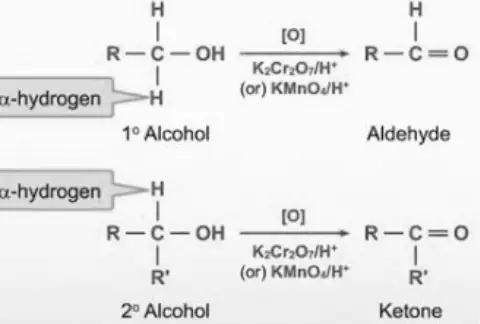
Illustration of aldehyde formation via oxidation of primary alcohol
Example Problem
Calculate the product formed when 1-butanol is oxidized under mild conditions.
Solution:
1-butanol (CH3CH2CH2CH2OH) is a primary alcohol. Upon oxidation, it forms butanal (CH3CH2CH2CHO).
Reaction:
\[ \text{CH}_3\text{CH}_2\text{CH}_2\text{CH}_2\text{OH} \xrightarrow[\text{oxidation}]{} \text{CH}_3\text{CH}_2\text{CH}_2\text{CHO} \]
Thus, the aldehyde produced is butanal.
Dehydrogenation of Alcohols Using Metal Catalysts
Dehydrogenation involves the removal of hydrogen atoms from alcohols, typically facilitated by metal catalysts such as copper. This industrially significant method converts volatile primary alcohols into their corresponding aldehydes efficiently. For instance, ethanol and isopropanol, when passed over copper at elevated temperatures, yield ethanal and acetone respectively.
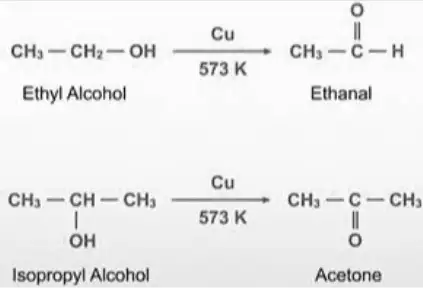
Dehydrogenation process of alcohols using copper catalyst
Example Problem
What is the product when propanol is dehydrogenated over a copper catalyst at 573 K?
Solution:
Propanol (CH3CH2CH2OH) is a primary alcohol. Dehydrogenation removes hydrogen to form propanal (CH3CH2CHO).
Reaction:
\[ \text{CH}_3\text{CH}_2\text{CH}_2\text{OH} \xrightarrow[\text{Cu, 573 K}]{} \text{CH}_3\text{CH}_2\text{CHO} + \text{H}_2 \]
The aldehyde formed is propanal.
Ozonolysis of Alkenes to Yield Aldehydes
Aldehydes can be synthesized by cleaving alkenes through ozonolysis. Initially, the alkene reacts with ozone to form an unstable ozonide intermediate. Subsequent treatment with zinc dust and water breaks down the ozonide, producing aldehydes or ketones depending on the alkene's structure.
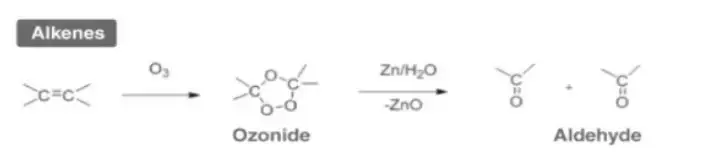
Ozonolysis reaction pathway for aldehyde formation
Example Problem
Determine the products formed when 1-hexene undergoes ozonolysis followed by reductive workup.
Solution:
1-hexene (CH2=CH(CH2)3CH3) cleaves at the double bond.
Products:
\[ \text{CH}_2=CH(CH_2)_3CH_3 \xrightarrow[\text{O}_3, \text{Zn/H}_2\text{O}]{} \text{HCHO} + \text{CH}_3(CH_2)_3CHO \]
Formaldehyde (HCHO) and pentanal (CH3(CH2)3CHO) are formed.
Additional Synthetic Routes for Aldehydes
Reduction of Acyl Chlorides via Rosenmund Reduction
Aldehydes can be prepared by selectively hydrogenating acid chlorides using palladium catalysts poisoned with barium sulfate, a process known as Rosenmund reduction. This method stops the reduction at the aldehyde stage, preventing further conversion to alcohols.
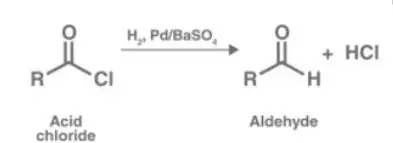
Selective hydrogenation of acyl chlorides to aldehydes
Example Problem
What aldehyde results from the Rosenmund reduction of benzoyl chloride?
Solution:
Benzoyl chloride (C6H5COCl) upon Rosenmund reduction forms benzaldehyde (C6H5CHO).
Reaction:
\[ \text{C}_6\text{H}_5\text{COCl} \xrightarrow[\text{Pd/BaSO}_4, \text{H}_2]{} \text{C}_6\text{H}_5\text{CHO} \]
Stephen Reaction: Conversion of Nitriles to Aldehydes
The Stephen reaction involves the partial reduction of nitriles using stannous chloride and hydrochloric acid to form imines, which upon hydrolysis yield aldehydes. This method is valuable for synthesizing aldehydes from nitrile precursors.

Synthesis of aldehydes via Stephen reaction
Example Problem
Identify the aldehyde formed when benzonitrile undergoes the Stephen reaction.
Solution:
Benzonitrile (C6H5CN) is converted to benzaldehyde (C6H5CHO) through the Stephen reaction.
Reaction:
\[ \text{C}_6\text{H}_5\text{CN} \xrightarrow[\text{SnCl}_2, \text{HCl}]{} \text{C}_6\text{H}_5\text{CHO} \]
Preparation of Aromatic Aldehydes from Hydrocarbons
Controlled Oxidation of Methylbenzene Derivatives
Toluene and its derivatives can be oxidized to benzoic acid by strong oxidants. However, by employing specific reagents, the oxidation can be halted at the aldehyde stage, producing benzaldehyde without further oxidation.
One such reagent is chromyl chloride (CrO2Cl2), which forms a chromium complex with toluene that hydrolyzes to benzaldehyde, a process known as the Etard reaction.
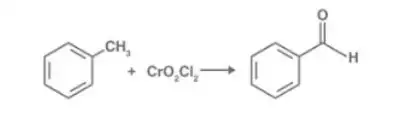
Etard reaction: oxidation of toluene to benzaldehyde
Example Problem
What is the product when toluene reacts with chromyl chloride followed by hydrolysis?
Solution:
Toluene (C6H5CH3) forms benzaldehyde (C6H5CHO) via the Etard reaction.
Reaction:
\[ \text{C}_6\text{H}_5\text{CH}_3 + \text{CrO}_2\text{Cl}_2 \xrightarrow[\text{hydrolysis}]{} \text{C}_6\text{H}_5\text{CHO} \]
Oxidation Using Chromic Oxide in Acetic Anhydride
When toluene or its substituted derivatives react with chromic acid in acetic anhydride, benzylidene diacetate is formed. Subsequent hydrolysis of this intermediate yields benzaldehyde. This method offers an alternative pathway to aromatic aldehydes.
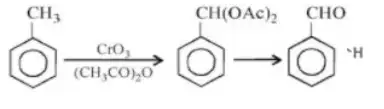
Formation of benzaldehyde via chromic oxide oxidation
Example Problem
Describe the product obtained when toluene is treated with chromic acid in acetic anhydride followed by hydrolysis.
Solution:
Toluene is converted to benzylidene diacetate, which upon hydrolysis yields benzaldehyde.
Reaction:
\[ \text{C}_6\text{H}_5\text{CH}_3 \xrightarrow[\text{CrO}_3, \text{Ac}_2\text{O}]{} \text{C}_6\text{H}_5\text{CH(OAc)}_2 \xrightarrow[\text{hydrolysis}]{} \text{C}_6\text{H}_5\text{CHO} \]
Gattermann–Koch Formylation of Aromatic Rings
The Gattermann–Koch reaction introduces a formyl group into aromatic rings by treating benzene or its derivatives with carbon monoxide and hydrogen chloride in the presence of aluminium chloride catalyst. This method efficiently produces benzaldehyde or substituted benzaldehydes.
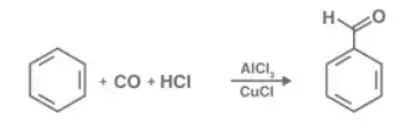
Gattermann–Koch reaction producing benzaldehyde
Example Problem
What is the product when benzene undergoes the Gattermann–Koch reaction?
Solution:
Benzene (C6H6) reacts to form benzaldehyde (C6H5CHO).
Reaction:
\[ \text{C}_6\text{H}_6 + \text{CO} + \text{HCl} \xrightarrow[\text{AlCl}_3]{} \text{C}_6\text{H}_5\text{CHO} \]
Quick Reference: Summary of Aldehyde Preparation Methods
Method | Starting Material | Reagents/Conditions | Product |
|---|---|---|---|
Oxidation of Primary Alcohols | Primary Alcohols | Oxidizing agents (e.g., PCC, KMnO4) | Aldehydes |
Dehydrogenation | Primary Alcohols | Cu catalyst, 573 K | Aldehydes |
Ozonolysis | Alkenes | O3, Zn/H2O | Aldehydes/Ketones |
Rosenmund Reduction | Acyl Chlorides | H2, Pd/BaSO4 | Aldehydes |
Stephen Reaction | Nitriles | SnCl2, HCl, Hydrolysis | Aldehydes |
Etard Reaction | Toluene | CrO2Cl2, Hydrolysis | Benzaldehyde |
Chromic Oxide Oxidation | Toluene | CrO3, Acetic Anhydride, Hydrolysis | Benzaldehyde |
Gattermann–Koch Reaction | Benzene | CO, HCl, AlCl3 | Benzaldehyde |
Glossary of Key Terms
Term | Definition |
|---|---|
Carbonyl Group | A functional group consisting of a carbon atom double bonded to an oxygen atom (C=O). |
Aldehyde | An organic compound with a carbonyl group bonded to at least one hydrogen atom (-CHO). |
Ketone | A carbonyl compound where the carbonyl carbon is bonded to two carbon atoms (-CO-). |
Oxidation | A chemical process involving the loss of electrons or increase in oxidation state. |
Dehydrogenation | Removal of hydrogen atoms from a molecule, often using catalysts. |
Ozonolysis | A reaction where ozone cleaves double bonds in alkenes to form carbonyl compounds. |
Rosenmund Reduction | Selective hydrogenation of acyl chlorides to aldehydes using poisoned palladium catalysts. |
Stephen Reaction | Reduction of nitriles to imines followed by hydrolysis to form aldehydes. |
Etard Reaction | Oxidation of methyl groups in aromatic compounds to aldehydes using chromyl chloride. |
Gattermann–Koch Reaction | Formylation of aromatic rings using CO and HCl in the presence of AlCl3. |
Frequently Asked Questions
What defines an aldehyde in organic chemistry?
An aldehyde is an organic molecule containing a carbonyl group bonded to at least one hydrogen atom and another substituent, typically represented as -CHO.
Are aldehydes acidic or basic in nature?
Aldehydes generally have a planar sp2-hybridized carbonyl carbon. The C–H bond in aldehydes is not acidic, and aldehydes do not exhibit basic properties.
What are some common applications of aldehydes?
Aldehydes like formaldehyde are used in disinfectants, preservatives, resin production (e.g., Bakelite), and as intermediates in manufacturing adhesives, coatings, and pharmaceuticals.
Where are natural aldehydes found?
Natural aldehydes occur in substances such as cinnamon bark (cinnamaldehyde) and vanilla beans (vanillin), contributing to their characteristic aromas and flavors.
How can aldehydes be distinguished from ketones?
Aldehydes have at least one hydrogen attached to the carbonyl carbon, while ketones have two carbon substituents. Chemical tests like Tollens' test can differentiate them, as aldehydes reduce Tollens' reagent, producing a silver mirror.