Comprehensive Guide to Nucleophilic Substitution Reactions
Fundamentals of Nucleophilic Substitution
Understanding the Core Concept and Participants
Nucleophilic substitution is a fundamental organic reaction where a nucleophile replaces another group attached to a carbon atom. This process resembles displacement reactions in inorganic chemistry, where a more reactive species displaces a less reactive one. The group that departs, taking an electron pair with it, is termed the leaving group, while the molecule undergoing substitution is called the substrate. The leaving group typically exits as a neutral molecule or an anion.
In these reactions, the strength or reactivity of the nucleophile is referred to as its nucleophilicity. A stronger nucleophile displaces a weaker one from the substrate, as illustrated below:
\[ \text{R-LG} + \text{Nu}^- \rightarrow \text{R-Nu} + \text{LG}^- \]
Here, R represents an alkyl group, and LG is the leaving group with lower nucleophilicity.
For example, when methyl bromide reacts with sodium hydroxide, methanol is formed along with sodium bromide:
\[ \mathrm{CH_3Br} + \mathrm{OH}^- \rightarrow \mathrm{CH_3OH} + \mathrm{Br}^- \]
Methyl bromide acts as the substrate, hydroxide ion is the nucleophile, and bromide ion is the leaving group.
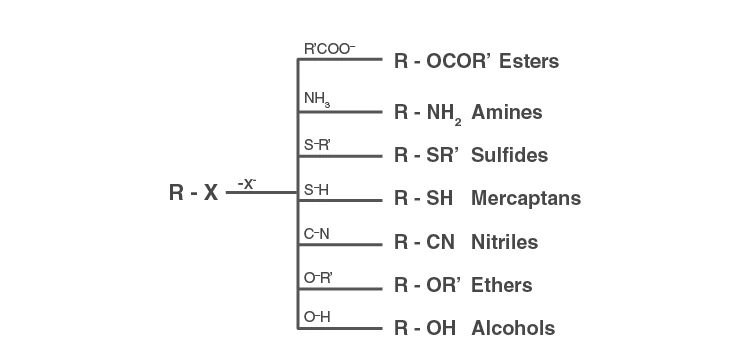
Diagram illustrating nucleophilic substitution process
Example Problem
Predict the product when ethyl chloride reacts with hydroxide ion.
Solution:
Ethyl chloride (\(\mathrm{C_2H_5Cl}\)) is the substrate, and hydroxide ion (\(\mathrm{OH}^-\)) is the nucleophile. The hydroxide ion will replace the chloride ion, which is the leaving group.
Reaction:
\[ \mathrm{C_2H_5Cl} + \mathrm{OH}^- \rightarrow \mathrm{C_2H_5OH} + \mathrm{Cl}^- \]
The product formed is ethanol (\(\mathrm{C_2H_5OH}\)) and chloride ion is released.
Factors Influencing Nucleophilicity
Key Elements Affecting Nucleophile Strength
Nucleophilicity measures how readily a nucleophile donates its lone pair to an electrophilic center. It is a kinetic property related to the reaction rate. Several factors influence nucleophilicity:
Basic Strength: Strong bases tend to be stronger nucleophiles. For example, among halide ions, the order of basic strength is \(\mathrm{F}^- > \mathrm{Cl}^- > \mathrm{Br}^- > \mathrm{I}^-\), which generally correlates with nucleophilicity in non-protic solvents.
Electronegativity: Nucleophiles with lone pairs on less electronegative atoms are more nucleophilic because their electrons are less tightly held. For instance, \(\mathrm{SH}^-\) is a better nucleophile than \(\mathrm{OH}^-\), despite \(\mathrm{OH}^-\) being a stronger base.
Electron-Donating Groups: Groups that release electrons increase nucleophilicity by raising electron density on the nucleophilic atom. For example, \(\mathrm{CH_3COO}^-\) is more nucleophilic than \(\mathrm{HCOO}^-\) due to the electron-donating methyl group.
Steric Hindrance: Bulky nucleophiles have reduced nucleophilicity because their approach to the electrophilic center is hindered. Tertiary alkoxides are less nucleophilic than primary or secondary ones.
Charge: Negatively charged nucleophiles are generally more reactive than their neutral counterparts. For example, \(\mathrm{OH}^-\) is more nucleophilic than \(\mathrm{H_2O}\).
Solvent Effects: Polar protic solvents can decrease nucleophilicity by stabilizing nucleophiles through hydrogen bonding (hydration). Smaller ions with higher charge density, like \(\mathrm{F}^-\), are more heavily hydrated and thus less nucleophilic in such solvents.
Example Problem
Compare the nucleophilicity of \(\mathrm{Cl}^-\) and \(\mathrm{Br}^-\) in water.
Solution:
Although \(\mathrm{Cl}^-\) is a stronger base than \(\mathrm{Br}^-\), in aqueous solution \(\mathrm{Br}^-\) is more nucleophilic because it is less hydrated due to its larger size, which allows it to attack electrophiles more readily.
Leaving Group Ability and Its Impact
Role of Leaving Groups in Reaction Rates
The rate of nucleophilic substitution is influenced not only by the nucleophile but also by the leaving group's ability to depart. A good leaving group is typically a weak base, as it can stabilize the negative charge after departure. The general order of leaving group ability among halides is:
\[ \mathrm{F}^- < \mathrm{Cl}^- < \mathrm{Br}^- < \mathrm{I}^- \]
Here, iodide is the best leaving group due to its large size and ability to stabilize the negative charge effectively.
Example Problem
Which halide ion would be the best leaving group in a nucleophilic substitution reaction: \(\mathrm{Cl}^-\), \(\mathrm{Br}^-\), or \(\mathrm{I}^-\)? Explain.
Solution:
\(\mathrm{I}^-\) is the best leaving group because it is the weakest base among the three and can stabilize the negative charge more effectively due to its larger atomic radius.
\(\mathrm{Br}^-\) is intermediate in leaving ability.
\(\mathrm{Cl}^-\) is the poorest leaving group among these.
Mechanistic Pathways of Nucleophilic Substitution
Exploring SN2 Reaction Dynamics
The SN2 (Substitution Nucleophilic Bimolecular) mechanism involves a single concerted step where the nucleophile attacks the substrate from the opposite side of the leaving group, leading to simultaneous bond formation and bond breaking. The rate depends on both the substrate and nucleophile concentrations:
\[ \text{Rate} = k[\text{R-LG}][\text{Nu}^-] \]
This backside attack causes inversion of stereochemistry at the carbon center, often called the Walden inversion.
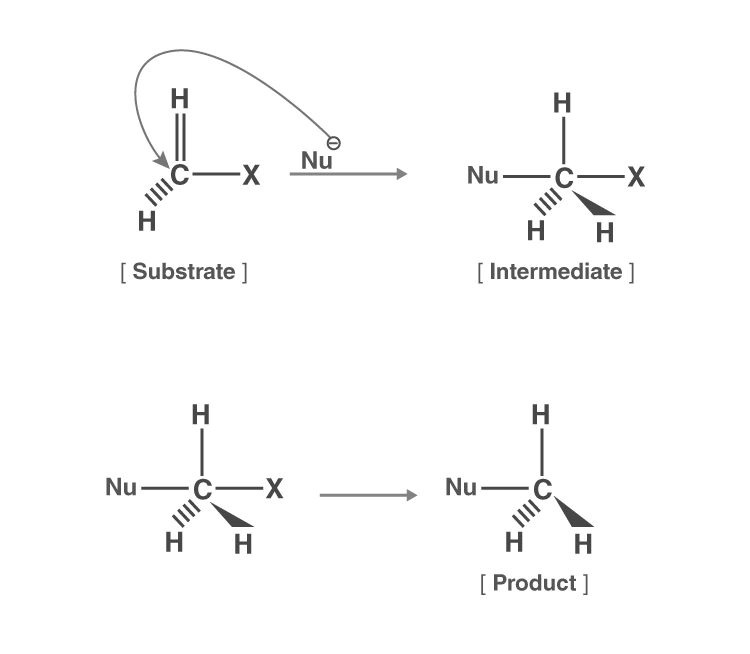
SN2 mechanism illustrating backside nucleophilic attack
Bulky substrates hinder the nucleophile's approach, making tertiary alkyl halides less reactive in SN2 reactions. The reactivity order is:
\[ 1^\circ > 2^\circ > 3^\circ \]
Polar aprotic solvents like DMF and DMSO enhance SN2 reaction rates by not strongly solvating nucleophiles.
Example Problem
Predict the stereochemical outcome when (R)-2-bromobutane undergoes an SN2 reaction with hydroxide ion.
Solution:
The hydroxide ion attacks from the backside, displacing bromide and inverting the configuration at the chiral center. Thus, the product will be (S)-2-butanol.
Understanding the SN1 Reaction Mechanism
The SN1 (Substitution Nucleophilic Unimolecular) mechanism proceeds via two steps: first, the leaving group departs forming a carbocation intermediate; second, the nucleophile attacks the carbocation. The rate depends only on the substrate concentration:
\[ \text{Rate} = k[\text{R-LG}] \]
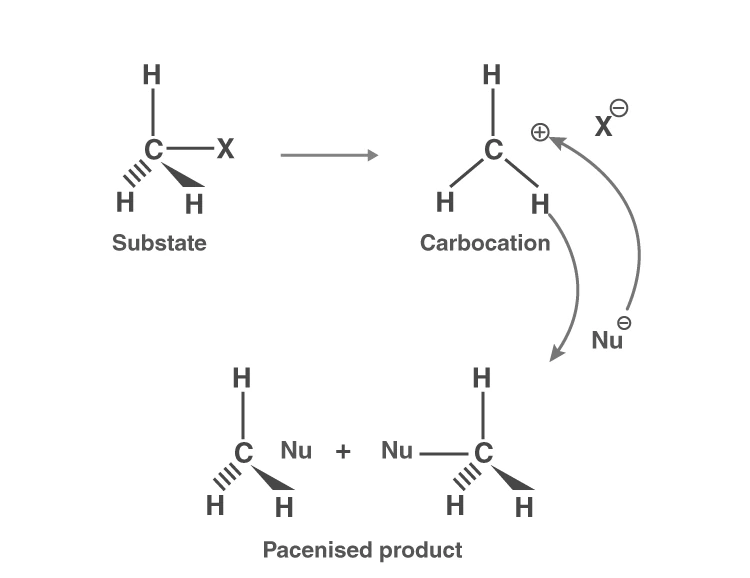
SN1 mechanism involving carbocation intermediate formation
Because the carbocation is planar, the nucleophile can attack from either side, resulting in a racemic mixture of products with retention and inversion of configuration.
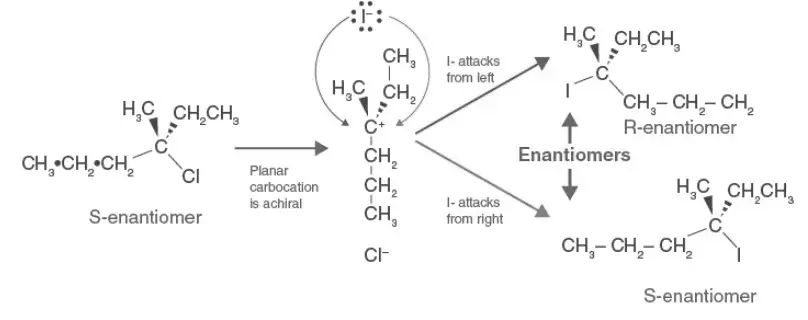
Racemization due to nucleophilic attack on planar carbocation in SN1
Tertiary alkyl halides are most reactive in SN1 due to carbocation stability, with the order:
\[ 3^\circ > 2^\circ > 1^\circ \]
Polar protic solvents stabilize carbocations and enhance SN1 reaction rates.
Example Problem
Explain the product mixture when tert-butyl chloride reacts with water under SN1 conditions.
Solution:
First, tert-butyl chloride forms a tertiary carbocation by losing chloride.
Water attacks the planar carbocation from both sides equally.
This results in a racemic mixture of (R)- and (S)-tert-butyl alcohol.
Comparing SN1 and SN2 Reactions
Key Differences in Mechanism and Reactivity
Feature | SN1 Reaction | SN2 Reaction |
|---|---|---|
Mechanism | Two-step with carbocation intermediate | One-step concerted reaction |
Rate Law | Depends only on substrate concentration: \(r = k[\text{R-LG}]\) | Depends on substrate and nucleophile: \(r = k[\text{R-LG}][\text{Nu}^-]\) |
Stereochemistry | Racemization (both retention and inversion) | Inversion of configuration (Walden inversion) |
Substrate Reactivity | \(3^\circ > 2^\circ > 1^\circ\) | \(1^\circ > 2^\circ > 3^\circ\) |
Rearrangements | Possible carbocation rearrangements | No rearrangements |
Electrophilic Substitution Reactions Overview
Introduction to Electrophilic Aromatic Substitution
Electrophilic substitution involves replacing one electrophile with another, commonly observed in aromatic compounds like benzene. The mechanism typically proceeds via the formation of an arenium ion intermediate, followed by restoration of aromaticity.
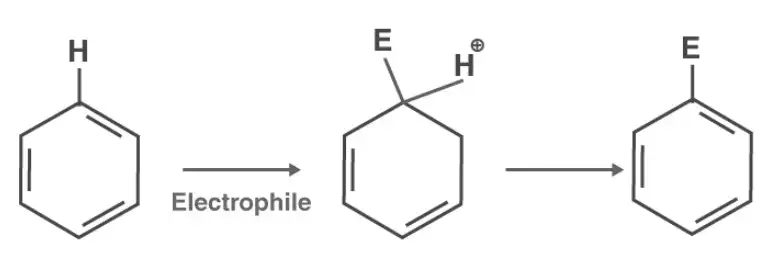
General mechanism of electrophilic substitution in benzene
Common electrophilic substitution reactions include:
Nitration: Introduction of a nitro group (\(-\mathrm{NO_2}\)) using nitric acid and sulfuric acid.
Nitration reaction of benzene
Friedel-Crafts Halogenation: Substitution of a halogen atom onto the aromatic ring.
Friedel-Crafts halogenation process
Friedel-Crafts Alkylation: Introduction of alkyl groups onto the aromatic ring.
Friedel-Crafts alkylation reaction
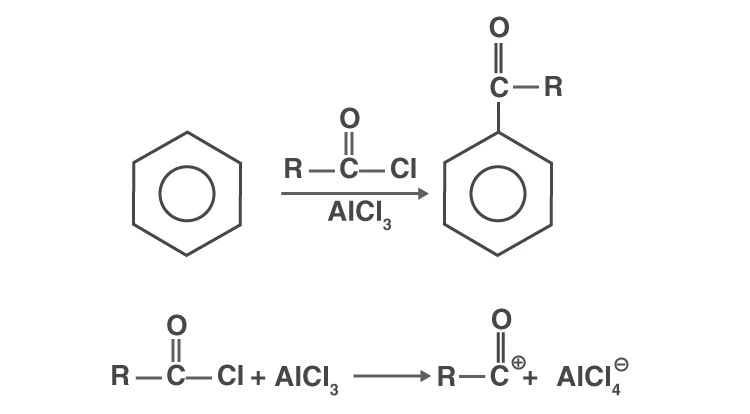
Various electrophilic substitution reactions on aromatic rings
Quick Reference Summary
Aspect | SN1 Reaction | SN2 Reaction |
|---|---|---|
Mechanism | Two-step, carbocation intermediate | One-step, concerted |
Rate Law | Rate depends on substrate only | Rate depends on substrate and nucleophile |
Stereochemistry | Racemization | Inversion of configuration |
Substrate Preference | Tertiary > Secondary > Primary | Primary > Secondary > Tertiary |
Leaving Group Ability | Better leaving groups increase rate | Better leaving groups increase rate |
Solvent Effect | Polar protic solvents favor SN1 | Polar aprotic solvents favor SN2 |
Glossary of Key Terms
Term | Definition |
|---|---|
Nucleophile | A species that donates an electron pair to an electrophile to form a bond. |
Leaving Group | The atom or group that detaches from the substrate during substitution. |
Substrate | The molecule undergoing substitution in a reaction. |
SN1 Reaction | Unimolecular nucleophilic substitution involving carbocation intermediate. |
SN2 Reaction | Bimolecular nucleophilic substitution with a single concerted step. |
Carbocation | A positively charged carbon intermediate formed during SN1 reactions. |
Nucleophilicity | The kinetic ability of a nucleophile to attack an electrophilic center. |
Basic Strength | Thermodynamic tendency of a species to accept protons. |
Steric Hindrance | Resistance to reaction due to bulky groups around reactive sites. |
Polar Protic Solvent | Solvents capable of hydrogen bonding, affecting nucleophile reactivity. |
Frequently Asked Questions
Which nucleophilic substitution mechanism involves a carbocation intermediate?
The SN1 mechanism proceeds through a carbocation intermediate formed after the leaving group departs.
What distinguishes the SN2 mechanism from SN1 in terms of steps?
SN2 is a single-step reaction where bond formation and bond breaking occur simultaneously, unlike the two-step SN1 mechanism.
What is the order of substrate reactivity in SN2 reactions?
Primary alkyl halides react fastest, followed by secondary, with tertiary being least reactive due to steric hindrance.
How does solvent choice affect SN1 and SN2 reactions?
Polar protic solvents favor SN1 by stabilizing carbocations, while polar aprotic solvents enhance SN2 by not strongly solvating nucleophiles.
Can you name some common electrophilic substitution reactions?
Nitration, Friedel-Crafts alkylation, and Friedel-Crafts acylation are typical examples of electrophilic substitution on aromatic rings.