Understanding the Nernst Equation in Electrochemistry
Fundamentals of the Nernst Equation
Concept and Mathematical Formulation
The Nernst equation is a vital tool in electrochemistry that links the potential of an electrochemical cell to its standard potential, temperature, and the concentrations of reactants and products. It enables the calculation of cell potentials under non-standard conditions, such as varying ion concentrations or temperatures.
For a general redox reaction involving the transfer of electrons, the cell potential \( E_{\text{cell}} \) can be expressed as:
\[ E_{\text{cell}} = E^\circ_{\text{cell}} - \frac{RT}{nF} \ln Q \]
Where:
\( E^\circ_{\text{cell}} \) is the standard cell potential (at 298 K, 1 atm, 1 M concentration)
\( R \) is the universal gas constant (8.314 J/mol·K)
\( T \) is the absolute temperature in Kelvin
\( n \) is the number of electrons transferred in the reaction
\( F \) is the Faraday constant (96485 C/mol)
\( Q \) is the reaction quotient, representing the ratio of product and reactant activities
At 25°C (298 K), this equation simplifies to:
\[ E_{\text{cell}} = E^\circ_{\text{cell}} - \frac{0.0592}{n} \log_{10} Q \]
This form is widely used for practical calculations involving electrochemical cells.
Example 1: Calculating Electrode Potential of a Zinc Ion Solution
Given the standard electrode potential of the zinc ion is 0.76 V, find the electrode potential of a 3 M zinc ion solution at 298 K.
Solution:
The Nernst equation for the zinc half-cell is:
\[ E = E^\circ - \frac{0.0592}{n} \log_{10} \frac{1}{[Zn^{2+}]} \]
Here, \( n = 2 \), \( [Zn^{2+}] = 3 \text{ M} \), and \( E^\circ = 0.76 \text{ V} \).
Substituting values:
\[ E = 0.76 - \frac{0.0592}{2} \log_{10} \frac{1}{3} = 0.76 - 0.0296 \times (-0.4771) = 0.76 + 0.0141 = 0.7741 \text{ V} \]
Therefore, the electrode potential of the 3 M zinc ion solution at 298 K is approximately 0.774 V.
Deriving the Nernst Equation from Thermodynamic Principles
Linking Gibbs Free Energy and Electrode Potential
The Nernst equation originates from the relationship between Gibbs free energy change and electrical work in electrochemical reactions. Consider a metal electrode in equilibrium with its ions in solution:
\[ M^{n+} + ne^- \rightleftharpoons M \]
The maximum electrical work done when electrons move is related to the Gibbs free energy change \( \Delta G \) by:
\[ W_{\text{max}} = -\Delta G = nFE \]
At standard conditions, the Gibbs free energy change is:
\[ \Delta G^\circ = -nFE^\circ \]
For non-standard conditions, the Gibbs free energy change is given by the Van't Hoff equation:
\[ \Delta G = \Delta G^\circ + RT \ln Q \]
Substituting and rearranging yields the Nernst equation:
\[ E = E^\circ - \frac{RT}{nF} \ln Q \]
This derivation highlights how changes in concentration affect the electrode potential.
Example 2: Determining Cell Potential at Non-Standard Conditions
Calculate the cell potential for the reaction \( Cu^{2+} + Zn \rightarrow Cu + Zn^{2+} \) at 298 K, given \( E^\circ_{Cu^{2+}/Cu} = 0.34 \text{ V} \), \( E^\circ_{Zn^{2+}/Zn} = -0.76 \text{ V} \), \( [Cu^{2+}] = 0.01 \text{ M} \), and \( [Zn^{2+}] = 0.1 \text{ M} \).
Solution:
The standard cell potential is:
\[ E^\circ_{\text{cell}} = E^\circ_{\text{cathode}} - E^\circ_{\text{anode}} = 0.34 - (-0.76) = 1.10 \text{ V} \]
The reaction quotient \( Q \) is:
\[ Q = \frac{[Zn^{2+}]}{[Cu^{2+}]} = \frac{0.1}{0.01} = 10 \]
Using the Nernst equation:
\[ E_{\text{cell}} = 1.10 - \frac{0.0592}{2} \log_{10} 10 = 1.10 - 0.0296 \times 1 = 1.0704 \text{ V} \]
Thus, the cell potential under these conditions is approximately 1.07 V.
Equilibrium Constants and the Nernst Equation
Connecting Cell Potential to Chemical Equilibrium
At equilibrium, the cell potential becomes zero because the forward and reverse reactions occur at the same rate. The reaction quotient \( Q \) equals the equilibrium constant \( K \), and the Gibbs free energy change \( \Delta G \) is zero.
Setting \( E_{\text{cell}} = 0 \) in the Nernst equation gives:
\[ 0 = E^\circ_{\text{cell}} - \frac{RT}{nF} \ln K \]
Rearranged to express the equilibrium constant:
\[ \ln K = \frac{nFE^\circ_{\text{cell}}}{RT} \]
At 298 K, converting to base-10 logarithm:
\[ \log_{10} K = \frac{nE^\circ_{\text{cell}}}{0.0592} \]
This equation links the standard cell potential to the position of equilibrium, indicating whether the reaction favors products or reactants.
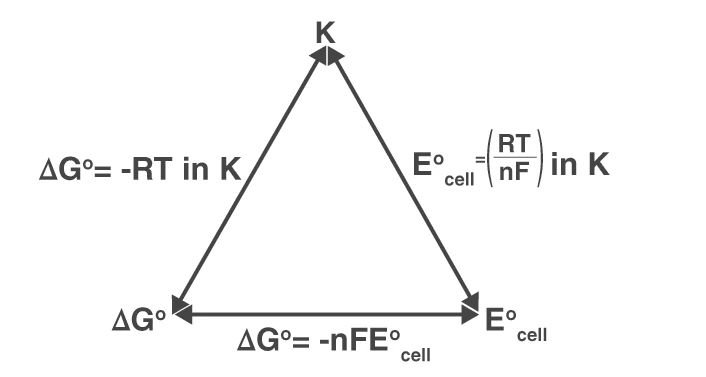
Graphical representation of the Nernst equation, equilibrium constant, and Gibbs free energy relationship
Example 3: Calculating Equilibrium Constant from Cell Potential
For a redox reaction with a standard cell potential of 0.44 V involving 2 electrons, find the equilibrium constant at 298 K.
Solution:
Using the formula:
\[ \log_{10} K = \frac{nE^\circ_{\text{cell}}}{0.0592} = \frac{2 \times 0.44}{0.0592} = 14.86 \]
Therefore,
\[ K = 10^{14.86} \approx 7.24 \times 10^{14} \]
This large value of \( K \) indicates the reaction strongly favors the formation of products.
Practical Uses and Constraints of the Nernst Equation
Applications in Electrochemical Analysis
The Nernst equation is extensively applied to:
Calculate electrode potentials under varying conditions
Determine unknown ion concentrations in solutions
Estimate the pH of solutions using hydrogen ion concentration
Assess the feasibility of redox reactions and cell combinations
Measure solubility of sparingly soluble salts
Limitations and Considerations
Despite its usefulness, the Nernst equation has some limitations:
It assumes ion activity equals concentration, which is inaccurate in highly concentrated or very dilute solutions.
It is valid only under equilibrium or near-equilibrium conditions; when current flows, factors like overpotential and resistance affect the potential.
Experimental determination of ion activity coefficients may be necessary for precise calculations.
Example 4: Finding Silver Ion Concentration in a Copper-Silver Cell
In a copper-silver electrochemical cell at 298 K, the cell potential is 0.45 V. Given \( E^\circ_{Ag^+/Ag} = 0.80 \text{ V} \), \( E^\circ_{Cu^{2+}/Cu} = 0.34 \text{ V} \), and \( [Cu^{2+}] = 0.05 \text{ M} \), calculate the concentration of \( Ag^+ \) ions.
Solution:
The standard cell potential is:
\[ E^\circ_{\text{cell}} = E^\circ_{\text{cathode}} - E^\circ_{\text{anode}} = 0.80 - 0.34 = 0.46 \text{ V} \]
The balanced cell reaction is:
\[ 2Ag^+ + Cu \rightarrow 2Ag + Cu^{2+} \]
Number of electrons transferred, \( n = 2 \).
Reaction quotient \( Q \) is:
\[ Q = \frac{[Cu^{2+}]}{[Ag^+]^2} = \frac{0.05}{[Ag^+]^2} \]
Using the Nernst equation:
\[ E_{\text{cell}} = E^\circ_{\text{cell}} - \frac{0.0592}{n} \log_{10} Q \]
Substitute values:
\[ 0.45 = 0.46 - \frac{0.0592}{2} \log_{10} \left( \frac{0.05}{[Ag^+]^2} \right) \]
Rearranged:
\[ \frac{0.0592}{2} \log_{10} \left( \frac{0.05}{[Ag^+]^2} \right) = 0.46 - 0.45 = 0.01 \]
\[ \log_{10} \left( \frac{0.05}{[Ag^+]^2} \right) = \frac{0.01 \times 2}{0.0592} = 0.338 \]
\[ \log_{10} 0.05 - 2 \log_{10} [Ag^+] = 0.338 \]
\[ -1.3010 - 2 \log_{10} [Ag^+] = 0.338 \]
\[ -2 \log_{10} [Ag^+] = 0.338 + 1.3010 = 1.639 \]
\[ \log_{10} [Ag^+] = -0.8195 \]
\[ [Ag^+] = 10^{-0.8195} = 0.151 \text{ M} \]
The silver ion concentration is approximately 0.151 M.
Quick Reference: Key Formulas and Constants
Parameter | Value / Formula | Notes |
|---|---|---|
Universal Gas Constant (R) | 8.314 J·mol\(^{-1}\)·K\(^{-1}\) | Used in thermodynamic calculations |
Faraday Constant (F) | 96485 C·mol\(^{-1}\) | Charge per mole of electrons |
Standard Temperature (T) | 298 K (25°C) | Common reference temperature |
Nernst Equation (General) | \( E = E^\circ - \frac{RT}{nF} \ln Q \) | Relates cell potential to reaction quotient |
Nernst Equation (at 25°C) | \( E = E^\circ - \frac{0.0592}{n} \log_{10} Q \) | Simplified for standard lab conditions |
Equilibrium Constant Relation | \( \log_{10} K = \frac{nE^\circ}{0.0592} \) | Connects standard potential to equilibrium |
Number of Electrons (n) | Varies per reaction | Determined from balanced redox equation |
Reaction Quotient (Q) | Ratio of product to reactant activities | Changes with concentration |
Standard Cell Potential (\(E^\circ\)) | Measured under standard conditions | Reference for calculations |
Temperature (T) | Kelvin scale | Must be in absolute units for calculations |
Glossary of Important Terms
Term | Definition |
|---|---|
Nernst Equation | Mathematical relation to calculate cell potential under non-standard conditions |
Standard Electrode Potential | Potential of an electrode measured under standard conditions |
Reaction Quotient (Q) | Ratio of concentrations or activities of products to reactants at any point |
Equilibrium Constant (K) | Ratio of product to reactant concentrations at equilibrium |
Faraday Constant (F) | Charge carried by one mole of electrons |
Gibbs Free Energy (\( \Delta G \)) | Thermodynamic quantity indicating spontaneity of a reaction |
Electrode Potential | Voltage developed at the interface of an electrode and electrolyte |
Overpotential | Additional potential required to drive a non-equilibrium electrochemical reaction |
Redox Reaction | Reaction involving transfer of electrons between species |
Standard Conditions | Temperature 298 K, pressure 1 atm, and 1 M concentration |
Frequently Asked Questions
What does the Nernst equation calculate?
It calculates the potential of an electrochemical cell or electrode under any conditions of concentration, temperature, and pressure.
Why is the Nernst equation important in electrochemistry?
Because it allows prediction of cell potentials beyond standard conditions, helping understand real-world battery and corrosion behavior.
Can the Nernst equation be used when current flows through the cell?
No, it applies only under equilibrium or near-equilibrium conditions; current flow introduces overpotentials and resistive losses.
How is the equilibrium constant related to the Nernst equation?
The equilibrium constant can be derived from the standard cell potential using the Nernst equation at equilibrium when cell potential is zero.
What are the limitations of using concentration instead of activity in the Nernst equation?
In concentrated or very dilute solutions, ion activity differs from concentration, leading to inaccuracies unless activity coefficients are used.