Comprehensive Overview of Amines: Nitrogen-Containing Organic Compounds
Fundamentals of Amines and Their Molecular Architecture
Defining Amines and Their Structural Characteristics
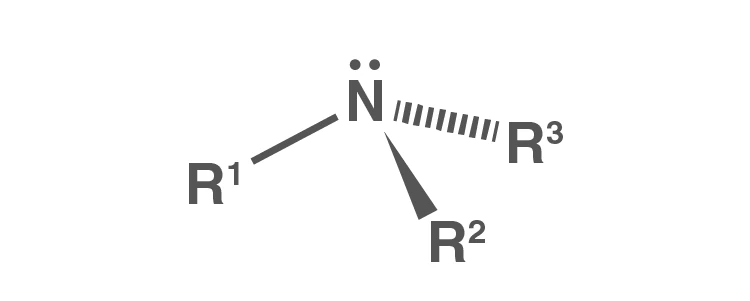
Amines are a vital category of organic molecules distinguished by the presence of a nitrogen atom bearing a lone electron pair. Structurally, they are derivatives of ammonia (NH3), where one or more hydrogen atoms are substituted by alkyl or aryl groups, resulting in alkylamines or arylamines respectively. Unlike amides, which contain a carbonyl group attached to nitrogen (R–CO–NR′R″), amines lack this feature, leading to distinct chemical behaviors.
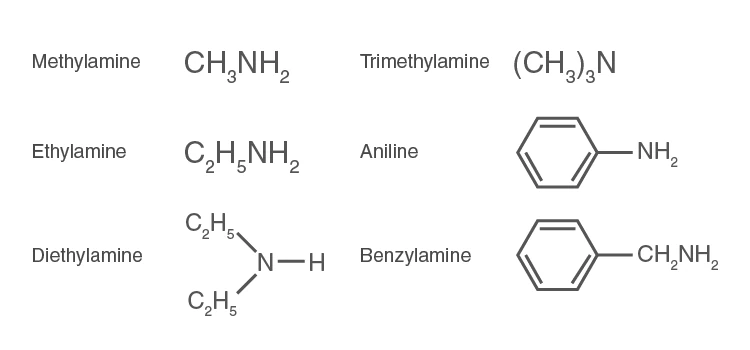
Illustration of amine molecular structure highlighting nitrogen's lone pair
Example Problem
Identify the functional group in the compound with formula C2H7N and explain its classification.
Solution: The formula C2H7N corresponds to ethylamine (CH3CH2NH2), where one hydrogen of ammonia is replaced by an ethyl group. This compound is a primary amine because only one hydrogen atom of ammonia is substituted by an alkyl group.
Spatial Arrangement and Hybridization of Nitrogen in Amines
The nitrogen atom in amines has five valence electrons and forms three sigma bonds with either hydrogen or carbon atoms, leaving one lone pair. According to Valence Shell Electron Pair Repulsion (VSEPR) theory, the nitrogen is sp3 hybridized, resulting in a pyramidal geometry rather than a perfect tetrahedron due to the lone pair's repulsion. This lone pair compresses the bond angles, making the C–N–H bond angle approximately 107°, slightly less than the ideal tetrahedral angle of 109.5°.
Example Problem
Calculate the expected bond angle in a simple amine molecule and explain the deviation from the tetrahedral angle.
Solution: In amines, the nitrogen is sp3 hybridized with one lone pair and three bonded atoms. The lone pair exerts greater repulsion, reducing the bond angle from 109.5° to about 107°. Thus, the C–N–H bond angle is approximately 107° due to lone pair-bond pair repulsion.
Classification and Natural Occurrence of Amines
Varieties of Amines Based on Substitution Patterns
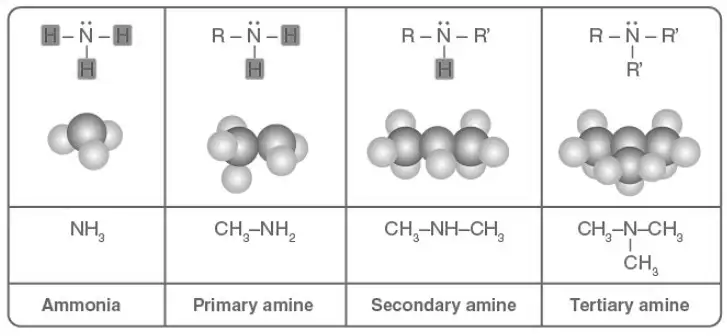
Amines are categorized by the number of hydrogen atoms in ammonia replaced by organic groups. The four main types include:
Primary Amines: One hydrogen replaced by an alkyl or aryl group (e.g., methylamine CH3NH2, aniline C6H5NH2).
Secondary Amines: Two hydrogens replaced by organic groups (e.g., dimethylamine (CH3)2NH, diphenylamine (C6H5)2NH).
Tertiary Amines: All three hydrogens replaced by organic substituents (e.g., trimethylamine N(CH3)3).
Cyclic Amines: Secondary or tertiary amines incorporated into ring structures (e.g., piperidine (CH2)5NH, aziridines C2H5N).
Classification of amines based on substitution of hydrogen atoms
Example Problem
Classify the amine with formula (C2H5)2NH and justify your answer.
Solution: The compound (C2H5)2NH has two ethyl groups attached to nitrogen, replacing two hydrogens. This makes it a secondary amine because two hydrogen atoms of ammonia are substituted by alkyl groups.
Natural Presence and Synthetic Applications of Amines
Amines are naturally found in biological molecules such as proteins, vitamins, and hormones. They also play a crucial role in synthetic chemistry for producing polymers, pharmaceuticals, and dyes. Their presence in neurotransmitters like serotonin highlights their biological significance.
Amines occurring naturally in biological systems
Example Problem
Explain why amines are important in biological systems and give one example.
Solution: Amines are essential in biology as they form the building blocks of proteins (amino acids) and act as neurotransmitters. For example, serotonin is an amine that regulates mood and appetite.
Methods for Synthesizing Amines and Their Chemical Properties
Common Synthetic Routes to Primary Amines
Primary amines can be synthesized through several methods:
From Halogenoalkanes: Heating haloalkanes with concentrated ammonia in ethanol in a sealed tube produces primary amines via nucleophilic substitution. The reaction proceeds through an intermediate ammonium salt, which can revert to reactants if not controlled.

Synthesis of primary amines from halogenoalkanes
Reduction of Nitriles: Treating nitriles with lithium aluminium hydride (LiAlH4) reduces them to primary amines, adding one carbon atom more than the original nitrile.
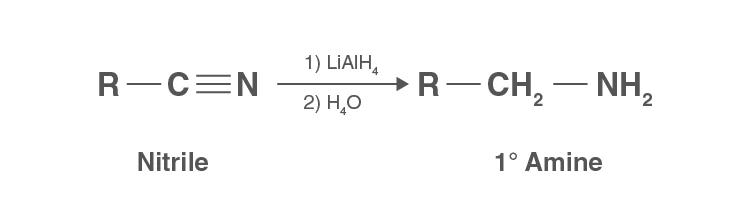
Conversion of nitriles into primary amines by reduction
Gabriel Phthalimide Synthesis: This method involves reacting phthalimide with ethanolic KOH to form potassium phthalimide, which upon alkylation and subsequent hydrolysis yields primary amines. Aromatic primary amines cannot be prepared by this method due to the resistance of aryl halides to nucleophilic substitution.
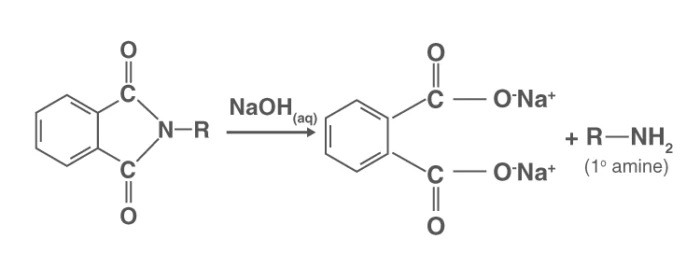
Gabriel synthesis pathway for primary amines
Example Problem
Describe the product formed when bromoethane is heated with excess ammonia in ethanol under sealed conditions.
Solution: Bromoethane reacts with ammonia to form ethylamine (a primary amine) via nucleophilic substitution. The reaction proceeds through the formation of ethylammonium bromide salt, which upon treatment yields ethylamine.
Acid-Base Behavior and Practical Applications of Amines
Amines exhibit basicity due to the lone pair on nitrogen, which can accept protons. Primary and secondary amines possess protic hydrogens, giving them weak acidic character (pKa ≈ 38), but their basicity (pKb ≈ 4) dominates, making their aqueous solutions alkaline. Tertiary amines lack protic hydrogens and thus do not show acidity.
Amines are widely used in water treatment, pharmaceutical synthesis, and as intermediates in producing insecticides and pesticides. They are also crucial in forming amino acids and neurotransmitters like serotonin, which regulate physiological functions.
Example Problem
Explain why an aqueous solution of methylamine is basic and estimate its pKb value.
Solution: Methylamine has a lone pair on nitrogen that accepts protons, making the solution basic. Its pKb is approximately 3.4, indicating moderate basic strength in water.
Quick Reference: Essential Facts About Amines
Aspect | Details |
|---|---|
Definition | Organic compounds with nitrogen atom bearing a lone pair, derived from ammonia by substitution. |
Types | Primary, Secondary, Tertiary, Cyclic amines |
Hybridization | sp3 hybridized nitrogen with pyramidal shape |
Bond Angle | Approximately 107° due to lone pair repulsion |
Basicity | pKb ~ 4; aqueous solutions are alkaline |
Preparation Methods | From halogenoalkanes, reduction of nitriles, Gabriel synthesis |
Natural Occurrence | Proteins, vitamins, hormones, neurotransmitters |
Applications | Pharmaceuticals, water purification, pesticides, amino acid synthesis |
Difference from Amides | Amines lack carbonyl group; amides contain R–CO–NR′R″ structure |
Common Examples | Methylamine, Aniline, Dimethylamine, Trimethylamine |
Glossary of Key Terms Related to Amines
Term | Meaning |
|---|---|
Amine | Organic compound containing nitrogen with a lone pair, derived from ammonia. |
Alkyl Group | A hydrocarbon substituent derived from an alkane by removing one hydrogen. |
Aryl Group | A functional group derived from an aromatic ring, such as phenyl. |
Primary Amine | Amines with one hydrogen replaced by an organic group. |
Secondary Amine | Amines with two hydrogens replaced by organic groups. |
Tertiary Amine | Amines with all three hydrogens replaced by organic groups. |
Gabriel Synthesis | A method to prepare primary amines using phthalimide derivatives. |
Hybridization | Mixing of atomic orbitals to form new hybrid orbitals. |
pKb | Measure of base strength; lower values indicate stronger bases. |
VSEPR Theory | Model to predict molecular geometry based on electron pair repulsion. |
Frequently Asked Questions About Amines
What determines the basicity order of different amines?
The basicity of amines depends on electronic effects, steric hindrance, and solvent interactions. In aqueous solution, secondary amines are generally more basic than primary, which are more basic than tertiary amines due to solvation effects and electron donation.
How do amines differ structurally from amides?
Amines contain nitrogen bonded to alkyl or aryl groups without a carbonyl group, whereas amides have a nitrogen attached directly to a carbonyl (C=O) group, giving them distinct chemical properties.
What are the main uses of amines in industry and biology?
Amines are used in manufacturing medicines, pesticides, and water treatment chemicals. Biologically, they form amino acids, neurotransmitters, and vitamins essential for life processes.
Are all amines safe for human exposure?
Many aliphatic amines are non-toxic and naturally occur in food and the body. However, some aromatic amines can be irritants or toxic, requiring careful handling.
How many types of amines exist based on substitution?
Amines are classified as primary, secondary, tertiary, and cyclic based on the number and arrangement of organic groups attached to the nitrogen atom.