Comprehensive Overview of Inner Transition Elements
Fundamental Traits of Inner Transition Metals
Key Properties and Behavior
Inner transition metals belong to the f-block of the periodic table, where electrons progressively fill the 4f and 5f orbitals. These elements are formally part of group 3 but are displayed separately due to their unique electron configurations. They are commonly referred to as inner transition elements.
These metals exhibit several distinctive features: their third-last electron shell is being filled, they often form ions with vivid colors, and they display multiple oxidation states. Notably, actinides are inherently radioactive. Elements with atomic numbers beyond 92 up to 103 are synthetic and radioactive, not naturally occurring in the Earth's crust.
Example Problem
Question: Identify three characteristic properties of inner transition elements that distinguish them from typical d-block transition metals.
Solution:
Their electrons fill the (n-2)f orbitals, unlike d-block elements where d orbitals are filled.
They often form colored ions due to f-f electronic transitions.
Actinides are radioactive, and some elements beyond uranium are synthetic.
Electronic Structure Patterns in Inner Transition Series
General Electron Configurations
The lanthanide series, spanning from cerium (Z=58) to lutetium (Z=71), fills the 4f orbitals with a general electronic configuration of \(4f^{1-14}5d^{0-1}6s^2\). Similarly, the actinide series, from thorium (Z=90) to lawrencium (Z=103), fills the 5f orbitals with configurations of \(5f^{1-14}6d^{0-1}7s^2\).
Due to the similar outer shell arrangements and comparable energies of the f-electrons, these elements predominantly exhibit a +3 oxidation state. This uniformity in electronic structure results in closely related chemical properties, making their separation challenging.
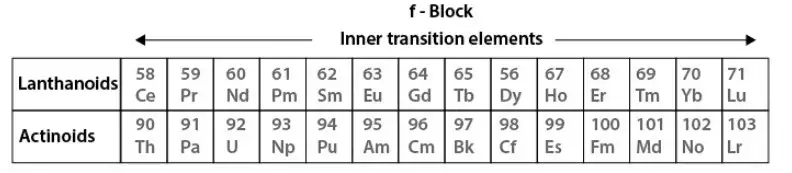
Illustration of Inner Transition Elements' Electron Configuration
Example Problem
Question: Write the expected electronic configuration for an actinide element with atomic number 94 and state its common oxidation state.
Solution:
For plutonium (Z=94), the configuration is approximately \(5f^6 6d^0 7s^2\). The common oxidation state is +3 due to the loss of three electrons from the outer shells.
\[ \text{Pu: } [Rn] 5f^6 7s^2 \quad \Rightarrow \quad \text{Common oxidation state} = +3 \]
Placement and Classification in the Periodic Table
Positioning and Grouping of f-Block Elements
Inner transition elements are positioned in the f-block, where the last electron enters the (n-2)f orbitals. Both lanthanides and actinides are metals, with actinides being radioactive. Elements beyond uranium (Z=92) are synthetic and placed separately at the bottom of the periodic table to maintain its structural symmetry.
The modern periodic table, also known as the long form, consists of seven horizontal periods and eighteen vertical groups. Groups are numbered from 1 to 18 according to IUPAC standards, replacing older notations like IA to VIIA and IB to VIIB.

Position of Inner Transition Elements in the Modern Periodic Table
Example Problem
Question: Explain why actinides are placed separately at the bottom of the periodic table rather than within the main body.
Solution:
Actinides have electrons filling the 5f orbitals, which differ from the main d-block elements.
They are mostly radioactive and include synthetic elements beyond uranium.
Placing them separately preserves the table’s symmetry and clarity.
Distinguishing Lanthanides and Actinides
Classification and Characteristics of the Two Series
The lanthanide series begins after lanthanum (La) and includes fourteen elements filling the 4f orbitals. Although lanthanum itself lacks 4f electrons, it is grouped with lanthanides due to similar chemical behavior.
The actinide series follows actinium (Ac) and comprises fourteen elements filling the 5f orbitals, from thorium (Th) to lawrencium (Lr). Actinium is included with actinides despite not having 5f electrons, owing to its chemical resemblance.
Representation of Lanthanide and Actinide Series
Example Problem
Question: Differentiate between lanthanides and actinides based on their electron filling and natural occurrence.
Solution:
Lanthanides fill the 4f orbitals; actinides fill the 5f orbitals.
Lanthanides are mostly stable and naturally abundant; actinides are radioactive and include synthetic elements.
Lanthanides generally exhibit +3 oxidation state; actinides show multiple oxidation states due to 5f electron involvement.
Summary Table for Quick Revision
Aspect | Lanthanides | Actinides |
|---|---|---|
Orbital Being Filled | 4f | 5f |
Typical Oxidation State | +3 | +3 (varies up to +6) |
Radioactivity | Mostly non-radioactive | Radioactive |
Natural Occurrence | Abundant in nature | Some synthetic elements |
Color of Ions | Colored ions common | Colored ions common |
Position in Periodic Table | Below main body, f-block | Below main body, f-block |
Glossary of Key Terms
Term | Definition |
|---|---|
Inner Transition Elements | Elements filling the 4f and 5f orbitals, located in the f-block. |
Lanthanides | Fourteen elements filling the 4f orbitals, following lanthanum. |
Actinides | Fourteen elements filling the 5f orbitals, following actinium. |
Oxidation State | The charge an atom acquires when it loses or gains electrons. |
f-block | Section of the periodic table where f orbitals are being filled. |
Radioactivity | Spontaneous emission of radiation from unstable atomic nuclei. |
Synthetic Elements | Elements not found naturally, created artificially in laboratories. |
Electron Configuration | Distribution of electrons in atomic orbitals. |
Periodic Table | Arrangement of elements based on atomic number and properties. |
Valence Electrons | Electrons in the outermost shell involved in chemical bonding. |
Frequently Asked Questions
What are inner transition metals commonly called?
They are often referred to as lanthanides and actinides, collectively known as inner transition elements or f-block elements.
How do inner transition elements differ from d-block transition metals?
Inner transition elements fill f orbitals and usually exhibit +3 oxidation state, while d-block metals fill d orbitals and show multiple oxidation states.
Why are actinides mostly radioactive?
Actinides have unstable nuclei due to their large atomic numbers, causing them to emit radiation spontaneously.
Are all inner transition elements naturally occurring?
No, elements beyond uranium (Z=92) are synthetic and produced artificially in laboratories.
What causes the colored ions in inner transition elements?
Colored ions arise from electronic transitions within the f orbitals, which absorb and emit visible light.