Understanding First-Order Chemical Reactions
Fundamentals of First-Order Reaction Kinetics
Defining the Nature of First-Order Reactions
A first-order reaction is characterized by a reaction rate that depends directly and linearly on the concentration of a single reactant. This means that if the concentration of this reactant doubles, the reaction rate also doubles, reflecting a proportional relationship. Such reactions may involve one or more reactants, but the rate is influenced by only one reactant's concentration, making the overall reaction order equal to one.
This concept is crucial in chemical kinetics as it simplifies the analysis of reaction rates and helps predict how changes in concentration affect the speed of the reaction.
Example Problem
Consider a reaction where the concentration of reactant \( A \) is initially \( 0.80 \text{ mol/L} \). If the reaction rate is \( 0.040 \text{ mol/(L·s)} \), calculate the rate constant \( k \) for this first-order reaction.
Solution:
The rate law for a first-order reaction is given by:
\[ \text{Rate} = k [A] \]
Rearranging to find \( k \):
\[ k = \frac{\text{Rate}}{[A]} = \frac{0.040 \text{ mol/(L·s)}}{0.80 \text{ mol/L}} = 0.050 \text{ s}^{-1} \]
Thus, the rate constant \( k \) is \( 0.050 \text{ s}^{-1} \).
Mathematical Expressions Governing First-Order Reactions
Formulating the Differential Rate Law
The differential rate law expresses how the concentration of a reactant changes instantaneously over time. For a first-order reaction involving reactant \( A \), the rate can be mathematically described as:
\[ \text{Rate} = -\frac{d[A]}{dt} = k [A] \]
Here, \( k \) is the rate constant with units of inverse seconds (\( \text{s}^{-1} \)), and \( [A] \) is the concentration of the reactant at time \( t \). The negative sign indicates that the concentration of \( A \) decreases as the reaction proceeds.
Example Problem
In a first-order reaction, the concentration of reactant \( B \) decreases from \( 0.50 \text{ mol/L} \) to \( 0.30 \text{ mol/L} \) in 20 seconds. Calculate the rate constant \( k \).
Solution:
Using the integrated rate law (explained in the next subtopic), but for now, we can use the differential form to understand the rate constant. However, since we have concentrations at two times, the integrated form is more appropriate here.
We will calculate \( k \) in the next section.
Deriving the Integrated Rate Law
The integrated rate law relates the concentration of the reactant at any time \( t \) to its initial concentration \( [A]_0 \) and the rate constant \( k \). Starting from the differential rate law, separation of variables and integration yield:
\[ \int_{[A]_0}^{[A]} \frac{1}{[A]} d[A] = -k \int_0^t dt \]
Evaluating the integrals gives:
\[ \ln [A] - \ln [A]_0 = -kt \]
Or equivalently,
\[ \ln [A] = \ln [A]_0 - kt \]
Exponentiating both sides results in:
\[ [A] = [A]_0 e^{-kt} \]
This equation allows calculation of the reactant concentration at any time during the reaction.
Example Problem
For a first-order reaction with an initial concentration \( [A]_0 = 1.2 \text{ mol/L} \) and rate constant \( k = 0.025 \text{ s}^{-1} \), find the concentration after 40 seconds.
Solution:
Using the integrated rate law:
\[ [A] = [A]_0 e^{-kt} = 1.2 \times e^{-0.025 \times 40} \]
Calculate the exponent:
\[ -0.025 \times 40 = -1 \]
Therefore,
\[ [A] = 1.2 \times e^{-1} = 1.2 \times 0.3679 = 0.4415 \text{ mol/L} \]
The concentration after 40 seconds is approximately \( 0.44 \text{ mol/L} \).
Visualizing and Quantifying First-Order Reaction Behavior
Graphical Interpretation of Concentration Changes
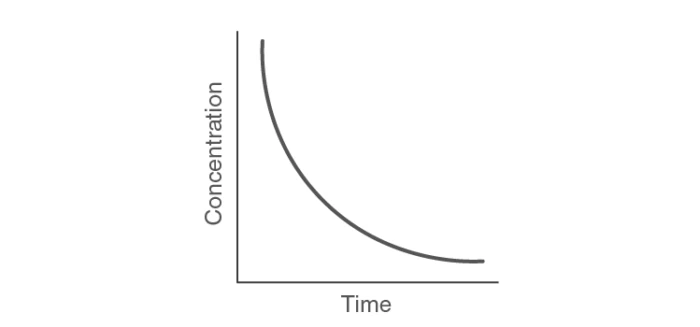
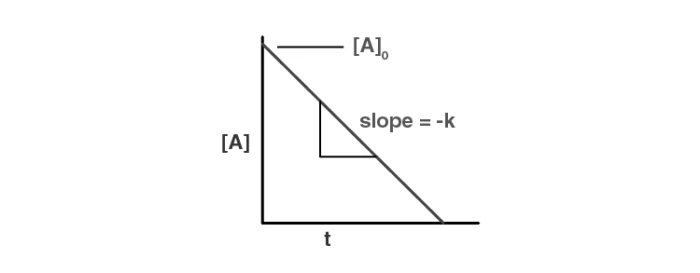
Plotting the natural logarithm of the reactant concentration \( \ln [A] \) against time \( t \) produces a straight line for a first-order reaction. The slope of this line equals the negative rate constant \( -k \), and the intercept corresponds to \( \ln [A]_0 \).
This linear relationship is a powerful tool for determining the rate constant experimentally by analyzing concentration data over time.
Example Problem
A plot of \( \ln [A] \) versus time for a reaction yields a straight line with a slope of \( -0.035 \text{ s}^{-1} \). Determine the rate constant and write the integrated rate law for this reaction.
Solution:
The slope of the line is \( -k \), so:
\[ k = 0.035 \text{ s}^{-1} \]
The integrated rate law is:
\[ \ln [A] = \ln [A]_0 - 0.035 t \]
This equation can be used to calculate the concentration at any time \( t \).
Calculating the Half-Life of a First-Order Reaction
The half-life \( t_{1/2} \) is the duration required for the reactant concentration to reduce to half its initial value. For first-order reactions, the half-life is independent of the initial concentration and is related to the rate constant by:
\[ t_{1/2} = \frac{0.693}{k} \]
This formula is derived by substituting \( [A] = \frac{[A]_0}{2} \) into the integrated rate law and solving for \( t \).
Example Problem
Given a first-order reaction with a rate constant \( k = 0.022 \text{ s}^{-1} \), calculate its half-life.
Solution:
Using the half-life formula:
\[ t_{1/2} = \frac{0.693}{0.022} = 31.5 \text{ seconds} \]
The half-life of the reaction is approximately 31.5 seconds.
Summary Table for First-Order Reaction Kinetics
| Concept | Expression | Units |
|---|---|---|
| Differential Rate Law | \( \text{Rate} = k [A] \) | \( \text{mol·L}^{-1}\text{s}^{-1} \) |
| Integrated Rate Law | \( [A] = [A]_0 e^{-kt} \) | \( \text{mol·L}^{-1} \) |
| Linearized Form | \( \ln [A] = \ln [A]_0 - kt \) | Dimensionless (logarithm) |
| Half-Life | \( t_{1/2} = \frac{0.693}{k} \) | \( \text{s} \) |
| Rate Constant Units | \( k \) | \( \text{s}^{-1} \) |
Key Terms and Definitions
| Term | Meaning |
|---|---|
| First-Order Reaction | A reaction where the rate depends linearly on the concentration of one reactant. |
| Rate Constant (k) | A proportionality constant that relates the reaction rate to reactant concentration. |
| Differential Rate Law | An expression showing the instantaneous rate of reaction as a function of concentration. |
| Integrated Rate Law | An equation relating reactant concentration to time during the reaction. |
| Half-Life (\( t_{1/2} \)) | The time required for the concentration of a reactant to reduce to half its initial value. |
| Natural Logarithm (\( \ln \)) | The logarithm to the base \( e \), used in integrated rate laws. |
| Concentration (\( [A] \)) | The amount of reactant per unit volume, typically in mol/L. |
| Reaction Order | The sum of powers to which reactant concentrations are raised in the rate law. |
| Euler’s Number (\( e \)) | The base of natural logarithms, approximately equal to 2.718. |
| Rate of Reaction | The speed at which reactants are converted to products, usually in mol/(L·s). |
Common Questions on First-Order Reactions
What defines a first-order reaction?
A first-order reaction is one where the reaction rate depends solely on the concentration of a single reactant, increasing proportionally as that concentration increases.
How are the differential and integrated rate laws related?
The differential rate law expresses the instantaneous rate of change of concentration, while the integrated rate law relates the concentration at any time to the initial concentration and rate constant, allowing calculation of concentration over time.
What is the significance of the half-life in first-order reactions?
The half-life indicates the time needed for the reactant concentration to fall to half its initial value and remains constant regardless of starting concentration in first-order kinetics.
What units does the rate constant have in a first-order reaction?
For first-order reactions, the rate constant \( k \) has units of inverse seconds (\( \text{s}^{-1} \)).
What does the plot of \( \ln [A] \) versus time reveal?
This plot yields a straight line with a slope of \( -k \), confirming first-order kinetics and enabling determination of the rate constant.