Comprehensive Guide to Haloalkanes and Haloarenes
Fundamentals of Haloalkanes and Haloarenes
Defining Haloalkanes and Haloarenes
Haloalkanes, also known as alkyl halides, are organic compounds formed when one or more hydrogen atoms in saturated hydrocarbons (alkanes) are substituted by halogen atoms such as fluorine, chlorine, bromine, or iodine. In contrast, haloarenes, or aryl halides, arise when halogen atoms replace hydrogen atoms attached to aromatic rings, typically benzene derivatives.
The key distinction lies in their origin: haloalkanes derive from open-chain saturated hydrocarbons, whereas haloarenes originate from aromatic systems. This difference influences their chemical behavior and physical properties significantly.
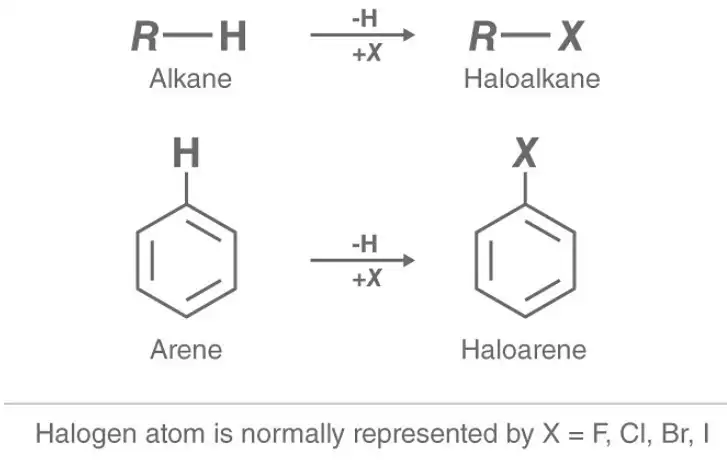
Illustration of Haloalkanes and Haloarenes Structures
In haloalkanes, halogen atoms are bonded to sp3-hybridized carbon atoms, whereas in haloarenes, the halogen is attached to sp2-hybridized carbons within the aromatic ring. This difference in hybridization affects bond strength and reactivity, making haloalkanes generally more reactive in nucleophilic substitution reactions compared to haloarenes.
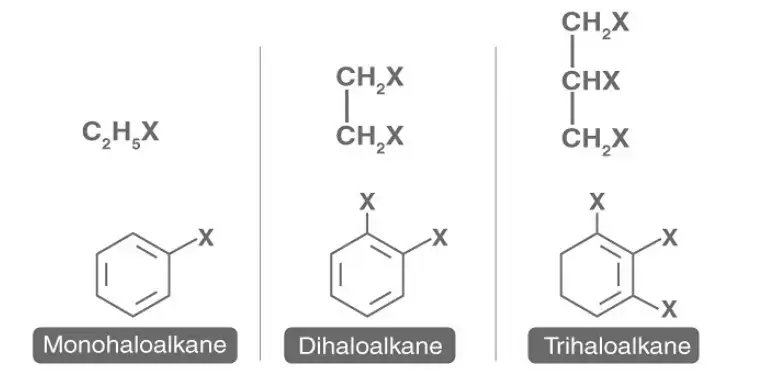
Comparison of Carbon-Halogen Bonding in Haloalkanes and Haloarenes
Example Problem
Question: Identify whether the compound chloromethane (CH3Cl) and chlorobenzene (C6H5Cl) are haloalkanes or haloarenes, and explain the hybridization of the carbon atom bonded to chlorine in each case.
Solution:
Chloromethane (CH3Cl) is a haloalkane because the chlorine atom is attached to a saturated carbon atom (sp3 hybridized) in an alkane chain.
Chlorobenzene (C6H5Cl) is a haloarene since the chlorine is bonded to a carbon atom within an aromatic benzene ring, which is sp2 hybridized.
The sp3 hybridization in haloalkanes results in a tetrahedral geometry around the carbon, while the sp2 hybridization in haloarenes leads to a planar trigonal geometry.
Classification and Characteristics of Haloalkanes and Haloarenes
Systematic Categorization Based on Structure
Haloalkanes and haloarenes can be categorized by the number of halogen atoms present and the hybridization of the carbon atom bonded to the halogen. Mono-, di-, and polyhalogenated compounds exist depending on how many halogen atoms replace hydrogens.
In haloalkanes, the carbon-halogen bond involves an sp3-hybridized carbon, whereas in haloarenes, the bond is with an sp2-hybridized carbon within the aromatic ring. This classification helps predict reactivity and physical properties.
Classification Parameter | Haloalkanes (Alkyl Halides) | Haloarenes (Aryl Halides) |
|---|---|---|
Carbon Hybridization | sp3 | sp2 |
Number of Halogen Atoms | Mono-, Di-, Polyhalogenated | Mono-, Di-, Polyhalogenated |
Origin | Derived from alkanes | Derived from aromatic hydrocarbons |
Example Problem
Question: Classify the following compounds and state the hybridization of the carbon attached to the halogen: 1-bromopropane, 1,2-dichlorobenzene, and iodobenzene.
Solution:
1-Bromopropane is a haloalkane with bromine attached to an sp3-hybridized carbon in an alkane chain.
1,2-Dichlorobenzene is a dihaloarene with two chlorine atoms attached to sp2-hybridized carbons in an aromatic ring.
Iodobenzene is a haloarene with iodine bonded to an sp2-hybridized carbon in the benzene ring.
Applications and Environmental Impact of Haloalkanes and Haloarenes
Practical Uses and Ecological Considerations
Haloalkanes and haloarenes serve important roles in various industries due to their chemical properties. They are effective solvents for non-polar substances and are widely used in pharmaceuticals and agriculture.
For instance, chloramphenicol, an alkyl halide derivative, is an antibiotic used to treat typhoid fever, while chloroquine, another halogenated compound, is employed in malaria treatment. Additionally, dichlorodiphenyltrichloroethane (DDT), a haloarene, has been used as an insecticide to control mosquito populations.
However, some haloalkanes and haloarenes, such as chlorofluorocarbons (CFCs), have detrimental environmental effects, including ozone layer depletion, which increases harmful ultraviolet radiation reaching the Earth.
Example Problem
Question: Explain why chlorofluorocarbons (CFCs) are harmful to the environment and describe one beneficial use of haloalkanes in medicine.
Solution:
CFCs release chlorine atoms in the stratosphere, which catalyze the breakdown of ozone (O3) molecules, thinning the ozone layer that protects Earth from UV radiation.
This depletion leads to increased UV exposure, causing health risks like skin cancer and environmental damage.
On the beneficial side, haloalkanes such as chloramphenicol are used as antibiotics to treat bacterial infections like typhoid, showcasing their medicinal importance.
Quick Reference Summary
Aspect | Haloalkanes | Haloarenes |
|---|---|---|
Origin | Alkanes (saturated hydrocarbons) | Aromatic hydrocarbons (benzene rings) |
Carbon Hybridization | sp3 | sp2 |
Reactivity | More reactive in nucleophilic substitution | Less reactive due to resonance stabilization |
Common Uses | Solvents, pharmaceuticals (e.g., chloramphenicol) | Insecticides (e.g., DDT), dyes, explosives |
Environmental Impact | Some are pollutants (e.g., CFCs) | Some are toxic and persistent pollutants |
Glossary of Key Terms
Term | Definition |
|---|---|
Haloalkane | An alkane derivative where one or more hydrogen atoms are replaced by halogen atoms. |
Haloarene | An aromatic compound with halogen atoms substituting hydrogen atoms on the benzene ring. |
sp3 Hybridization | Carbon atom bonded to four atoms with tetrahedral geometry. |
sp2 Hybridization | Carbon atom bonded to three atoms with trigonal planar geometry. |
Grignard Reagent | An organomagnesium compound formed by reaction of haloalkanes with magnesium in dry ether. |
Nucleophilic Substitution | A reaction where a nucleophile replaces a leaving group in a molecule. |
Chlorofluorocarbons (CFCs) | Halogenated compounds harmful to the ozone layer. |
Dichlorodiphenyltrichloroethane (DDT) | A synthetic insecticide derived from haloarenes. |
Alkyl Halide | Another term for haloalkane. |
Aryl Halide | Another term for haloarene. |
Frequently Asked Questions
What distinguishes haloalkanes from haloarenes?
Haloalkanes are derived from saturated hydrocarbons with halogens attached to sp3 carbons, while haloarenes come from aromatic rings with halogens bonded to sp2 carbons.
How do haloalkanes typically react in chemical processes?
Haloalkanes commonly undergo nucleophilic substitution reactions and can form Grignard reagents when reacted with magnesium in anhydrous ether.
Can you provide examples of haloarenes?
Examples include chlorobenzene, bromobenzene, and iodobenzene, where halogens are attached to benzene rings.
What are some practical uses of haloarenes?
Haloarenes are used in manufacturing insecticides like DDT, explosives, dyes, and synthetic fibers such as nylon.
What defines a mono haloalkane?
A mono haloalkane contains exactly one halogen atom attached to the alkane carbon chain.