Comprehensive Guide to Diazonium Salts: Structure, Preparation, and Applications
Fundamentals and Structural Characteristics of Diazonium Salts
Understanding the Composition and Naming of Diazonium Compounds
Diazonium salts are a unique class of organic compounds characterized by the presence of a positively charged nitrogen group bonded to an organic moiety. Their general formula is R−N2+X−, where R represents an alkyl or aryl group, and X denotes an inorganic or organic anion such as chloride (Cl−), bromide (Br−), or tetrafluoroborate (BF4−).
The term "diazonium" stems from the Greek roots: "di" meaning two, "azo" indicating nitrogen, and "ium" signifying a cationic species. This reflects the presence of two nitrogen atoms, one of which carries a positive charge. For example, benzenediazonium chloride (C6H5N2+Cl−) is a common diazonium salt.
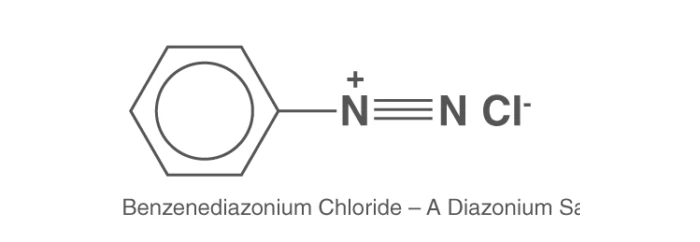
These compounds are named by appending the suffix "diazonium" to the parent hydrocarbon from which they are derived, followed by the name of the anion. For instance, "benzenediazonium bromide" indicates a benzene ring attached to the diazonium group with bromide as the counter ion.
Example Problem
Identify the correct formula and name for a diazonium salt formed from toluene with chloride as the anion.
Solution:
Toluene has the formula C6H5CH3. When converted to a diazonium salt, the methyl group remains attached to the aromatic ring, and the diazonium group replaces the amino group. The formula becomes C6H4CH3N2+Cl−.
The correct name is toluenediazonium chloride.
Methods and Conditions for Synthesizing Diazonium Salts
Preparation via Diazotization of Aromatic Amines
Diazonium salts are typically synthesized by converting primary aromatic amines into diazonium compounds through a process called diazotization. This involves reacting the amine with nitrous acid (HNO2) under cold conditions, usually below 5°C, to prevent decomposition.
Since nitrous acid is unstable and toxic, it is generated in situ by mixing sodium nitrite (NaNO2) with a mineral acid such as hydrochloric acid (HCl). The reaction proceeds as follows when aniline (C6H5NH2) is used:
\[ \text{C}_6\text{H}_5\text{NH}_2 + \text{HNO}_2 + \text{HCl} \rightarrow \text{C}_6\text{H}_5\text{N}_2^+\text{Cl}^- + 2\text{H}_2\text{O} \]
Maintaining the temperature below 5°C is crucial because diazonium salts are unstable at higher temperatures and tend to decompose, releasing nitrogen gas (N2).
Example Problem
Calculate the amount of sodium nitrite required to prepare 0.1 mol of benzenediazonium chloride from aniline, assuming complete reaction.
Solution:
The balanced reaction shows a 1:1 molar ratio between aniline and sodium nitrite.
Therefore, moles of NaNO2 needed = 0.1 mol.
Molar mass of NaNO2 = 69 g/mol.
Mass of NaNO2 required = \(0.1 \times 69 = 6.9 \text{ g}\).
Properties and Practical Uses of Diazonium Salts
Physical Characteristics and Industrial Applications
Diazonium salts are ionic compounds, generally soluble in water, and exist as colorless crystalline solids when aryl groups are involved. For example, benzenediazonium chloride dissolves in water but reacts only upon warming, whereas benzenediazonium tetrafluoroborate is water-insoluble and more stable at room temperature.
These salts are highly valued in the dye and pigment industries for fabric coloration. Their sensitivity to ultraviolet light allows their use in photographic and document reproduction processes. Additionally, diazonium salts serve as intermediates in synthesizing various aromatic derivatives by facilitating the introduction of functional groups such as –F, –Br, –Cl, –I, –NO2, –OH, and –CN into aromatic rings.
Direct halogenation or nucleophilic substitution on aromatic rings is often challenging; diazonium salts provide a versatile alternative for such transformations.
Example Problem
Explain how benzenediazonium chloride can be used to synthesize chlorobenzene via the Sandmeyer reaction.
Solution:
- Benzenediazonium chloride reacts with copper(I) chloride (CuCl) in aqueous solution.
- The diazonium group is replaced by a chlorine atom, forming chlorobenzene.
- The reaction proceeds with the release of nitrogen gas (N2), which escapes as a gas.
The overall reaction is:
\[ \text{C}_6\text{H}_5\text{N}_2^+\text{Cl}^- + \text{CuCl} \rightarrow \text{C}_6\text{H}_5\text{Cl} + \text{N}_2 + \text{Cu}^+ \]
Quick Reference: Key Points on Diazonium Salts
| Aspect | Details |
|---|---|
| General Formula | R−N2+X− |
| Common Anions (X) | Cl−, Br−, BF4− |
| Preparation Method | Diazotization of primary aromatic amines with NaNO2 and mineral acid below 5°C |
| Physical State | Colorless crystalline solids (aryl diazonium salts) |
| Solubility | Generally water-soluble except some salts like tetrafluoroborates |
| Stability | Stable below 5°C; decomposes at higher temperatures releasing N2 |
| Applications | Dye industry, organic synthesis, document reproduction, introduction of functional groups |
| Key Reaction | Sandmeyer reaction for halogenation of aromatic rings |
Glossary of Important Terms
| Term | Definition |
|---|---|
| Diazonium Salt | Organic compound containing the group R−N2+X−, where R is an organic group and X is an anion. |
| Diazotization | Process of converting primary aromatic amines into diazonium salts using nitrous acid. |
| Primary Aromatic Amine | Aromatic compound with an –NH2 group attached directly to the benzene ring. |
| Sandmeyer Reaction | Reaction where diazonium salts are converted to aryl halides using copper(I) salts. |
| In Situ | Generation of a reactive species directly in the reaction mixture rather than isolating it. |
| Tetrafluoroborate (BF4−) | An anion often used to stabilize diazonium salts with enhanced stability. |
| Aryl Group | An aromatic ring system attached to a substituent. |
| Nucleophilic Substitution | Reaction where a nucleophile replaces a leaving group in a molecule. |
| Decomposition | Breakdown of diazonium salts releasing nitrogen gas, often triggered by heat. |
| Functional Group | Specific group of atoms within molecules responsible for characteristic chemical reactions. |
Frequently Asked Questions
What defines a diazonium salt in organic chemistry?
Diazonium salts are organic compounds containing the diazonium group (N2+) attached to an organic moiety, typically an aryl or alkyl group, paired with an anion.
How are diazonium salts typically synthesized?
They are prepared by reacting primary aromatic amines with nitrous acid, generated in situ from sodium nitrite and a mineral acid, under cold conditions to form the diazonium salt.
Why must diazonium salts be kept at low temperatures during preparation?
Because diazonium salts are unstable at higher temperatures and decompose rapidly, releasing nitrogen gas, maintaining temperatures below 5°C ensures their stability during synthesis.
What are the main industrial uses of diazonium salts?
They are extensively used in dye manufacturing, organic synthesis for introducing various functional groups, and in photographic and document reproduction due to their light sensitivity.
What is the significance of the Sandmeyer reaction involving diazonium salts?
It allows the substitution of the diazonium group with halogens or other groups, enabling the synthesis of aryl halides which are otherwise difficult to prepare directly.