Understanding Crystal Lattices and Unit Cells
Fundamentals of Crystal Lattice Structures
Defining the Crystal Lattice Framework
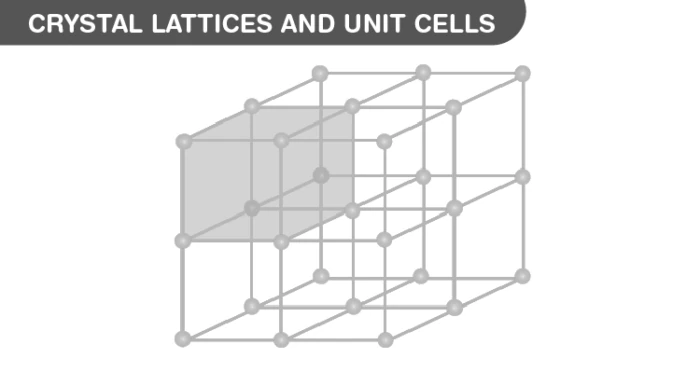
A crystal lattice represents a highly ordered, three-dimensional arrangement of atoms, ions, or molecules within a crystalline solid. This structure is visualized as a repetitive pattern of points in space, each point symbolizing the position of a constituent particle. The lattice forms the backbone of the crystal's geometry, providing a systematic way to describe the spatial distribution of particles.
By connecting these points, known as lattice points or lattice sites, with straight lines, one obtains a three-dimensional network that reveals the crystal's internal symmetry and periodicity. This spatial pattern is often referred to as a Bravais lattice, which serves as a fundamental concept in crystallography.
Example Problem
Consider a crystal where the lattice points are arranged such that each point is equidistant from its neighbors by 0.25 nm. Calculate the distance between two lattice points diagonally across a square face of the lattice.
Solution:
The lattice points form a square with side length \( a = 0.25 \text{ nm} \).
The diagonal distance \( d \) across the square face is given by:
\[ d = \sqrt{a^2 + a^2} = \sqrt{2a^2} = a\sqrt{2} \]
Substituting the value:
\[ d = 0.25 \times \sqrt{2} = 0.25 \times 1.414 = 0.3535 \text{ nm} \]
Therefore, the diagonal distance between two lattice points on the square face is approximately \(0.354 \text{ nm}\).
Exploring Unit Cells: The Building Blocks of Crystals
Understanding the Unit Cell and Its Parameters
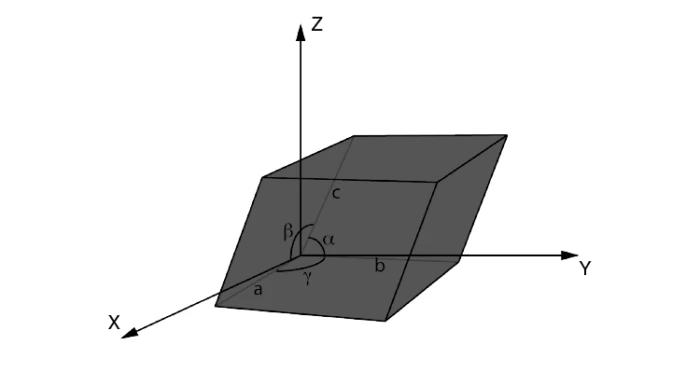
The unit cell is the smallest repeating segment of a crystal lattice that, when stacked in all directions, reconstructs the entire crystal structure. It encapsulates the fundamental symmetry and arrangement of the lattice points.
Each unit cell is characterized by six essential parameters: three edge lengths denoted as \( a \), \( b \), and \( c \), and three interaxial angles \( \alpha \), \( \beta \), and \( \gamma \). These parameters define the shape and size of the unit cell, which may or may not have edges perpendicular to each other.
Example Problem
A unit cell has edges \( a = 0.4 \text{ nm} \), \( b = 0.5 \text{ nm} \), and \( c = 0.6 \text{ nm} \) with angles \( \alpha = 90^\circ \), \( \beta = 90^\circ \), and \( \gamma = 120^\circ \). Calculate the volume of this unit cell.
Solution:
The volume \( V \) of a unit cell is given by:
\[ V = abc \sqrt{1 - \cos^2 \alpha - \cos^2 \beta - \cos^2 \gamma + 2 \cos \alpha \cos \beta \cos \gamma} \]
Since \( \alpha = 90^\circ \), \( \beta = 90^\circ \), and \( \gamma = 120^\circ \), we have:
\[ \cos 90^\circ = 0, \quad \cos 120^\circ = -0.5 \]
Substituting values:
\[ V = 0.4 \times 0.5 \times 0.6 \times \sqrt{1 - 0 - 0 - (-0.5)^2 + 2 \times 0 \times 0 \times (-0.5)} \]
\[ = 0.12 \times \sqrt{1 - 0.25} = 0.12 \times \sqrt{0.75} = 0.12 \times 0.866 = 0.1039 \text{ nm}^3 \]
The volume of the unit cell is approximately \(0.104 \text{ nm}^3\).
Classification of Unit Cells Based on Particle Positions
Distinguishing Primitive and Centered Unit Cells
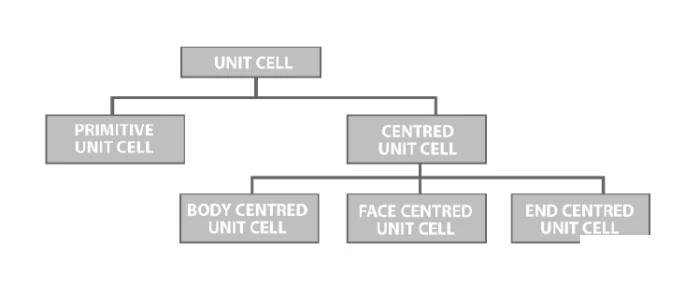
Unit cells are categorized by the locations of their constituent particles within the cell. When particles occupy only the corners of the cell, it is termed a primitive unit cell. Such a cell effectively contains one atom per unit cell due to the shared corners among adjacent cells.
Alternatively, if particles are present at additional positions besides the corners, the cell is called a centered unit cell. Centered cells are further divided into three types:
- Body-Centered Unit Cell: Contains a particle at the center of the cell body.
- Face-Centered Unit Cell: Has particles at the center of each face of the cell.
- End-Centered Unit Cell: Features particles at the centers of two opposite faces.
Example Problem
A cubic unit cell has edge length \( 0.3 \text{ nm} \). Calculate the number of atoms effectively contained in a face-centered cubic (FCC) unit cell.
Solution:
In an FCC unit cell:
- Each corner atom is shared by 8 unit cells, so each corner contributes \( \frac{1}{8} \) atom.
- There are 8 corners, so total corner contribution is \( 8 \times \frac{1}{8} = 1 \) atom.
- Each face atom is shared by 2 unit cells, so each face contributes \( \frac{1}{2} \) atom.
- There are 6 faces, so total face contribution is \( 6 \times \frac{1}{2} = 3 \) atoms.
Total atoms per FCC unit cell = \(1 + 3 = 4\) atoms.
Quick Reference: Key Points on Crystal Lattices and Unit Cells
| Concept | Description |
|---|---|
| Crystal Lattice | Regular 3D arrangement of points representing atoms, ions, or molecules in a crystal. |
| Lattice Point | Positions in space occupied by constituent particles in the lattice. |
| Unit Cell | Smallest repeating unit of a crystal lattice that builds the entire structure. |
| Unit Cell Parameters | Edges \(a, b, c\) and angles \(\alpha, \beta, \gamma\) defining the cell geometry. |
| Primitive Unit Cell | Unit cell with particles only at the corners, containing effectively one atom. |
| Body-Centered Unit Cell | Unit cell with an additional particle at the center of the cell body. |
| Face-Centered Unit Cell | Unit cell with particles at the center of each face. |
| End-Centered Unit Cell | Unit cell with particles at the centers of two opposite faces. |
| Bravais Lattice | Classification of 14 distinct lattice types based on symmetry and geometry. |
| Lattice Site | Another term for lattice point where constituent particles are located. |
Glossary of Important Terms
| Term | Meaning |
|---|---|
| Crystal Lattice | Ordered 3D array of points representing particle positions in a crystal. |
| Lattice Point | Specific location in the lattice occupied by an atom, ion, or molecule. |
| Unit Cell | Smallest repeating structural unit of a crystal lattice. |
| Edge Lengths (a, b, c) | Lengths of the edges of a unit cell. |
| Interaxial Angles (\(\alpha, \beta, \gamma\)) | Angles between the edges of a unit cell. |
| Primitive Unit Cell | Unit cell with particles only at the corners. |
| Body-Centered Unit Cell | Unit cell with a particle at the center of the cell. |
| Face-Centered Unit Cell | Unit cell with particles at the center of each face. |
| Bravais Lattice | Classification of lattice types based on symmetry. |
| Lattice Site | Point in the lattice representing a particle's position. |
Frequently Asked Questions
What defines a lattice structure in crystals?
A lattice structure is an organized set of points that represent the positions of particles in a crystal, defining its geometric framework.
How is a lattice point characterized in a crystal?
Each lattice point corresponds to the location of an atom, ion, or molecule, and all points have identical surroundings within the crystal.
What role do lattice points play in a unit cell?
Lattice points at the corners of a unit cell indicate where constituent particles are located, forming the basis for the crystal's repeating pattern.
How does a crystal lattice form from ions?
Crystal lattices form when ions attract each other electrostatically, releasing lattice energy that stabilizes the structure.
What causes the formation of a crystal lattice?
The electrostatic forces between oppositely charged ions arrange them into a regular, repeating geometric pattern known as a crystal lattice.