Understanding Corrosion: Causes, Types, and Prevention
Fundamentals of Metal Degradation
What Constitutes Corrosion?
Corrosion is a natural chemical process where metals gradually transform into more stable compounds such as oxides, hydroxides, or sulfides due to reactions with environmental agents like air and moisture. This transformation often results in the deterioration of the metal's physical and mechanical properties, making it brittle and flaky over time. The process typically initiates at the metal's surface exposed to the atmosphere and progressively affects the entire material.
Since corrosion involves oxidation reactions, it is essentially an electrochemical phenomenon where metals lose electrons and react with substances like oxygen, water, or acidic gases. This process is generally undesirable as it compromises the metal's strength and usability.
Interestingly, not all metals corrode at the same rate. Metals higher in the reactivity series, such as iron and zinc, are more prone to corrosion, whereas noble metals like gold and platinum resist corrosion due to their low tendency to oxidize. Aluminium, despite being reactive, forms a protective oxide layer that shields it from further corrosion.
Example: Corrosion Resistance of Aluminium
Aluminium is a reactive metal but does not corrode easily because it forms a thin, adherent layer of aluminium oxide (Al2O3) on its surface. This oxide layer acts as a barrier, preventing oxygen and moisture from reaching the underlying metal and thus halting further corrosion.
Influences on Corrosion Rate and Mechanism
Key Factors Accelerating Corrosion
The rate at which corrosion occurs depends on several environmental and material factors:
- Exposure to atmospheric gases such as carbon dioxide (CO2), sulfur dioxide (SO2), and sulfur trioxide (SO3).
- Presence of moisture, especially saltwater, which significantly speeds up corrosion.
- Impurities like salt (e.g., sodium chloride) that facilitate ionic conduction.
- Higher temperatures, which generally increase the corrosion rate.
- The nature of the initial oxide layer; some oxides like aluminium oxide are protective, while others like rust are porous and allow further corrosion.
- Acidic conditions in the atmosphere that accelerate metal degradation.
Corrosion can be quantified by measuring the weight loss of a metal sample exposed to a corrosive environment over time. The rate of corrosion \( R \) can be calculated using the formula:
\[ R = \frac{k \times W}{A \times \rho \times t} \]
where:
- \( k \) is a constant depending on units used,
- \( W \) is the weight loss of the metal (in grams),
- \( A \) is the surface area exposed (in cm2),
- \( \rho \) is the density of the metal (in g/cm3),
- \( t \) is the exposure time (in hours or days).
Example: Calculating Corrosion Rate of a Metal Sample
A steel plate with a surface area of 200 cm2 and density 7.85 g/cm3 loses 0.5 g after 10 days of exposure to a corrosive environment. Calculate the corrosion rate if \( k = 87.6 \) (to express rate in mm/year).
Solution:
Given: \( W = 0.5 \text{ g}, A = 200 \text{ cm}^2, \rho = 7.85 \text{ g/cm}^3, t = 10 \text{ days}, k = 87.6 \)
Using the formula:
\[ R = \frac{87.6 \times 0.5}{200 \times 7.85 \times 10} = \frac{43.8}{15700} = 0.00279 \text{ mm/year} \]
The corrosion rate is approximately \( 0.0028 \text{ mm/year} \), indicating a slow degradation.
Varieties of Corrosion and Their Characteristics
Common Forms of Corrosion
Corrosion manifests in several distinct types, each with unique causes and effects:
- Crevice Corrosion: Occurs in confined spaces where ionic concentration differences create localized corrosion cells, such as under gaskets or washers.
- Stress Corrosion Cracking (SCC): The combined effect of tensile stress and corrosive environment causes cracks, often at elevated temperatures.
- Intergranular Corrosion: Happens along grain boundaries due to impurities or compositional changes, weakening the metal structure.
- Galvanic Corrosion: Arises when two dissimilar metals are electrically connected in an electrolyte, causing the more reactive metal to corrode faster.
- Pitting Corrosion: Highly localized and unpredictable, forming small pits that penetrate deeply and can cause structural failure.
- Uniform Corrosion: Even corrosion over the entire surface, generally less damaging and easier to detect.
- Hydrogen Grooving: Formation of grooves due to hydrogen bubbles removing protective coatings on pipes.
- Metal Dusting: Severe corrosion in high-carbon environments leading to metal disintegration into powder.
- Microbial Corrosion: Caused by microorganisms that accelerate corrosion processes.
- High-Temperature Corrosion: Occurs when metals oxidize rapidly at elevated temperatures in the presence of gases like oxygen and sulfur compounds.
Example: Galvanic Corrosion in a Marine Environment
When aluminium and carbon steel are connected and submerged in seawater, aluminium corrodes faster while steel remains protected. This happens because aluminium acts as the anode and loses electrons, accelerating its corrosion.
Illustrative Cases and Chemical Reactions in Corrosion
Typical Corrosion Reactions and Their Effects
Several metals exhibit characteristic corrosion reactions when exposed to environmental agents:
Copper Oxidation
Copper reacts with oxygen to form copper(I) oxide, a red compound:
\[ 2\text{Cu}(s) + \frac{1}{2} \text{O}_2(g) \rightarrow \text{Cu}_2\text{O}(s) \]
This further oxidizes to black copper(II) oxide:
\[ \text{Cu}_2\text{O}(s) + \frac{1}{2} \text{O}_2(g) \rightarrow 2\text{CuO}(s) \]
These oxides react with atmospheric CO2, SO3, and water to form blue-green compounds like malachite and brochantite, giving aged copper its distinctive patina, as seen on the Statue of Liberty.
Silver Tarnishing
Silver reacts with hydrogen sulfide in the air to form black silver sulfide:
\[ 2\text{Ag}(s) + \text{H}_2\text{S}(g) \rightarrow \text{Ag}_2\text{S}(s) + 2\text{H}^+(aq) \]
Rusting of Iron
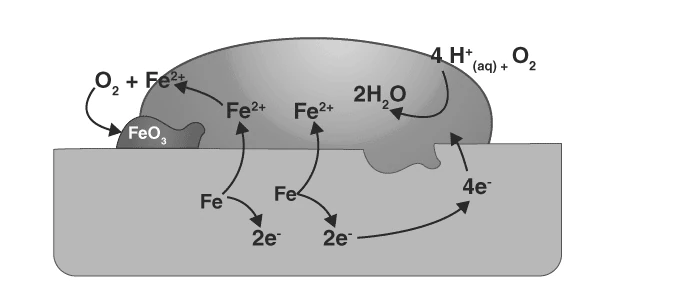
Iron corrodes in the presence of oxygen and moisture through electrochemical reactions. The anodic reaction involves iron losing electrons:
\[ 2\text{Fe}(s) \rightarrow 2\text{Fe}^{2+}(aq) + 4e^- \quad E^\circ_{\text{Fe}^{2+}/\text{Fe}} = -0.44 \text{ V} \]
The cathodic reaction involves oxygen and hydrogen ions combining with electrons to form water:
\[ \text{O}_2(g) + 4\text{H}^+(aq) + 4e^- \rightarrow 2\text{H}_2\text{O}(l) \quad E^\circ_{\text{O}_2/\text{H}^+} = 1.23 \text{ V} \]
The overall reaction is:
\[ 2\text{Fe}(s) + \text{O}_2(g) + 4\text{H}^+(aq) \rightarrow 2\text{Fe}^{2+}(aq) + 2\text{H}_2\text{O}(l) \quad E^\circ_{\text{cell}} = 1.67 \text{ V} \]
The Fe2+ ions further oxidize to Fe3+ and form hydrated iron(III) oxide, commonly known as rust:
\[ 4\text{Fe}^{2+} + 3\text{O}_2 + 6\text{H}_2\text{O} \rightarrow 4\text{Fe}^{3+} + 12\text{OH}^- \]
\[ \text{Fe}_2\text{O}_3 \cdot x\text{H}_2\text{O} \quad \text{(rust)} \]
Example: Rust Formation on Iron
Iron exposed to moist air undergoes oxidation forming Fe2+ ions at anodic sites, while oxygen is reduced at cathodic sites. The Fe2+ ions further react with oxygen and water to produce hydrated iron oxide, which appears as rust, weakening the metal structure.
Strategies to Mitigate Corrosion Damage
Effective Methods to Protect Metals
Preventing corrosion is essential to preserve metal structures and avoid economic losses and safety hazards. Various techniques are employed to slow down or prevent corrosion, especially for metals exposed to harsh environments:
- Electroplating: Coating a metal with a thin layer of another metal to protect it.
- Galvanization: Applying a protective zinc coating to steel or iron.
- Anodization: Enhancing the natural oxide layer on metals like aluminium.
- Passivation: Creating a protective oxide film to reduce corrosion.
- Biofilm Coatings: Using microbial films to inhibit corrosion.
- Anti-Corrosion Protective Coatings: Applying paints or greases to shield metal surfaces.
- Corrosion Inhibitors: Chemicals that slow down corrosion reactions.
- Regular Cleaning: Removing corrosive agents from metal surfaces periodically.
Example: Galvanization of Steel
Steel structures are often coated with zinc through galvanization. Zinc acts as a sacrificial anode, corroding preferentially and protecting the underlying steel from rusting, especially in outdoor or marine environments.
Quick Reference: Corrosion Overview
| Aspect | Details |
|---|---|
| Definition | Natural chemical process converting metals into stable compounds like oxides or sulfides. |
| Key Factors | Air gases, moisture, impurities, temperature, oxide layer nature, atmospheric acids. |
| Common Types | Crevice, stress cracking, intergranular, galvanic, pitting, uniform, microbial, high-temp. |
| Typical Reactions | Iron rusting, copper oxidation, silver tarnishing. |
| Prevention Methods | Electroplating, galvanization, anodization, passivation, coatings, inhibitors, cleaning. |
| Corrosion Rate Formula | \( R = \frac{kW}{A \rho t} \) |
Glossary of Corrosion Terms
| Term | Meaning |
|---|---|
| Corrosion | Degradation of metals by chemical reactions forming stable compounds. |
| Oxidation | Loss of electrons by a metal during corrosion. |
| Passivation | Formation of a protective oxide layer that slows corrosion. |
| Galvanic Corrosion | Corrosion caused by electrical contact between dissimilar metals. |
| Pitting | Localized corrosion forming small holes or pits. |
| Stress Corrosion Cracking | Cracking due to combined tensile stress and corrosive environment. |
| Crevice Corrosion | Corrosion in confined spaces with ionic concentration differences. |
| Electroplating | Coating a metal surface with another metal using electric current. |
| Galvanization | Applying zinc coating to protect steel or iron from corrosion. |
| Corrosion Inhibitor | Chemicals that reduce the rate of corrosion reactions. |
Frequently Asked Questions on Corrosion
What is corrosion?
Corrosion is the natural process where metals chemically transform into more stable compounds like oxides, leading to material degradation.
Do all metals undergo corrosion?
No, metals higher in the reactivity series corrode easily, while noble metals like gold and platinum resist corrosion due to their low oxidation tendency.
Which factors influence the rate of corrosion?
Exposure to moisture, atmospheric gases, impurities, temperature, and the nature of oxide layers significantly affect corrosion speed.
How does temperature affect corrosion?
Increasing temperature generally accelerates corrosion by enhancing chemical reaction rates.
What is high-temperature corrosion?
It is corrosion occurring at elevated temperatures where metals oxidize rapidly due to hot gases containing oxygen or sulfur compounds.