Comprehensive Guide to Colloidal Systems and Their Applications
Fundamentals and Characteristics of Colloidal Mixtures
Understanding the Nature and Definition of Colloids
Colloids are heterogeneous mixtures where tiny particles, ranging from 1 to 1000 nanometres in size, are uniformly dispersed within another substance. Unlike suspensions, these particles do not settle out upon standing, maintaining a stable dispersion. The dispersed particles are called the dispersed phase, while the medium in which they are suspended is the continuous phase. A distinctive feature of colloids is their ability to scatter light, a phenomenon known as the Tyndall Effect, which helps differentiate them from true solutions.
The International Union of Pure and Applied Chemistry (IUPAC) defines the colloidal state as a subdivision where molecules or polymolecular particles with at least one dimension between 1 nanometre and 1 micrometre are dispersed in a medium.
Illustrative Example: Identifying Colloidal Particles by Light Scattering
Problem: A beam of light passes through a mixture containing particles of size 500 nm. Explain whether the mixture exhibits the Tyndall Effect and justify your answer.
Solution:
The particle size of 500 nm lies within the colloidal range (1–1000 nm).
Colloidal particles scatter light due to their size, causing the Tyndall Effect.
Therefore, the mixture will scatter the light beam, making the path visible.
This confirms the mixture is a colloidal system exhibiting the Tyndall Effect.
Methods for Creating and Purifying Colloidal Solutions
Techniques for Synthesizing Colloidal Dispersions
Colloidal solutions can be prepared by two primary approaches: condensation and dispersion methods. Condensation involves the aggregation of smaller molecules or ions into colloidal-sized particles, while dispersion breaks down larger particles into colloidal dimensions.
Condensation methods include chemical reactions such as oxidation, reduction, hydrolysis, and physical processes like excessive cooling or solvent exchange. For example, colloidal sulfur can be formed by oxidizing hydrogen sulfide, and gold sols are produced by reducing gold salts with agents like formaldehyde.
Dispersion methods involve mechanical grinding or electrical techniques. Mechanical dispersion uses high-speed colloidal mills to reduce particle size, while Bredig’s arc method employs an electric arc between metal electrodes submerged in a liquid to generate metallic sols.
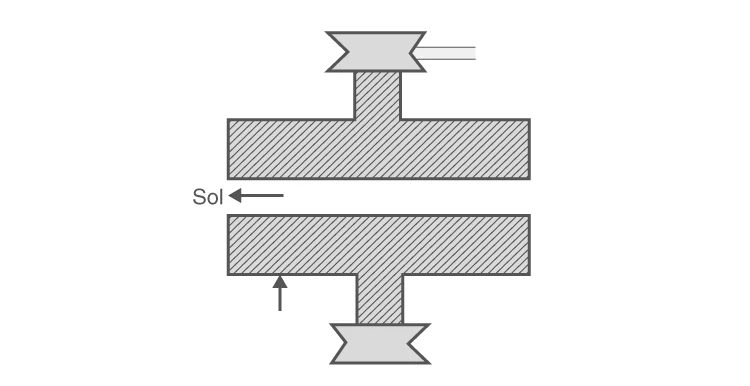
Colloidal mill with two metallic dyes rotating at high speed to produce colloidal particles
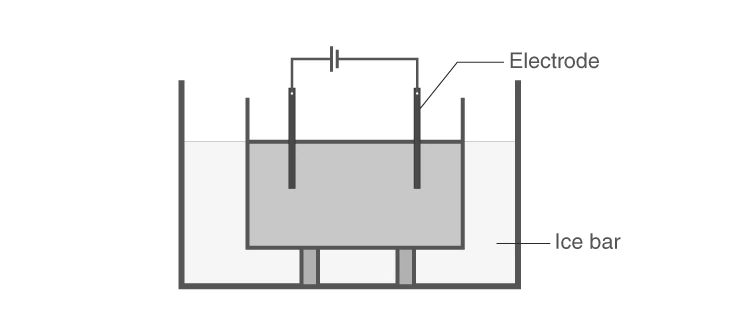
Bredig’s arc method apparatus used for generating metallic colloidal solutions
Example: Preparation of Gold Colloidal Solution by Reduction
Problem: Describe the preparation of a gold sol using a reducing agent and write the balanced chemical equation.
Solution:
Aqueous gold chloride solution is treated with formaldehyde as a reducing agent.
Gold ions are reduced to metallic gold particles suspended as a colloid.
The reaction is:
\[ 2\mathrm{AuCl}_3 + 3\mathrm{HCHO} + 3\mathrm{H}_2\mathrm{O} \rightarrow 2\mathrm{Au} + 3\mathrm{HCOOH} + 6\mathrm{HCl} \]
The resulting gold sol appears purple and is known as the purple of Cassius.
Purification Techniques for Colloidal Systems
Colloidal solutions often contain impurities that can affect their stability and applications. Purification methods include:
Dialysis: Removal of ionic impurities by diffusion through a semipermeable membrane that retains colloidal particles.
Electrodialysis: An enhanced dialysis process using an electric field to accelerate impurity removal.
Ultrafiltration: Filtration through membranes with very small pores, achieved by treating filter papers with collodion to reduce pore size.
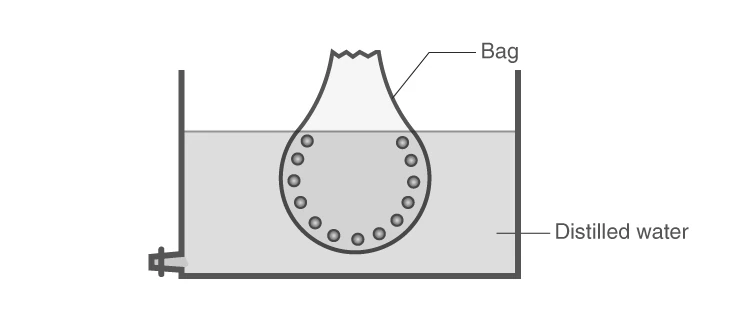
Dialysis apparatus used to separate impurities from colloidal solutions
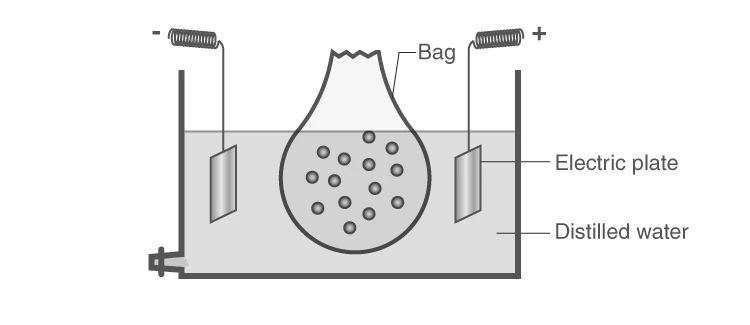
Electrodialysis setup employing electrical plates to speed up purification
Varieties, Applications, and Classification of Colloidal Systems
Common Examples and Practical Uses of Colloids
Colloids are prevalent in nature and industry. Examples include:
Blood: A hydrosol where proteins like albumin are dispersed in water.
Clouds: Aerosols consisting of water droplets dispersed in air.
Gold sol: Metallic colloid with gold particles suspended in water.
Applications span food products (e.g., syrups, soups), medicine (colloidal silver as antiseptics), air purification (Cottrell precipitator), leather tanning, and natural phenomena like delta formation through coagulation of clay particles.
Colloidal silver employed in medical antiseptic applications
Use of colloids in industrial air purification systems
Systematic Classification of Colloidal Mixtures
Colloids can be categorized based on their physical state, dispersion medium, interaction forces, and particle properties:
Physical State: Solid solutions (e.g., gemstones), aerosols (clouds, smoke), gels (cheese, butter), and emulsions (milk, vanishing cream).
Dispersion Medium: Hydrosols (water-based), alcosols (alcohol-based), and acrosols (air-based).
Interaction Forces: Lyophobic sols with weak interactions and instability (metallic sols), and lyophilic sols with strong interactions and stability (gum, gelatin).
Particle Properties: Multimolecular colloids formed by aggregation of atoms or molecules (gold sol), and macromolecular colloids consisting of large polymer molecules (proteins, synthetic polymers).
Example: Differentiating Lyophilic and Lyophobic Colloids
Problem: Compare lyophilic and lyophobic sols in terms of stability, interaction forces, and reversibility.
Solution:
Lyophilic sols: Exhibit strong attraction between dispersed phase and medium, resulting in high stability and reversible sol formation.
Lyophobic sols: Have weak Van der Waals forces, are unstable, and irreversible upon solvent removal.
Lyophilic sols require small amounts of electrolyte for formation, whereas lyophobic sols coagulate easily with electrolyte addition.
Quick Reference: Essential Points on Colloids
Aspect | Details |
|---|---|
Particle Size | 1 nm to 1000 nm |
Dispersed Phase | Substance present as tiny particles |
Continuous Phase | Medium in which particles are dispersed |
Tyndall Effect | Light scattering by colloidal particles |
Preparation Methods | Condensation and dispersion techniques |
Purification | Dialysis, electrodialysis, ultrafiltration |
Classification | Based on physical state, medium, forces, particle type |
Lyophilic Sols | Stable, reversible, strong interaction |
Lyophobic Sols | Unstable, irreversible, weak interaction |
Applications | Medicine, food, industry, environmental purification |
Glossary of Key Terms Related to Colloids
Term | Definition |
|---|---|
Colloid | A mixture with particles sized between 1 and 1000 nm dispersed in a medium |
Dispersed Phase | The substance present as fine particles in a colloid |
Continuous Phase | The medium in which the dispersed phase is suspended |
Tyndall Effect | Scattering of light by colloidal particles |
Lyophilic Sol | Colloid with strong affinity between dispersed phase and medium |
Lyophobic Sol | Colloid with weak interaction between dispersed phase and medium |
Dialysis | Process of removing impurities through a semipermeable membrane |
Electrodialysis | Dialysis accelerated by an electric field |
Ultrafiltration | Filtration using membranes with very small pores to separate colloids |
Peptization | Conversion of precipitate into colloidal solution by adding electrolyte |
Frequently Asked Questions (FAQs)
What are the main types of colloids based on their physical state?
Colloids can be solid solutions, aerosols, gels, or emulsions depending on the states of dispersed phase and dispersion medium.
Can you give an example of a colloid where liquid is dispersed in gas?
Fog is a colloid where tiny liquid water droplets are dispersed in air, which is a gas.
What size range do colloidal particles typically fall into?
Colloidal particles generally range from 1 nanometre to 1000 nanometres in diameter.
How are lyophilic and lyophobic sols different?
Lyophilic sols have strong interactions and are stable and reversible, while lyophobic sols have weak interactions, are unstable, and irreversible.
What type of colloid is blood classified as?
Blood is a hydrosol colloid, with proteins dispersed in water as the continuous phase.