Understanding Colloids: Properties, Examples, and Applications
Fundamentals of Colloidal Systems
Defining Colloids and Their Characteristics
A colloid is a type of heterogeneous mixture where tiny particles of one substance are evenly dispersed throughout another substance, known as the dispersion medium. These dispersed particles typically range in size from 1 to 1000 nanometers, small enough to remain suspended without settling out due to gravity. Unlike true solutions, colloidal particles do not dissolve but stay distributed, giving the mixture unique properties.
Common forms of colloids include sols, aerosols, foams, and emulsions, each differing by the state of dispersed particles and the medium. Understanding these distinctions is crucial for recognizing colloids in everyday life and industrial applications.
Example Problem
Consider a colloidal suspension where particles have an average diameter of 500 nanometers. If the dispersion medium is water, explain why these particles do not settle quickly despite their size.
Solution:
The particles, being 500 nm in diameter, are small enough to be influenced significantly by Brownian motion, which is the random movement caused by collisions with water molecules. This constant motion counteracts the force of gravity, preventing the particles from settling rapidly. Additionally, the particles often carry an electric charge that causes mutual repulsion, further stabilizing the suspension.
Everyday Examples of Colloidal Mixtures
Common Colloids in Food and Nature
Many foods we consume daily are colloidal in nature. Dairy products such as milk, cream, butter, and ice cream are classic examples. Other items like bread, cake, margarine, fruit juices, and whipped cream also exhibit colloidal properties due to the dispersion of tiny particles within a continuous phase.
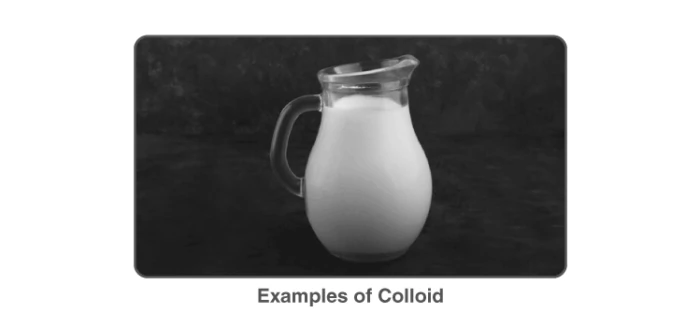
Examples of colloidal food products
Natural phenomena such as fog, mist, clouds, and rain are also colloidal systems where liquid droplets or solid particles are dispersed in air. Dust and smoke are other examples of colloids suspended in the atmosphere.
Fog and mist as examples of atmospheric colloids
The blue color of the sky results from the scattering of sunlight by tiny dust and water particles suspended in the air, a colloidal effect known as Rayleigh scattering. Similarly, the blue hue of seawater is due to colloidal impurities that scatter blue light more effectively than other wavelengths.
Soil contains colloidal particles such as clay and humus, which are essential for nutrient storage and exchange, playing a vital role in agriculture and plant growth.
Example Problem
Explain why seawater appears blue due to colloidal particles and how this differs from the color of pure water.
Solution:
Seawater contains suspended colloidal impurities like tiny particles of organic and inorganic matter. These particles scatter sunlight, especially shorter wavelengths like blue, more effectively than pure water, which absorbs longer wavelengths. This selective scattering causes seawater to appear blue. Pure water, lacking these colloidal particles, absorbs light differently and appears less intensely colored.
Industrial and Medical Uses of Colloids
Applications in Manufacturing and Healthcare
Colloids serve as essential components in various industrial products, acting as thickening agents in lubricants, lotions, toothpaste, and coatings. Their unique properties enable the creation of stable gels and suspensions, such as the gel ink used in ballpoint pens.
In water purification, colloidal impurities are removed by adding substances like aluminium sulfate (alum) or iron salts, which cause the particles to coagulate and settle, clarifying the water.
Medicinally, many drugs are formulated as colloids to enhance delivery and effectiveness. For example, colloidal gold and calcium are injected to support muscle vitality. Silver sol (Argyrol) is used as an eye lotion, while other colloids like albumin, hetastarch, and dextran are employed in various treatments.
Example Problem
Describe how alum helps in purifying water by acting on colloidal impurities.
Solution:
Alum, when added to water containing colloidal impurities, causes these tiny particles to aggregate through a process called coagulation. The alum neutralizes the charges on the colloidal particles, reducing their repulsion and allowing them to clump together into larger particles. These larger aggregates then settle down due to gravity, making it easier to remove the impurities and clarify the water.
Quick Reference: Key Points on Colloids
Aspect | Details |
|---|---|
Particle Size | 1 to 1000 nanometers |
Mixture Type | Heterogeneous but appears homogeneous macroscopically |
Examples | Milk, fog, smoke, butter, paint |
Stability | Particles remain suspended due to Brownian motion and charge repulsion |
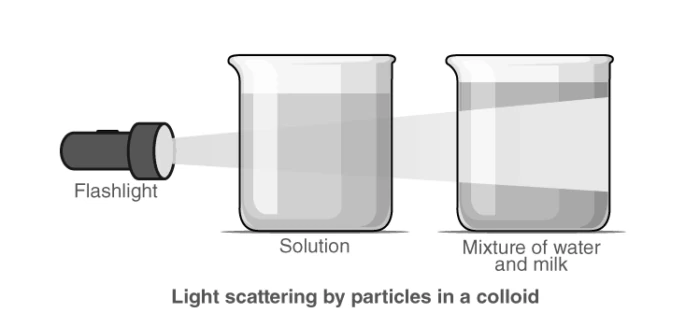
Light Scattering | Exhibits Tyndall effect |
Applications | Food, medicine, water purification, industrial products |
Removal of Impurities | Coagulation using alum or iron salts |
Medical Colloids | Colloidal gold, silver sol, albumin |
Natural Occurrence | Soil colloids, atmospheric aerosols |
Color Effects | Sky and seawater color due to scattering by colloidal particles |
Glossary of Important Terms
Term | Definition |
|---|---|
Colloid | A mixture with particles dispersed throughout a medium, sized between 1 and 1000 nm. |
Dispersion Medium | The substance in which colloidal particles are distributed. |
Brownian Motion | Random movement of particles caused by collisions with molecules of the medium. |
Tyndall Effect | Scattering of light by colloidal particles, making the beam visible. |
Coagulation | Process where colloidal particles clump together to form larger particles. |
Sol | A colloid with solid particles dispersed in a liquid. |
Aerosol | Colloidal system with liquid or solid particles dispersed in a gas. |
Emulsion | A colloid of liquid droplets dispersed in another liquid. |
Albumin | A protein colloid used medically as a plasma substitute. |
Argyrol | Silver sol used as an antiseptic eye lotion. |
Frequently Asked Questions
What defines a colloidal solution?
A colloidal solution is a mixture where tiny particles of one substance are suspended uniformly within another, without dissolving, and remain dispersed at a microscopic scale.
How do colloids differ from true solutions?
Colloids contain larger particles than true solutions, which do not settle but scatter light, whereas true solutions have molecularly dissolved particles that do not scatter light.
How can one identify a colloid experimentally?
The Tyndall effect helps identify colloids by shining light through the mixture; the light scatters off the particles, making the beam visible.
Can you give two examples of colloidal mixtures?
Milk and mayonnaise are common colloids where tiny particles are dispersed in a continuous medium.
Are colloids homogeneous or heterogeneous?
Colloids are heterogeneous mixtures but appear homogeneous to the naked eye due to the small size of dispersed particles.