Comprehensive Guide to Alkynes and Their Characteristics
Fundamentals of Alkynes: Structure and Nature
Understanding Alkynes and Their Molecular Framework
Alkynes are a class of unsaturated hydrocarbons distinguished by the presence of at least one carbon-carbon triple bond. This triple bond, often called the acetylenic bond, imparts unique chemical and physical properties to these compounds. The general molecular formula for alkynes is \( C_nH_{2n-2} \), reflecting their degree of unsaturation compared to alkanes and alkenes.
The simplest alkyne is ethyne, commonly known as acetylene, with the molecular formula \( C_2H_2 \). It consists of two carbon atoms connected by a triple bond, each bonded to a single hydrogen atom. This linear molecule exhibits sp hybridization at the carbon atoms, resulting in a straight geometry.
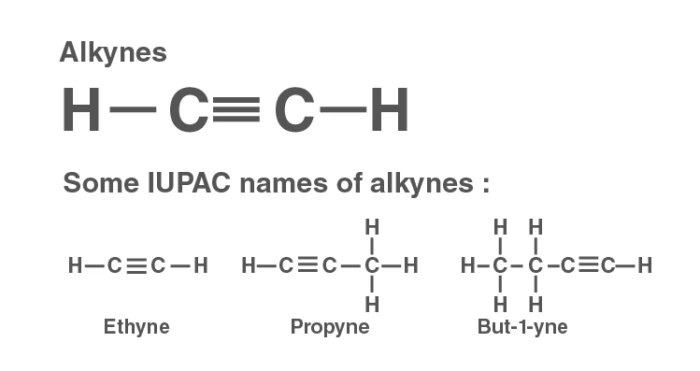
Illustration of an alkyne molecule highlighting the triple bond
Example Problem
Calculate the number of hydrogen atoms in a straight-chain alkyne with 5 carbon atoms.
Solution:
The general formula for alkynes is \( C_nH_{2n-2} \).
For \( n = 5 \), number of hydrogen atoms is:
\[ 2 \times 5 - 2 = 10 - 2 = 8 \]
Therefore, the molecular formula is \( C_5H_8 \).
Isomerism in Alkynes: Variations in Structure
Exploring Different Types of Isomerism in Alkynes
Alkynes exhibit three primary types of isomerism: chain isomerism, position isomerism, and functional isomerism. These variations arise due to differences in carbon chain arrangement, the location of the triple bond, or the presence of different functional groups with the same molecular formula.
Chain Isomerism
This occurs when the carbon atoms are arranged differently, either in a straight chain or branched form, while maintaining the same molecular formula.
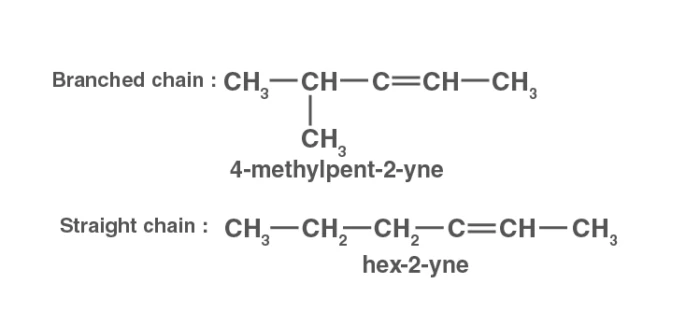
Examples of chain isomers: 4-methylpent-2-yne and hex-2-yne
Example Problem
Identify whether 3-methylbut-1-yne and pent-1-yne are chain isomers.
Solution:
3-methylbut-1-yne has a branched chain with 5 carbons total.
Pent-1-yne has a straight chain of 5 carbons.
Both have the same molecular formula \( C_5H_8 \) but different carbon arrangements.
Hence, they are chain isomers.
Position Isomerism
Position isomerism arises when the triple bond is located at different positions along the same carbon chain.
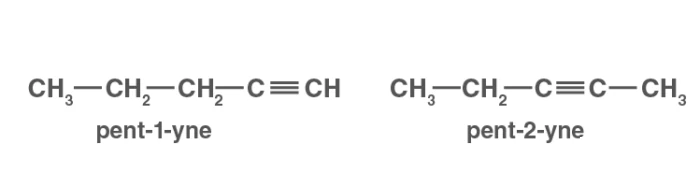
Position isomers: Pent-1-yne and pent-2-yne
Example Problem
Compare hex-1-yne and hex-3-yne to determine if they are position isomers.
Solution:
Both have the molecular formula \( C_6H_{10} \).
Hex-1-yne has the triple bond between the first and second carbon atoms.
Hex-3-yne has the triple bond between the third and fourth carbon atoms.
Therefore, they are position isomers.
Functional Isomerism
Functional isomerism occurs when compounds have the same molecular formula but different functional groups. Alkynes can be functional isomers with alkadienes, both having the formula \( C_nH_{2n-2} \).
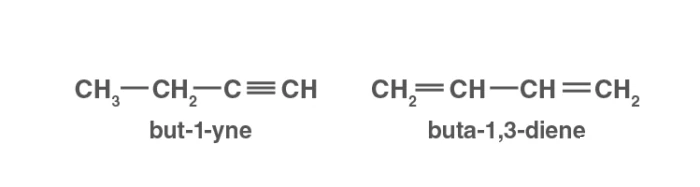
Functional isomers: But-1-yne and buta-1,3-diene
Example Problem
Explain why but-2-yne and buta-1,3-diene are functional isomers.
Solution:
Both have the molecular formula \( C_4H_6 \).
But-2-yne contains a carbon-carbon triple bond (alkyne).
Buta-1,3-diene contains two carbon-carbon double bonds (alkadiene).
Different functional groups but same formula indicate functional isomerism.
Key Properties and Applications of Alkynes
Characteristics of the Triple Bond and Its Effects
The triple bond in alkynes is the defining functional group and greatly influences their chemical behavior. The carbon atoms involved in the triple bond exhibit sp hybridization, resulting in a linear molecular shape. This linearity affects physical properties such as boiling points and reactivity.
Alkynes are hydrophobic and generally insoluble in water but soluble in organic solvents. Their unsaturation makes them reactive towards addition reactions and other chemical transformations.
Testing for the Presence of a Triple Bond
Alkynes can be identified by specific chemical tests that detect the triple bond:
Ammoniacal Silver Nitrate Test: Alkynes react to form a white precipitate of silver acetylide.
Ammoniacal Cuprous Chloride Test: Alkynes produce a red precipitate of cuprous acetylide.
Industrial and Practical Uses of Alkynes
Ethyne (acetylene) is widely used in oxyacetylene welding and cutting due to its high flame temperature of approximately 3600 Kelvin. It also serves as a precursor in the synthesis of various organic compounds such as ethanol, ethanoic acid, and acrylic acid.
Alkynes are essential starting materials in manufacturing polymers and other industrial chemicals like chloroprene and vinyl chloride.
Industrial applications of ethyne in welding and chemical synthesis
Example Problem
Calculate the temperature in Celsius of the flame produced by burning ethyne in oxygen if the flame temperature is 3600 Kelvin.
Solution:
Temperature in Celsius is given by:
\[ T_{^\circ C} = T_K - 273 \]
Substituting the value:
\[ 3600 - 273 = 3327^\circ C \]
The flame temperature is approximately \( 3327^\circ C \).
Summary Table: Essential Facts About Alkynes
Aspect | Details |
|---|---|
General Formula | \( C_nH_{2n-2} \) |
Functional Group | Carbon-carbon triple bond (acetylenic bond) |
Hybridization | sp hybridized carbons at triple bond |
Molecular Geometry | Linear around triple bond |
Isomerism Types | Chain, Position, Functional |
Common Tests | Ammoniacal silver nitrate and cuprous chloride tests |
Primary Uses | Welding fuel, organic synthesis, polymer production |
Example Compound | Ethyne (acetylene), \( C_2H_2 \) |
Glossary of Key Terms Related to Alkynes
Term | Definition |
|---|---|
Alkyne | Hydrocarbon with at least one carbon-carbon triple bond |
Acetylenic Bond | The carbon-carbon triple bond characteristic of alkynes |
sp Hybridization | Type of orbital hybridization where one s and one p orbital mix |
Chain Isomerism | Isomerism due to different carbon chain arrangements |
Position Isomerism | Isomerism due to different positions of the triple bond |
Functional Isomerism | Isomerism where compounds have different functional groups but same formula |
Homologous Series | Group of compounds with same functional group and similar properties |
Ammoniacal Silver Nitrate Test | Chemical test producing silver acetylide precipitate for alkynes |
Ammoniacal Cuprous Chloride Test | Chemical test producing cuprous acetylide precipitate for alkynes |
Ethyne (Acetylene) | Simplest alkyne with formula \( C_2H_2 \) |
Frequently Asked Questions About Alkynes
What is the structural formula of ethyne?
The condensed structural formula of ethyne is \( \mathrm{HC} \equiv \mathrm{CH} \), indicating two carbon atoms connected by a triple bond, each bonded to one hydrogen atom. Its molecular formula is \( C_2H_2 \).
How are alkynes named according to IUPAC rules?
Alkynes are named by identifying the longest carbon chain containing the triple bond and adding the suffix "-yne" to the alkane name. The position of the triple bond is indicated by the lowest possible number assigned to the carbon atoms.
What defines the alkyne functional group?
The alkyne functional group consists of a carbon-carbon triple bond. This unsaturation differentiates alkynes from alkanes and alkenes and is responsible for their characteristic chemical reactions.
How can alkynes be synthesized in the laboratory?
Alkynes can be prepared by dehydrohalogenation of vicinal dihalides using strong bases, which removes halogen atoms and forms the triple bond.
What methods are used to reduce alkynes to alkenes?
Alkynes can be partially reduced to trans-alkenes by treatment with sodium in liquid ammonia. The sodium donates electrons to the triple bond, forming an anion intermediate that is protonated to yield the alkene.