Fundamentals and Applications of Recombinant DNA Technology
Introduction to Genetic Engineering and Recombinant DNA
Concept and Mechanism of Recombinant DNA Technology
Recombinant DNA technology is a molecular technique that enables the alteration of an organism's traits by inserting a foreign DNA segment into its genome. This foreign DNA, known as the recombinant gene, is integrated into the host's genetic material using specialized vectors. The process involves isolating the gene of interest, combining it with a vector DNA, and introducing this recombinant DNA into the host organism to express desired characteristics.
This method, also called genetic engineering, revolutionized biology after the discovery of restriction enzymes in 1968 by Werner Arber. These enzymes allow precise cutting of DNA, facilitating the insertion of new genes. The recombinant DNA must be stably maintained and passed on to the host's progeny to ensure lasting genetic modification.
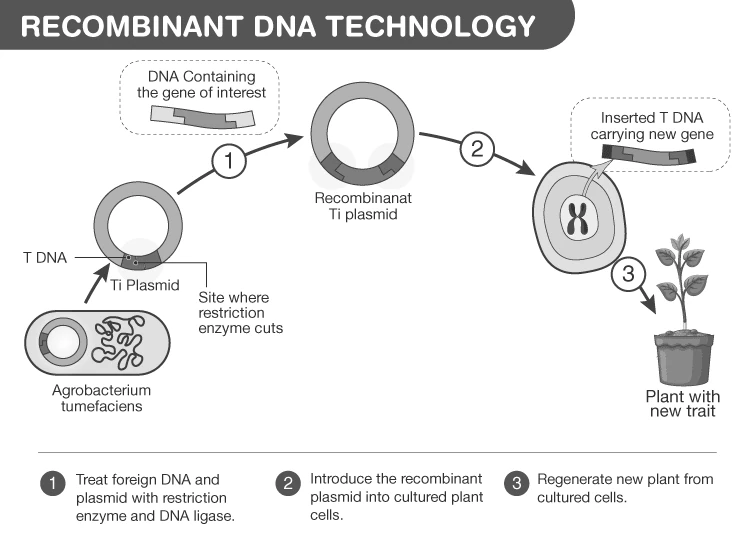
Illustration of Recombinant DNA Technology
Example Problem
A scientist wants to introduce a gene responsible for drought resistance into a crop plant. Describe the initial steps involved in preparing the recombinant DNA before introducing it into the plant.
Solution:
Isolate the drought resistance gene from the donor organism's DNA in pure form.
Use restriction enzymes to cut the isolated gene and the vector DNA at specific recognition sites to create compatible ends.
Amplify the gene copies using Polymerase Chain Reaction (PCR) to obtain sufficient quantity.
Ligate the gene fragment into the vector DNA using DNA ligase to form recombinant DNA.
Essential Components and Tools in Recombinant DNA Technology
Role of Enzymes and Vectors in Gene Manipulation
Recombinant DNA technology relies heavily on specific enzymes and vectors to manipulate genetic material effectively. Restriction enzymes, particularly restriction endonucleases, recognize palindromic sequences in DNA and cleave at precise locations, generating sticky ends that facilitate gene insertion. There are two main types: endonucleases, which cut within DNA strands, and exonucleases, which trim nucleotides from DNA ends.
Vectors serve as carriers that transport the recombinant DNA into host cells. Common vectors include plasmids and bacteriophages, chosen for their high replication rates and ability to carry foreign DNA. A typical vector contains an origin of replication, selectable markers (such as antibiotic resistance genes), and cloning sites recognized by restriction enzymes.
The host organism is the recipient of the recombinant DNA, where the inserted gene is expressed and propagated. Various methods like microinjection, gene gun, heat shock, or calcium ion treatment facilitate the introduction of recombinant DNA into host cells.
Example Problem
Explain why the same restriction enzyme must be used to cut both the vector and the gene of interest during recombinant DNA preparation.
Solution:
Using the same restriction enzyme ensures that both DNA fragments have complementary sticky ends.
Complementary sticky ends facilitate the precise and efficient ligation of the gene into the vector.
This compatibility increases the success rate of forming stable recombinant DNA molecules.
Stepwise Procedure and Practical Uses of Recombinant DNA Technology
Detailed Workflow and Applications in Biotechnology
The recombinant DNA technology process involves a series of carefully orchestrated steps:
Isolation of DNA: Extract the target DNA segment in a pure form, free from other cellular components.
Restriction Digestion: Use restriction enzymes to cut both the target gene and vector DNA at specific sites.
Amplification: Employ Polymerase Chain Reaction (PCR) to generate multiple copies of the gene.
Ligation: Join the gene fragment and vector DNA using DNA ligase to form recombinant DNA.
Transformation: Introduce the recombinant DNA into a host cell where it replicates and expresses the desired protein.
This technology has diverse applications including gene therapy to correct genetic disorders, production of insulin and vaccines, development of genetically modified crops like Bt cotton and golden rice, and diagnostic tools such as ELISA for detecting diseases like HIV.
Example Problem
A laboratory uses PCR to amplify a gene segment. If the initial DNA copy number is 1 and the PCR cycle is repeated 30 times, calculate the approximate number of DNA copies produced.
Solution:
Each PCR cycle doubles the DNA copies. Therefore, after \( n \) cycles, the number of copies is:
\[ 2^n \]
For \( n = 30 \):
\[ 2^{30} = 1,073,741,824 \text{ copies} \]
Thus, approximately 1.07 billion copies are generated after 30 cycles.
DNA Cloning and Its Significance in Genetic Research
Understanding Cloning and Its Practical Benefits
DNA cloning involves producing multiple identical copies of a specific DNA fragment. This is achieved by inserting the DNA segment into a small, self-replicating DNA molecule called a vector, which is then introduced into a host cell such as bacteria. The host replicates the vector along with the inserted DNA, creating numerous copies known as clones.
Common vectors for cloning include plasmids, viruses, and yeast cells. Plasmids are circular DNA molecules separate from the bacterial chromosome and often carry genes that confer advantageous traits like antibiotic resistance. Their small size and ability to carry foreign DNA make them ideal cloning tools.
Example Problem
Describe why plasmids are preferred as vectors in DNA cloning experiments.
Solution:
Plasmids replicate independently of the host chromosome, allowing high copy numbers.
They are small and easy to manipulate in the laboratory.
Contain selectable markers to identify successful clones.
Have multiple cloning sites for insertion of foreign DNA.
Summary Table: Key Points of Recombinant DNA Technology
Aspect | Description |
|---|---|
Recombinant DNA | DNA molecule formed by combining genetic material from different sources. |
Restriction Enzymes | Enzymes that cut DNA at specific sequences to create sticky or blunt ends. |
Vectors | DNA carriers like plasmids or bacteriophages used to transfer genes into hosts. |
Host Organism | Cell or organism that receives and expresses the recombinant DNA. |
Polymerase Chain Reaction (PCR) | Technique to amplify specific DNA sequences exponentially. |
Applications | Gene therapy, production of insulin, GM crops, vaccines, and diagnostics. |
DNA Cloning | Process of creating identical copies of a DNA fragment using vectors and hosts. |
Glossary of Important Terms
Term | Definition |
|---|---|
Recombinant DNA | DNA formed by joining DNA fragments from different sources. |
Restriction Enzymes | Proteins that cut DNA at specific sequences. |
Vector | A DNA molecule used to carry foreign DNA into a host cell. |
Host Cell | Organism or cell that receives and replicates recombinant DNA. |
Polymerase Chain Reaction (PCR) | Method to amplify DNA segments exponentially. |
Ligase | Enzyme that joins DNA fragments by forming phosphodiester bonds. |
Plasmid | Small circular DNA molecule found in bacteria, used as a vector. |
Transformation | Process of introducing recombinant DNA into a host cell. |
Cloning Site | Specific location on a vector where foreign DNA is inserted. |
Selectable Marker | Gene that allows identification of cells containing recombinant DNA. |
Frequently Asked Questions
What is the function of restriction enzymes in recombinant DNA technology?
Restriction enzymes act as molecular scissors that cut DNA at specific sequences, enabling the insertion of foreign genes into vectors.
Why are plasmids commonly used as vectors?
Plasmids replicate independently, are easy to manipulate, and contain selectable markers, making them ideal for gene cloning.
What is the purpose of PCR in genetic engineering?
PCR amplifies a specific DNA segment, producing millions of copies from a single DNA molecule for further manipulation.
How is recombinant DNA introduced into host cells?
Recombinant DNA can be introduced by methods such as microinjection, gene gun, heat shock, or chemical treatment to facilitate uptake by host cells.
List some applications of recombinant DNA technology.
It is used in gene therapy, production of insulin and vaccines, development of genetically modified crops, and diagnostic tests for diseases.