Comprehensive Overview of Proteins: Structure and Functions
Fundamentals of Proteins and Their Biological Significance
Understanding the Role and Composition of Proteins
Proteins are essential biomolecules often described as the fundamental units of life. They constitute approximately 60% of the dry mass of cells, making them the most plentiful molecules within living organisms. These macromolecules form the core components of cellular structures, enzymes, and regulatory systems, playing a vital role in growth and physiological development.
Common dietary sources rich in proteins include eggs, pulses, milk, and dairy products, which supply the necessary amino acids for bodily functions.
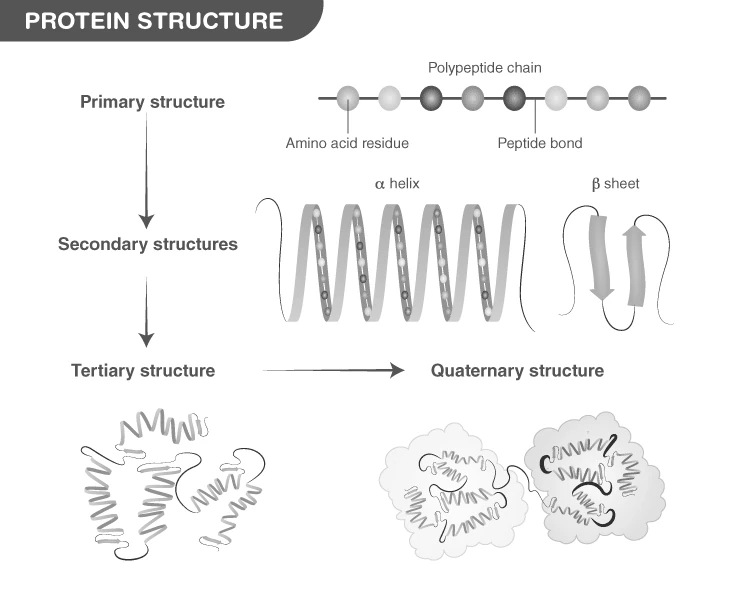
Illustration representing the significance of proteins in living organisms
Example Problem
Question: If a cell's dry weight is 5 mg, estimate the approximate mass of proteins present in it.
Solution: Given that proteins make up about 60% of the dry weight, the protein mass is calculated as:
\[ \text{Protein mass} = 0.60 \times 5 \text{ mg} = 3 \text{ mg} \]
Therefore, the cell contains approximately 3 mg of proteins.
Structural Organization of Proteins and Their Molecular Architecture
Composition and Hierarchical Arrangement of Protein Molecules
Proteins are polymers formed by linking amino acid units in long chains called polypeptides. Each amino acid contains an amino group (-NH2) and a carboxyl group (-COOH), which define their chemical nature. The unique sequence and arrangement of these amino acids determine the protein's specific properties and functions.
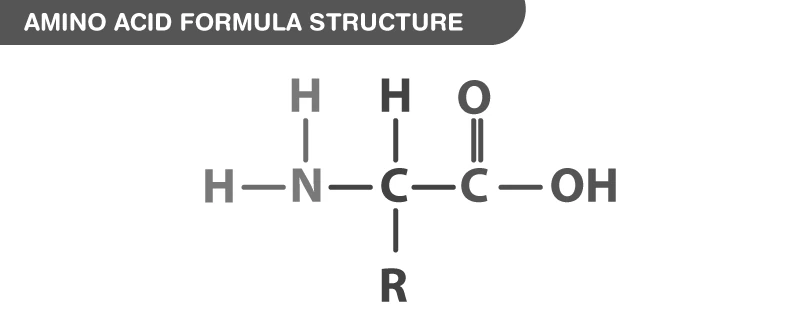
General chemical structure of an amino acid molecule
Proteins fold into complex three-dimensional shapes through interactions among amino acid side chains (R-groups). The structural complexity is categorized into four levels:
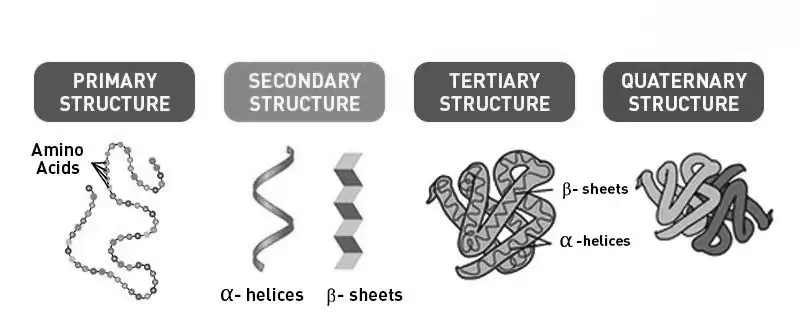
Schematic representation of protein structural levels
Primary Structure: The linear sequence of amino acids in a polypeptide chain. Even a single amino acid change can alter the protein's identity.
Secondary Structure: Local folding patterns stabilized by hydrogen bonds, forming α-helices and β-pleated sheets.
Tertiary Structure: The overall three-dimensional shape formed by interactions among R-groups, crucial for protein functionality.
Quaternary Structure: The assembly of multiple polypeptide subunits into a larger functional complex, present only in some proteins.
Example Problem
Question: Describe the type of bonding responsible for the formation of α-helix in protein secondary structure.
Solution: The α-helix is stabilized by hydrogen bonds formed between the carbonyl oxygen of one amino acid and the amide hydrogen of the amino acid four residues ahead in the polypeptide chain. This bonding pattern creates a spiral structure essential for the protein's stability and function.
Essential Roles and Biological Functions of Proteins
How Proteins Facilitate Vital Processes in the Body
The diverse functions of proteins arise from their varied structures. Key roles include:
Digestion: Enzymes, which are proteins, catalyze the breakdown of food molecules.
Movement: Proteins like myosin enable muscle contraction, facilitating bodily motion.
Structural Integrity: Keratin provides strength to hair, nails, and other body parts.
Cell Communication: Protein receptors on cell surfaces mediate interactions with the environment and other cells.
Signal Transmission: Certain proteins act as messengers, coordinating activities between cells and organs.
Visual depiction of various protein functions in biological systems
Example Problem
Question: Identify the protein responsible for muscle contraction and explain its role briefly.
Solution: Myosin is the protein that facilitates muscle contraction. It interacts with actin filaments to generate force and movement by converting chemical energy from ATP into mechanical work, enabling muscles to contract and produce motion.
Quick Reference: Summary of Protein Concepts
Aspect | Details |
|---|---|
Definition | Macromolecules made of amino acid chains essential for life processes |
Primary Structure | Linear sequence of amino acids |
Secondary Structure | α-helix and β-pleated sheets formed by hydrogen bonds |
Tertiary Structure | 3D folding due to R-group interactions |
Quaternary Structure | Multiple polypeptide subunits forming a complex |
Functions | Enzymatic activity, movement, structure, communication, signaling |
Dietary Sources | Eggs, pulses, milk, dairy products |
Glossary of Key Terms Related to Proteins
Term | Definition |
|---|---|
Amino Acid | Basic building block of proteins containing amino and carboxyl groups |
Polypeptide | Chain of amino acids linked by peptide bonds |
Peptide Bond | Covalent bond connecting amino acids in a protein |
Primary Structure | Sequence of amino acids in a protein chain |
Secondary Structure | Local folding patterns like α-helix and β-sheet |
Tertiary Structure | Overall 3D shape of a single polypeptide chain |
Quaternary Structure | Assembly of multiple polypeptide chains into a functional protein |
Enzyme | Protein that catalyzes biochemical reactions |
Keratin | Structural protein found in hair, nails, and skin |
Myosin | Protein responsible for muscle contraction |
Frequently Asked Questions About Proteins
What defines the primary structure of a protein?
The primary structure is the specific linear sequence of amino acids in a polypeptide chain, determining the protein's unique identity.
How do α-helices form in proteins?
α-helices form through hydrogen bonds between the carbonyl oxygen of one amino acid and the amide hydrogen four residues ahead, creating a spiral shape.
Why are proteins vital for muscle movement?
Proteins like myosin interact with actin filaments to produce muscle contractions, enabling movement.
What is the significance of the quaternary structure?
Quaternary structure allows multiple polypeptide chains to assemble into a functional protein complex, essential for certain protein activities.
Which foods are rich sources of proteins?
Eggs, pulses, milk, and dairy products are common dietary sources that provide essential amino acids for protein synthesis.