Comprehensive Guide to Polymerase Chain Reaction (PCR)
Fundamentals and Mechanism of DNA Amplification
Overview and Historical Background of PCR
Polymerase Chain Reaction (PCR) is a revolutionary molecular biology method designed to exponentially replicate a specific DNA fragment. Invented in 1983 by the American biochemist Kary Mullis, this technique enables the production of millions of copies of a targeted DNA sequence within hours. PCR has become an indispensable tool in biotechnology and molecular research laboratories worldwide.
By harnessing the natural enzymatic process of DNA replication, PCR allows scientists to analyze minute quantities of DNA with remarkable precision and speed.
Core Components Required for PCR
The PCR process relies on several essential ingredients to function effectively:
DNA Template: The specific DNA segment intended for amplification.
Thermostable DNA Polymerase: Typically, Taq polymerase is employed due to its ability to withstand high temperatures without denaturing.
Oligonucleotide Primers: Short, single-stranded DNA sequences complementary to the 3’ ends of the target DNA strands, serving as initiation points for DNA synthesis.
Deoxyribonucleotide Triphosphates (dNTPs): The building blocks that provide energy and nucleotides for new DNA strand synthesis.
Buffer Solution: Contains magnesium and potassium ions to maintain optimal conditions for enzyme activity, DNA denaturation, and strand annealing.
Each component plays a critical role in ensuring the fidelity and efficiency of the amplification process.
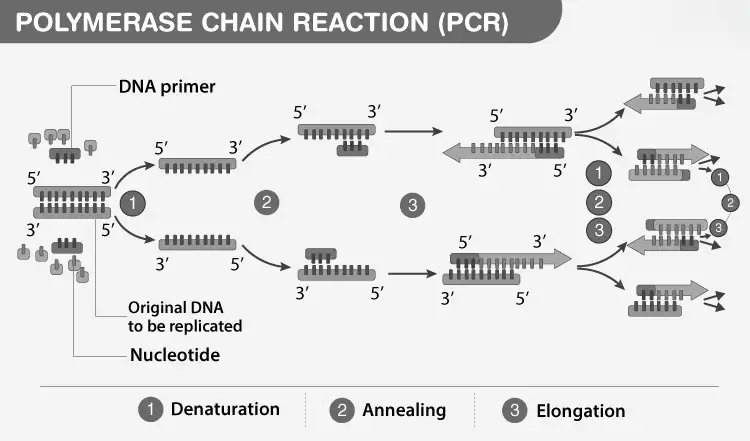
Illustration of PCR Setup
Schematic representation of the PCR components and process
Example: Identifying PCR Components in a Laboratory Setup
A researcher prepares a PCR reaction mixture containing a DNA template, primers, dNTPs, Taq polymerase, and buffer. If the buffer lacks magnesium ions, what effect would this have on the PCR process?
Solution:
Magnesium ions are essential cofactors for Taq polymerase activity.
Without magnesium, the enzyme's catalytic function is impaired, leading to inefficient or no DNA synthesis.
Therefore, the PCR amplification would fail or produce very low yield.
Different PCR Variants and Their Specific Uses
Real-Time PCR and Its Quantitative Capabilities
Real-time PCR, also known as quantitative PCR (qPCR), enables the monitoring of DNA amplification as it occurs by using fluorescent markers. The fluorescence intensity correlates directly with the amount of DNA produced, allowing precise quantification of the target sequence in real time.
This method is widely used in gene expression analysis, pathogen detection, and genetic variation studies.
Nested and Multiplex PCR Techniques
Nested PCR enhances specificity by performing two successive PCR reactions with two sets of primers, reducing non-specific amplification.
Multiplex PCR allows simultaneous amplification of multiple DNA targets in a single reaction by using several primer pairs, increasing efficiency and saving time.
Specialized PCR Methods: Arbitrary Primed and Quantitative PCR
Arbitrary Primed PCR is a DNA fingerprinting technique that uses primers with arbitrary sequences to generate unique patterns for genetic identification.
Quantitative PCR exploits the linear relationship between DNA amount and amplification cycles to detect and measure specific DNA sequences accurately.
Example: Choosing the Appropriate PCR Type
A forensic scientist needs to identify a suspect by analyzing multiple genetic markers simultaneously from a crime scene sample. Which PCR method should be employed and why?
Solution:
Multiplex PCR is ideal as it can amplify several DNA targets in one reaction.
This saves time and sample material while providing comprehensive genetic profiles.
Therefore, multiplex PCR is the preferred technique for this forensic application.
Stepwise Process and Practical Applications of PCR
Detailed Stages of the PCR Cycle
The PCR procedure consists of three main temperature-dependent steps repeated cyclically to amplify DNA:
Denaturation: Heating the mixture to approximately 94℃ for 30 seconds to 2 minutes separates the double-stranded DNA into single strands by breaking hydrogen bonds.
Annealing: Cooling the reaction to 54-60℃ for 20-40 seconds allows primers to bind specifically to their complementary sequences on the single-stranded DNA templates.
Extension (Elongation): Raising the temperature to 72-80℃ enables Taq polymerase to add nucleotides to the 3’ end of primers, synthesizing new DNA strands in the 5’ to 3’ direction at a rate of about 1000 base pairs per minute.
These cycles are typically repeated 20 to 40 times, exponentially increasing the number of DNA copies.
Visual Representation of PCR Cycling
Applications of PCR in Various Fields
PCR technology has transformed multiple disciplines, including:
Medical Diagnostics: Detecting genetic mutations, monitoring gene therapy progress, and identifying hereditary disease markers.
Forensic Science: Genetic fingerprinting for criminal identification and paternity testing.
Genetic Research: Comparing genomes, analyzing gene expression, and studying evolutionary relationships using DNA from diverse sources.
Gene Mapping: Locating genes on chromosomes to understand genetic disorders and traits.
Example: Calculating DNA Copies After PCR Cycles
If a PCR reaction starts with a single DNA molecule and undergoes 30 cycles, how many copies of the DNA will be produced assuming 100% efficiency?
Solution:
The number of DNA copies after \( n \) cycles is given by:
\[ \text{Copies} = 2^n \]
For \( n = 30 \):
\[ 2^{30} = 1,073,741,824 \text{ copies} \]
Thus, over one billion copies are generated from a single DNA molecule after 30 cycles.
Quick Reference Summary
Aspect | Details |
|---|---|
Inventor | Kary Mullis (1983) |
Key Enzyme | Taq DNA Polymerase (thermostable) |
Primary Steps | Denaturation, Annealing, Extension |
Typical Cycle Count | 20–40 cycles |
Primer Length | 20–30 nucleotides |
Temperature Ranges | Denaturation: ~94℃, Annealing: 54–60℃, Extension: 72–80℃ |
Applications | Medical diagnostics, Forensics, Genetic research, Gene mapping |
Variants | Real-time, Nested, Multiplex, Arbitrary Primed PCR |
Glossary of Key Terms
Term | Definition |
|---|---|
Annealing | Binding of primers to complementary DNA strands during PCR. |
Buffer | Solution providing optimal ionic conditions for PCR enzymes. |
Denaturation | Separation of double-stranded DNA into single strands by heat. |
dNTPs | Deoxyribonucleotide triphosphates, the building blocks of DNA. |
DNA Polymerase | Enzyme that synthesizes new DNA strands complementary to the template. |
Extension | Step where DNA polymerase adds nucleotides to primers to form new strands. |
Multiplex PCR | Technique amplifying multiple DNA targets simultaneously. |
Oligonucleotide Primer | Short DNA sequence that initiates DNA synthesis. |
Real-Time PCR | PCR method that quantifies DNA amplification using fluorescence. |
Taq Polymerase | Thermostable DNA polymerase used in PCR. |
Frequently Asked Questions
What is the main purpose of PCR?
PCR is used to amplify specific DNA sequences, producing millions of copies from a small initial sample for analysis.
Why is Taq polymerase preferred in PCR?
Taq polymerase is thermostable, meaning it remains active at high temperatures required for DNA denaturation, ensuring efficient DNA synthesis.
How many cycles are typically performed in a PCR experiment?
Usually, 20 to 40 cycles are conducted to generate sufficient DNA copies for detection and analysis.
What role do primers play in PCR?
Primers provide starting points for DNA polymerase to begin synthesizing new DNA strands by binding to complementary sequences on the template.
Can PCR be used to detect genetic diseases?
Yes, PCR is widely used in medical diagnostics to identify mutations and genetic markers associated with various diseases.