Understanding Pedigree Analysis in Genetics
Fundamentals of Pedigree Analysis
Concept and Purpose of Pedigree Charts
Pedigree analysis is a method used to trace the inheritance of specific traits or genetic disorders through generations of a family. It employs a diagrammatic family tree that visually represents individuals and their genetic characteristics, enabling geneticists to predict the likelihood of inheriting certain conditions.
This approach builds upon Gregor Mendel’s foundational work on heredity, where he identified genes as the units responsible for passing traits from parents to offspring. Since direct genetic experiments on humans are ethically restricted, pedigree charts serve as an essential tool to study inheritance patterns indirectly.
Example Problem
A family has a history of a recessive genetic disorder. If two unaffected parents have a child with the disorder, what is the probability that their next child will also be affected?
Solution:
Since the disorder is recessive, both parents must be carriers (heterozygous). The genotype of each parent is \( Aa \), where \( A \) is the normal allele and \( a \) is the recessive allele causing the disorder.
The Punnett square for the cross \( Aa \times Aa \) is:
\[ \begin{array}{c|cc} & A & a \\ \hline A & AA & Aa \\ a & Aa & aa \\ \end{array} \]
The probability of an affected child (genotype \( aa \)) is \( \frac{1}{4} \) or 25%.
Interpreting Pedigree Diagrams
Symbols and Their Meanings in Pedigree Charts
Pedigree charts use standardized symbols to represent family members and their genetic status. Squares denote males, while circles indicate females. Each horizontal row corresponds to a generation, and a horizontal line connecting a male and female symbolizes a mating or marriage.
Vertical lines descending from the mating line represent offspring. Fully shaded symbols indicate individuals affected by a genetic trait, half-shaded symbols represent carriers, and unshaded symbols denote unaffected individuals. A double horizontal line signifies consanguineous marriage, where partners are closely related.
In sex-linked recessive traits, carriers are often marked with a dot inside the symbol. The individual who initiates the genetic study is marked with an arrow and called the propositus.
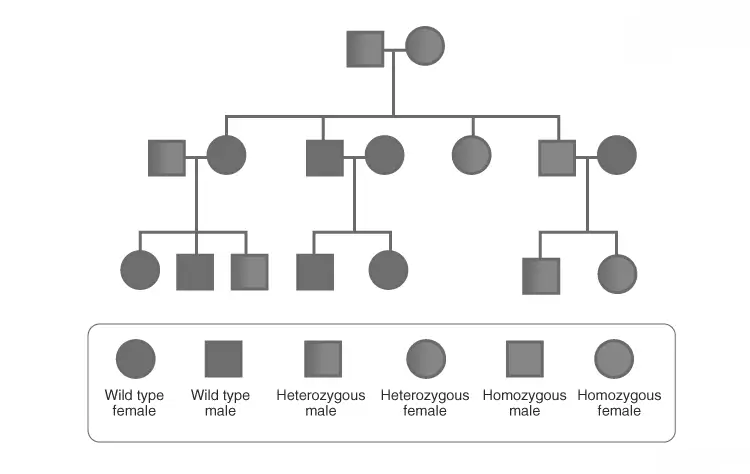
Diagram of a Pedigree Chart Showing Generations and Genetic Status
Example Problem
In a pedigree chart, a male (square) is half-shaded, and his sister (circle) is fully shaded. What can be inferred about their genetic status if the trait is autosomal recessive?
Solution:
The half-shaded male is a carrier (heterozygous) for the recessive trait.
The fully shaded sister is affected (homozygous recessive).
This suggests the parents are likely carriers, passing the recessive allele to their children.
Applications and Importance of Pedigree Analysis
Using Pedigree Charts to Predict Genetic Risks
Pedigree analysis is crucial for identifying inheritance patterns such as dominant, recessive, sex-linked, or mitochondrial traits. By examining family history, genetic counselors can estimate the probability of an individual inheriting or carrying a genetic disorder, aiding in early diagnosis and management.
This method is especially valuable for Mendelian disorders, which follow predictable inheritance patterns. It also helps in understanding complex traits and planning family health strategies.
Example Problem
A woman with no family history of a sex-linked recessive disorder has a brother affected by the condition. What is the chance that she is a carrier?
Solution:
Since the disorder is sex-linked recessive, males are affected if they inherit the allele from their mother.
The affected brother inherited the recessive allele from their mother, making her a carrier.
The woman has a 50% chance of being a carrier because she inherits one X chromosome from her mother.
Quick Reference: Key Points on Pedigree Analysis
Aspect | Details |
|---|---|
Purpose | To trace inheritance of traits and predict genetic risks |
Symbols | Square: Male, Circle: Female, Shading: Affected/carrier status |
Generations | Represented in horizontal rows |
Consanguinity | Double horizontal line between mates |
Propositus | Individual initiating genetic study, marked with an arrow |
Inheritance Patterns | Dominant, recessive, sex-linked, mitochondrial |
Carrier Representation | Half-shaded or dot inside symbol for sex-linked traits |
Ethical Use | Non-invasive method to study human genetics |
Applications | Genetic counseling, disease prediction, research |
Limitations | Requires accurate family history and data |
Glossary of Terms Related to Pedigree Analysis
Term | Definition |
|---|---|
Allele | Different forms of a gene found at the same locus |
Carrier | An individual who carries one copy of a recessive allele but does not show the trait |
Consanguinity | Marriage or mating between close relatives |
Dominant Trait | A trait expressed when at least one dominant allele is present |
Generation | A group of individuals born and living at the same time |
Heterozygous | Having two different alleles for a gene |
Homozygous | Having two identical alleles for a gene |
Pedigree Chart | A diagram showing family relationships and inheritance of traits |
Propositus | The individual from whom a pedigree is initiated |
Recessive Trait | A trait expressed only when two recessive alleles are present |
Frequently Asked Questions on Pedigree Analysis
What is the main function of a pedigree chart?
A pedigree chart visually represents family relationships and tracks the inheritance of specific genetic traits or disorders across generations.
How can pedigree analysis help in genetic counseling?
It helps estimate the risk of inheriting genetic conditions by analyzing family history and identifying carriers or affected individuals.
What do shaded and unshaded symbols indicate in a pedigree?
Shaded symbols represent affected individuals, half-shaded indicate carriers, and unshaded symbols denote unaffected family members.
Why is consanguinity important in pedigree analysis?
Consanguineous marriages increase the chance of recessive genetic disorders appearing due to shared ancestry and alleles.
Can pedigree analysis determine all types of genetic disorders?
It is most effective for Mendelian disorders but may have limitations with complex or multifactorial genetic conditions.